Tag: WWFM

  • Bella Davidovich at 90 & Zukerman at 70

    Bella Davidovich at 90 & Zukerman at 70

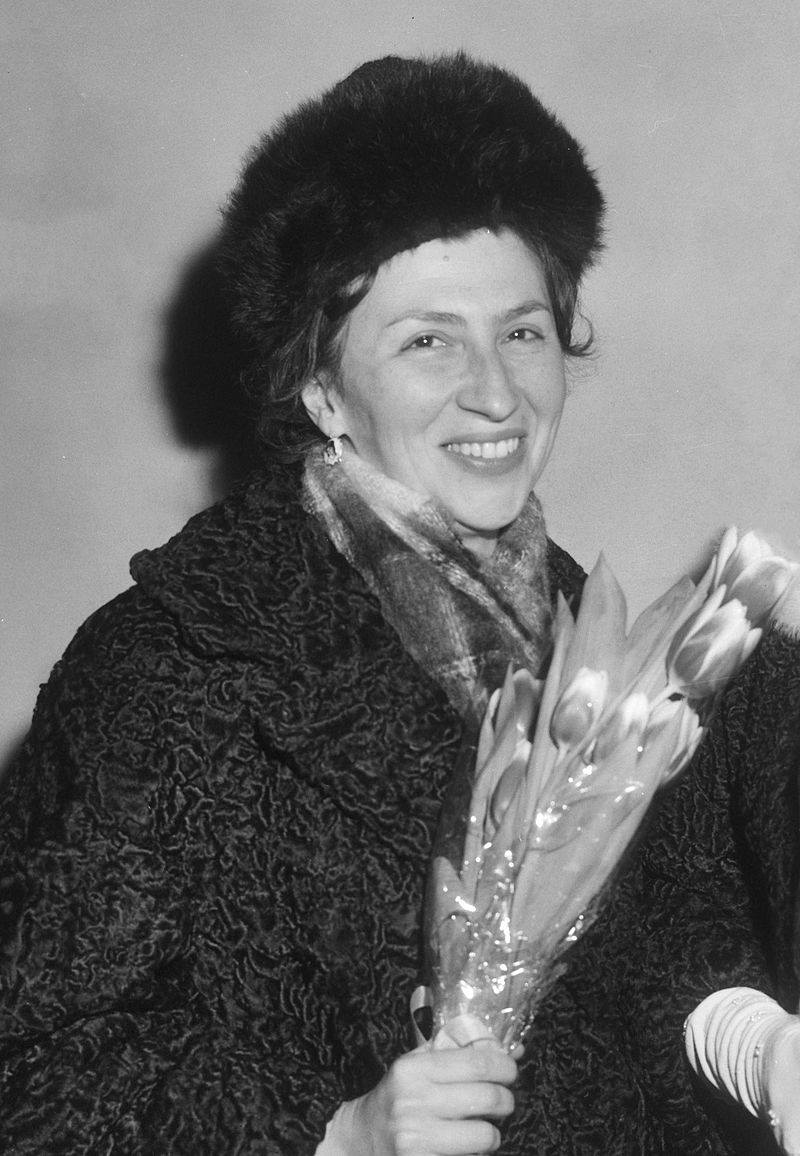
    Pinchas Zukerman is 70 today. Tell that to Bella Davidovich. The formidable pianist has just turned 90.

    Davidovich first attained international recognition through a shared first prize at the 1949 Warsaw Chopin Competition. This was the launch of a successful career that took her all over the Soviet Union and Eastern Europe. She played with every major Soviet conductor. She was soloist with the Leningrad Philharmonic for 28 consecutive seasons.

    In 1978, she emigrated from the USSR to the United States, where she became a naturalized American citizen. Prior to the move, she taught at the Moscow Conservatory for sixteen years. She has taught at the Juilliard School since 1982. Her son (with the late violinist Julian Sitkovetsky) is Dmitry Sitkovetsky.

    I don’t think a month goes by without someone at the station playing one of her superlative Chopin recordings. We’ll sample her artistry – though not to the neglect of Zukerman – today between 4 and 7 p.m. EDT, on WWFM – The Classical Network and wwfm.org.

    Davidovich plays Chopin’s Grande valse brillante:

    And the Scherzo No. 2:

  • Marlboro Music Festival Beethoven & Spohr

    Marlboro Music Festival Beethoven & Spohr

    Caution! Musicians at play!

    The Marlboro Music Festival will present this summer’s opening concerts this weekend, in Marlboro, VT. Extraordinarily talented young performers will share the stage with seasoned veterans when presenting music by Mozart, Copland and Schumann (Saturday) and Beethoven, Schubert, Nielsen and Schumann (Sunday). For the complete schedule and to plan your visit, look online at marlboromusic.org.

    Then join me this Wednesday evening on The Classical Network, for performances by Marlboro musicians of works by Ludwig van Beethoven and Ludwig “Louis” Spohr.

    In his day, Spohr was as highly regarded as Beethoven. A triple threat – a violinist, a conductor, and a composer – he churned out music in all genres. He wrote nine symphonies, ten operas, fifteen violin concertos, four clarinet concertos, and 36 string quartets. Add to that, innumerable chamber works for all sorts of instrumental combinations – with a special emphasis on the harp, since it was the instrument of his wife, with whom he often appeared in concert.

    Following his death, in 1859, his reputation plummeted. It wasn’t until the late 20th century that his music underwent a significant revival.

    We’ll hear Spohr’s Sextet in C major, Op. 140, a comparatively late work, but one infused with a remarkably youthful spirit. A supporter of German unification, republicanism, and democratic causes, Spohr was inspired by the revolutions that swept across Europe in 1848.

    From the 1980 Marlboro Music Festival, we’ll enjoy a performance by violinists Pina Carmirelli and Veronica Knittel, violists Philipp Naegele and Karen Dreyfus, and cellists Peter Wiley and Georg Faust.

    Spohr was a friend and colleague of Beethoven. He participated in a memorable run-through of Beethoven’s “Ghost” Trio, with the composer banging away at an out-of-tune piano. He also played in the premiere of Beethoven’s Seventh Symphony.

    With their association in mind, we’ll also hear Beethoven’s Wind Octet in E-flat major, Op. 103, from 1792. The 1957 recording will feature Marlboro cofounder Marcel Moyse as director of an ensemble made up of oboists Alfred Genovese and Earl Schuster, clarinetists Harold Wright and Richard Lesser, bassoonists Anthony Checchia and Roland Small, and hornists Myron Bloom and Richard Mackey.

    I hope you’ll join me for music by the two Ludwigs, this Wednesday evening at 6:00 EST, on WWFM – The Classical Network and wwfm.org.

    Marlboro School of Music and Festival: Official Page

  • Folia Madness on The Classical Network

    Folia Madness on The Classical Network

    On today’s Noontime Concert on The Classical Network, we go mad for the folia.

    Of course “folia” means madness, or folly. This anonymous dance of Iberian origin has been a classical music earworm since at least the 15th century.

    The folia started out as a fertility dance in three-four time. It was fast-paced and even tumultuous, with cross-dressing men borne on the shoulders of dancers, said to be driven mad by the stirring rhythm. Over time, the dance insinuated its way into the royal courts of Europe, and the tempo became more stately.

    Allegedly Jean-Baptiste Lully was the first to legitimize the “later folia,” in a work published in 1672 (though there were earlier examples published by Gaspar Sanz and Francesco Corbetta). The folia became codified as a kind of passacaglia, with a fixed melody supported by a standard chord progression.

    Since then, more than 150 composers have been infected by the Folia Bug, over a span of more than three centuries. Baroque composers, in particular, were crazy for it, with Corelli’s trio sonata arguably being the most famous. In the 20th century, Rachmaninoff and Ponce were all too ready to “go there.”

    Today’s program, presented by the Belladonna Baroque Quartet, will include folias from Spain, Italy and France, alongside pieces built upon other ground bass dances and those that incorporate dance rhythms into their structures.

    The program was presented on November 2, 2017 at St. Bartholomew’s Church, 50th Street and Park Avenue, in Midtown Manhattan, where free lunchtime concerts are held every Thursday at 1:15 p.m. The 2017-2018 schedule has run its course, but concerts will resume in the fall.

    Today’s broadcast is made possible in part by Gotham Early Music Scene, or GEMS. GEMS is a non-profit corporation that supports and promotes artists and organizations in New York City devoted to early music – music of the Middle Ages, Renaissance, Baroque, and early Classical periods. For more information and updates to GEMS’ events calendar, look online at gemsny.org.

    Then stick around for more madness, as we present Carl Orff’s settings of poetry by the debauched monks of Benediktbeuren Abbey, “Carmina Burana.” It’s one of our featured highlights, on this, Orff’s birthday.

    Tune in for Belladonna Baroque’s “Follies Festival” at 12 p.m. EDT. I’ll be dancing and drinking until 4, on WWFM – The Classical Network and wwfm.org.

  • Respighi’s Rafter-Rattling Birthday Bash

    Respighi’s Rafter-Rattling Birthday Bash

    Hey, when you write tone poems that rattle the rafters, you deserve to enjoy a little down time.

    Ottorino Respighi may be taking the day off, but we’ll celebrate the anniversary of his birth, with music that’s so over-the-top that Cecile B. DeMille would have blushed.

    The ballet “Belkis, Queen of Sheba,” a quasi-Biblical spectacle set at the court of King Solomon, was given its first performance at La Scala in 1932. The finale featured over a thousand performers, which likely accounts for the work’s subsequent neglect. Grandiose even by Respighi standards, the concluding orgiastic dance whipped the opening night audience into a frenzy.

    We’ll also observe the birthdays today of composers David Diamond and Paul Chihara, pianist Leonard Pennario, and conductor David Zinman, and remember composer and conductor Oliver Knussen, who died yesterday at the age of 66.

    The music will be pretty spectacular, between 4 and 7 p.m. EDT, on WWFM – The Classical Network and wwfm.org.


    Respighi (second from right) hits the beach with quattro amici

  • George Antheil Trenton’s Bad Boy of Music

    George Antheil Trenton’s Bad Boy of Music

    This Sunday night on “The Lost Chord,” Trenton’s Bad Boy makes good.

    George Antheil, self-proclaimed “Bad Boy of Music” (the title of his autobiography), sparked one of classical music’s great riots when his “Ballet Mécanique” was unveiled in Paris in 1926.

    The work made preposterous demands on performers and audience alike, with its battery of player pianos, sirens, bells, and airplane propellers – all difficult to coordinate, but worth it, if they were to transform concert halls into free-for-alls and secure Antheil’s status as enfant terrible. His notoriety earned him the respect, friendship, and envy of Paris’ artistic community. From the stage, he watched as Man Ray punched a heckler in the face, as Satie cheered, “Quel precision!,” and as Ezra Pound shouted, “Shut up, you are all stupid idiots.” Pound became one of Antheil’s most ardent champions, taking a break from poetry to publish an inflammatory book, “Antheil and the Treatise on Harmony.”

    Antheil speculated, perhaps facetiously, that his mechanistic nightmares may have been inspired by his having been born across the street from a noisy machine shop. In fact, a number of his works bear the boisterous imprint of the factories he knew in Trenton as a boy, including the “Airplane Sonata,” “The Death of Machines,” and the “Sonata Sauvage.”

    It was all rather forward-looking. Antheil was one of the first composers to search beyond conventional instruments for musical means. He not only presaged the alien soundscapes of Edgard Varèse, but also anticipated the stupefying repetitions of minimalism – though infusing his own compositions with enough violence to prevent them from ever becoming numbing. Stravinsky was his hero. He fed off the savagery of “The Rite of Spring,” then followed the master’s subsequent hairpin turn into neoclassicism. Both artists suffered a backlash from former idolaters who felt betrayed by what was perceived as a cowardly retreat into the past.

    In Antheil’s case, his reputation never recovered. The one-two punch of his Piano Concerto No. 2, transparently influenced by Bach, and the spectacular failure of his “Ballet Mécanique” to impress at its American premiere at Carnegie Hall (mostly due to faulty machinery) cast Antheil, rebel angel that he was, from the lofty heights of notoriety to the slag heap of has-beenery.

    But if it is true that the remainder of his career was indeed that of a has-been, we should all be so lucky.

    The composer of six symphonies, Antheil also wrote books on endocrinology and speculative war tactics, a murder mystery, a nationally syndicated column of advice to the lovelorn, and over 30 Hollywood film scores. With the actress Hedy Lamarr, he patented a torpedo guidance system that became the basis for modern Bluetooth, Wi-Fi, and cellular phone technology.

    I hope you’ll join me for music by this eccentric and multitalented figure, including “Ballet Mécanique,” in all its original, uncompromising glory; then selections from his neo-classical Piano Concerto No. 2, his wartime Symphony No. 4, and dance music from his score to the ballet film noir “Specter of the Rose.”

    Trenton’s “Bad Boy” makes good, on “Antheil Establishment,” this Sunday night at 10:00 EDT, on WWFM – The Classical Network and wwfm.org.

    Happy birthday, George Antheil (born July 8, 1900).


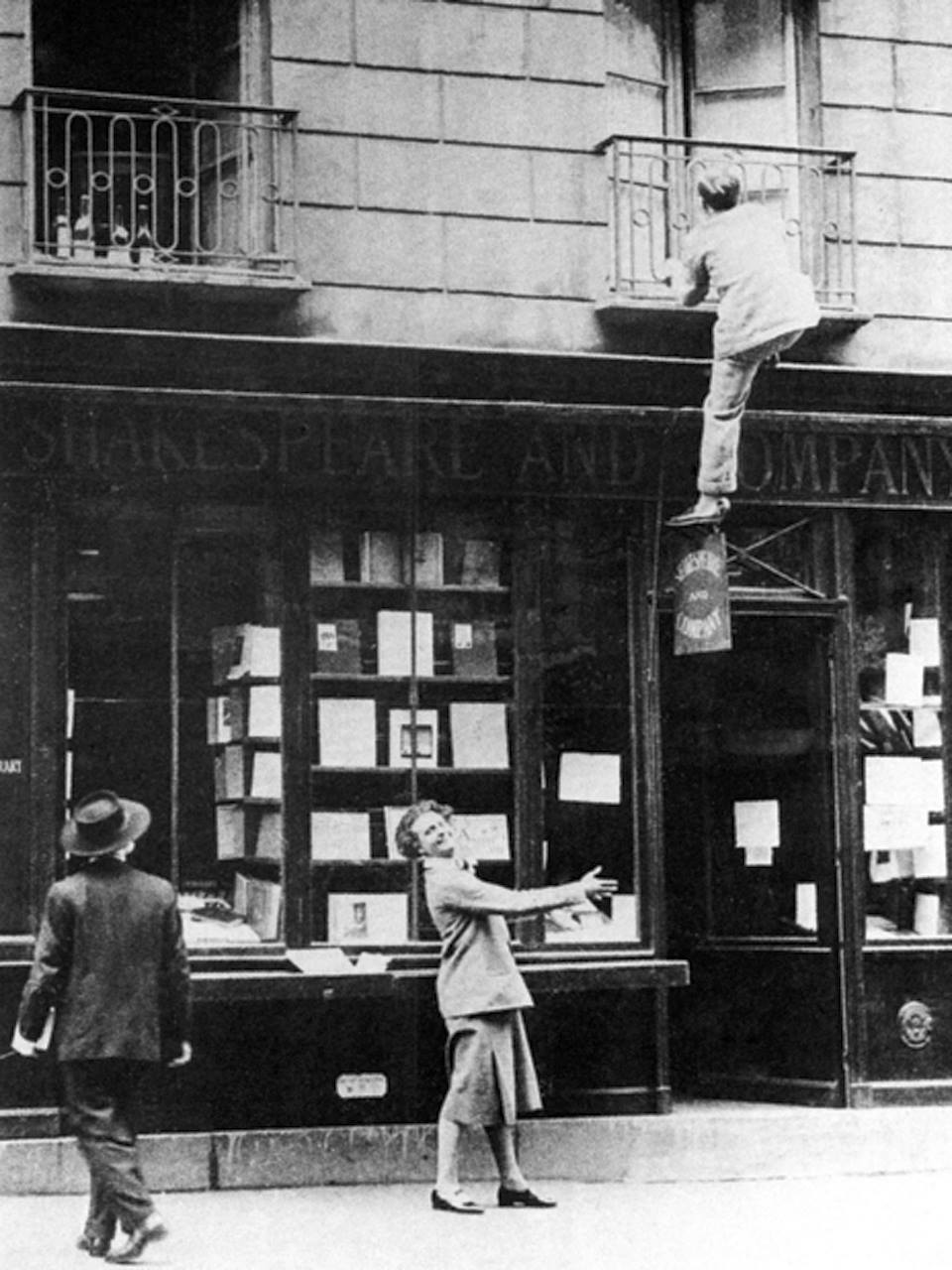
    Sylvia Beach acts as spotter as Antheil ascends to his second-story apartment, located above the legendary Parisian bookshop Shakespeare and Company
Tag Cloud

Aaron Copland (93) Beethoven (95) Composer (114) Film Music (124) Film Score (143) Film Scores (255) Halloween (94) John Williams (188) KWAX (229) Leonard Bernstein (101) Marlboro Music Festival (125) Movie Music (139) Opera (202) Philadelphia Orchestra (89) Picture Perfect (174) Princeton Symphony Orchestra (106) Radio (87) Ralph Vaughan Williams (85) Ross Amico (244) Roy's Tie-Dye Sci-Fi Corner (290) The Classical Network (101) The Lost Chord (268) Vaughan Williams (103) WPRB (396) WWFM (881)

DON’T MISS A BEAT

Receive a weekly digest every Sunday at noon by signing up here


RECENT POSTS