Tag: Yannick Nézet-Séguin

  • Wagner’s “Tristan”: The Agony and the Ecstasy

    Wagner’s “Tristan”: The Agony and the Ecstasy

    At the conclusion of Sunday’s marathon performance of Wagner’s “Tristan und Isolde” by the Philadelphia Orchestra, after having been stretched on the rack for five hours, the elastic finally snapped. Spine and scalp were atingle with the thrilling Romantic sublimity of it all, as Isolde clears that final, hysterical hurdle to ecstasy and death with the Liebestod.

    But that’s the magic of “Tristan,” surely the most extreme example of deferred gratification in the repertoire. And by the time that gratification is achieved, most everyone is dead. And the audience is not spared. It’s classical music’s equivalent of making love to a praying mantis. No matter how flippant I can be about “Tristan,” it exists on a very high plain, perhaps the highest. The greatest works of art can tear a hole in the fabric of the world and reveal the emotional truth of existence. They tap into something primal and irrational and leave you shaken to the core. On Sunday, the work hit me with three times its usual power. And I live to tell the tale.

    Of course, there was Wagner’s music, achieving apotheosis and release at the end of five glorious hours of portentous woodwinds and passionate, seething strings, and superhuman voices cresting terrifying waves of sound.

    Then there was the audience reaction, which could only be described as ecstatic. All three acts were greeted with volcanic applause, but the final curtain was received most rapturously, with the lava flowing long and lovingly, and deservedly so.

    Either one of those in themselves would have been enough to wreck me, but the performance also marked Nina Stemme’s farewell to the role of Isolde, a part she sang to great acclaim for a very long time, and she was visibly moved, wiping away tears at the end. I’m getting choked up now, nearly two days later, just thinking about it. There’s something to be said about going out on top, but Stemme, at 62, was so powerful and secure, with perhaps only two or three times where she might have landed a tad sharp on a high note (I do not have perfect pitch), but she kept her toes near the chalk and sang with adamantine strength. I was totally in love with her.

    Her partner, Stuart Skelton near-matched her in power as Tristan (though perhaps not quite), and he was in good voice throughout, but I feared for his stamina. Skelton is a big man, to put it mildly. He was the elephant in the room, both figuratively and near-literally. Later, I found an interview with him on YouTube, in which he speaks of how every part of the body serves a function in terms of creating a singer’s unique resonance, but there’s got to be a compromise so that those of us in the audience don’t worry about witnessing someone’s imminent collapse. But perhaps my concern was misplaced, as over three hours in, he still had plenty of power in reserve for Tristan’s mercurial highs and lows in Act III. Wagner must be the one branch of opera wherein the old stereotype of the gargantuan singer endures. At least in a staged production, they could have thrown some furs on the guy, or given him a winged helmet. Kurnewal’s remark about having carried him ashore brought a moment of unintended comedy (for me), only to be surpassed, when in supposed death, Skelton reached into his vest pocket and popped a lozenge or perhaps a nitroglycerin pill. All respect to your artistry, sir, but for godsake, do take care of yourself!

    The orchestra’s music director, Yannick Nézet-Séguin, ever stylin’, conducted in what looked like a synthetic t-shirt, long-sleeved with a kind of Nehru collar and French cuffs, that had been tossed in the wash with some black towels. And of course, he wouldn’t be caught dead without his Louboutins. Yannick gonna be Yannick. Sartorial choices aside, he conducted with muscle and vigor throughout. I guess his workout routine in the tongue-in-cheek video used to market these performances really paid-off.

    It took a few minutes for the Prelude to start weaving its magic as it should, but it wasn’t long before I was in the music’s thrall. Regardless of what you may think about the depth of this guy’s performances, he is a magnetic conductor.

    The orchestra musicians themselves played with great commitment, some really throwing themselves into it. Principal double bass Joseph Conyers was right in my sightline, and he really dug in and played with exuberance and zest. Wagner gives his musicians plenty to enjoy, whether it’s to claw at your heart, reach for the ineffable, or imitate burbling fountains.

    “Tristan und Isolde” is like a narcotic. Is there any other piece of music that can so alter one’s consciousness? It both depresses and inflames the listener. It’s like spider venom. But what ecstasy! I’m sure I’m not the first to observe, it can’t be good for you.

    Moreover, the whole Romantic fascination with love-death is so deeply unhealthy, but in my abnormally-prolonged youth I embraced it to the hilt. How I ever made it to my 50s is anyone’s guess. Act II made me remember every love affair I ever had – ardent, reckless, and doomed.

    The stage performance lacked sword fights and poisoned chalices, but Skelton and Stemme held hands and touched foreheads during the love scenes. For the most part, the singers were positioned on a scaffold behind the orchestra, accessible from the stairs of the “Conductor’s Circle” (seating near the organ loft at the back of the stage), but occasionally they popped up unexpectedly on other tiers. I was enraptured being so close to Karen Cargill, her Brangäne keeping watch over the lovers in Act II, as she sang, hypnotically, only yards from my box. I jotted down one word: BLISS! Likewise, members of the orchestra were sent around the hall and backstage to achieve certain spatial effects. English hornist Elizabeth Starr Masoudnia had a plum part, doubling for a shepherd’s pipe and sharing the scaffold with Tristan and his wingman, Kurwenal.

    Cargill was a standout among the supporting cast. Brian Mulligan, as Kurwenal, was another. But the singer who perhaps best inhabited his role, in terms of balancing the demands of voice and action, was Tareq Nazmi as King Marke, whose embodiment of the part transcended the requirements of a concert performance. His rounded portrayal drew real sympathy for the character, who is not only king, but Tristan’s uncle, come to regard the younger man as his son. Nazmi sold the realism of a betrayed, baffled, and ultimately beneficent king. If anything, it made the Friar Laurence moment of his too-late-arrival all the more poignant. Then again, no one told Tristan he had to tear off his bandages.

    The opera spanned close to five hours, with two 25-minute intermissions. For the first of those I hurried down the elevator and weaved across the lobby like a running back, bypassing the concessions crowds with a dash across Broad Street to the Good Karma Cafe, adjacent to the Wilma Theater, for a medium coffee. This I supplemented with doughnut holes from a tiny Tupperware I’d smuggled from home. Once during the first act I caught myself nodding and I was afraid I might tumble right over the railing. During the second intermission, I kept my energy up by eating a banana.

    Before the start of the performance (at 2:00), I couldn’t help but smile to myself as I glanced down the rows of seats in what pass for boxes in Philadelphia. The Third Tier is the Lonely Guy tier. Predominately bachelors and social misfits. Always like this wherever I go, come to think of it, with whatever I happen to enjoy. What does that say about me, I wonder? The guy in the box in front of me showed up in shorts carrying a hardbound copy of the score, which he followed most assiduously, seldom looking up for most of the first act. He disappeared for the rest of the opera. I hope it was to find a better seat. The guy behind me slipped out during the third act. I turned around, and he was gone well before the Liebestod. Did he lack the stamina, or was he hoping to avoid the traffic? I never understand people who go to a concert and then dash off before the end to beat the crowd to the garage. Kind of defeats the purpose of even attending.

    One thing that impressed me was – an unfortunate, unmuffled cough at the beginning of the Prelude aside – the audience was unusually and blessedly quiet throughout. Yes, there were coughs, very occasionally, but none of those annoyingly ostentatious gotta-cough-for-the-sake-of-coughing coughs. And no cell phones! Wagnerites are a different breed. Don’t attempt to desecrate their temple.

    I would have loved to have seen this “Tristan” staged, but in making it a concert performance, at least the audience was spared the Regietheater excesses that mar so many Wagner productions these days. Here, the music was allowed to speak without any sideshow distractions. I will remember Stemme’s Isolde for a long time. Were there moments when she was lost in the wash of sound? Believe me, they were few. I know I’m mixing my Wagner music dramas, but she had the vocal power of a Valkyrie. I count myself very fortunate to have experienced her instrument live.

    It was instructive to attend this performance two days after having heard Richard Strauss’ “Guntram” at Carnegie Hall on Friday. I’m hoping to write that up tomorrow for Strauss’ birthday.

    In the meantime: bravo, The Philadelphia Orchestra! Truly, this was a transformative event.
  • Wagner Yannick and Tristan A Mixed Reaction

    May 22. Richard Wagner’s birthday. Anyone else looking forward to this endurance test with the Philadelphia Orchestra? 4 and ½ blissful hours of blood clot-inducing “Tristan und Isolde.”

    This tongue-in-cheek teaser has been receiving a mixed reaction. I happen to think it’s very funny, but on message boards, music chats, and social media, it’s been getting more than its share of vitriol. Evidently, there are some real Yannick haters out there. And I am sorry to have to admit, classical music still does have its stuffed shirts.

    Thankfully, I spend as little time around them as I can. In fact, I’m not sure how close I am to any of them in real life. But you know how it is. These guys can come across as the most unassuming, mildest-mannered people, but give them the anonymity of the internet and they all turn into monsters.

    It’s okay to have opinions – I’ve got plenty of them myself, and by no means am I satisfied with everything Yannick conducts, strictly from an interpretive standpoint – but lighten up. It’s just a teaser, and it’s supposed to be fun!

    This “Tristan” is unlikely to be on a level of Wilhelm Furtwängler’s or Victor de Sabata’s, but it is an opportunity to hear one of the world’s great orchestras play Wagner’s hypnotic, narcotic, viscerally intense, revolutionary score without the distraction of the seemingly-inevitable, nihilistic Regietheater nonsense productions you’re likely to encounter these days at virtually any opera house that’s going to attempt a staging.

    The Everest of “Tristan” is littered with the literal corpses of those who have attempted the climb. Not only have singers destroyed their voices, but conductors have actually died. Felix Mottl and Joseph Keilberth both dropped dead while conducting the second act. The very first Tristan, heldentenor Ludwig Schnorr von Carolsfeld, died suddenly at the age of 29, after only four performances.

    In an interview given shortly before his death, Giuseppe Verdi said that he “stood in wonder and terror” before Wagner’s “Tristan.” Is it any wonder that Yannick is getting himself into shape?

  • Mahler 7 Philadelphia Orchestra Review

    Mahler 7 Philadelphia Orchestra Review

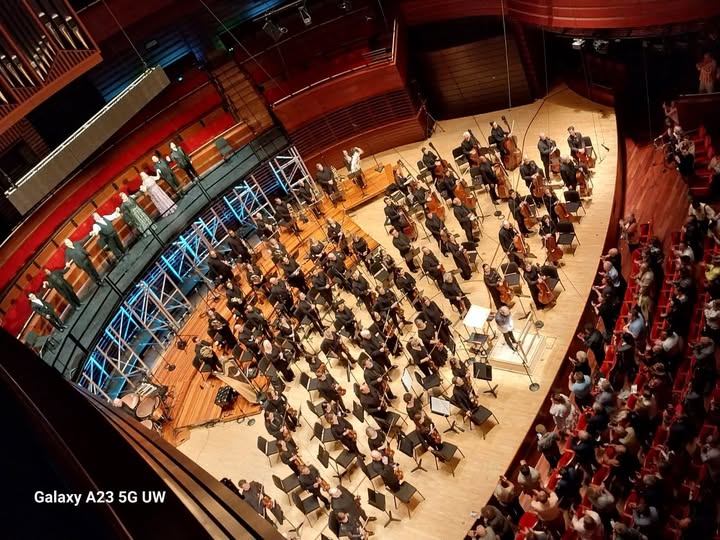
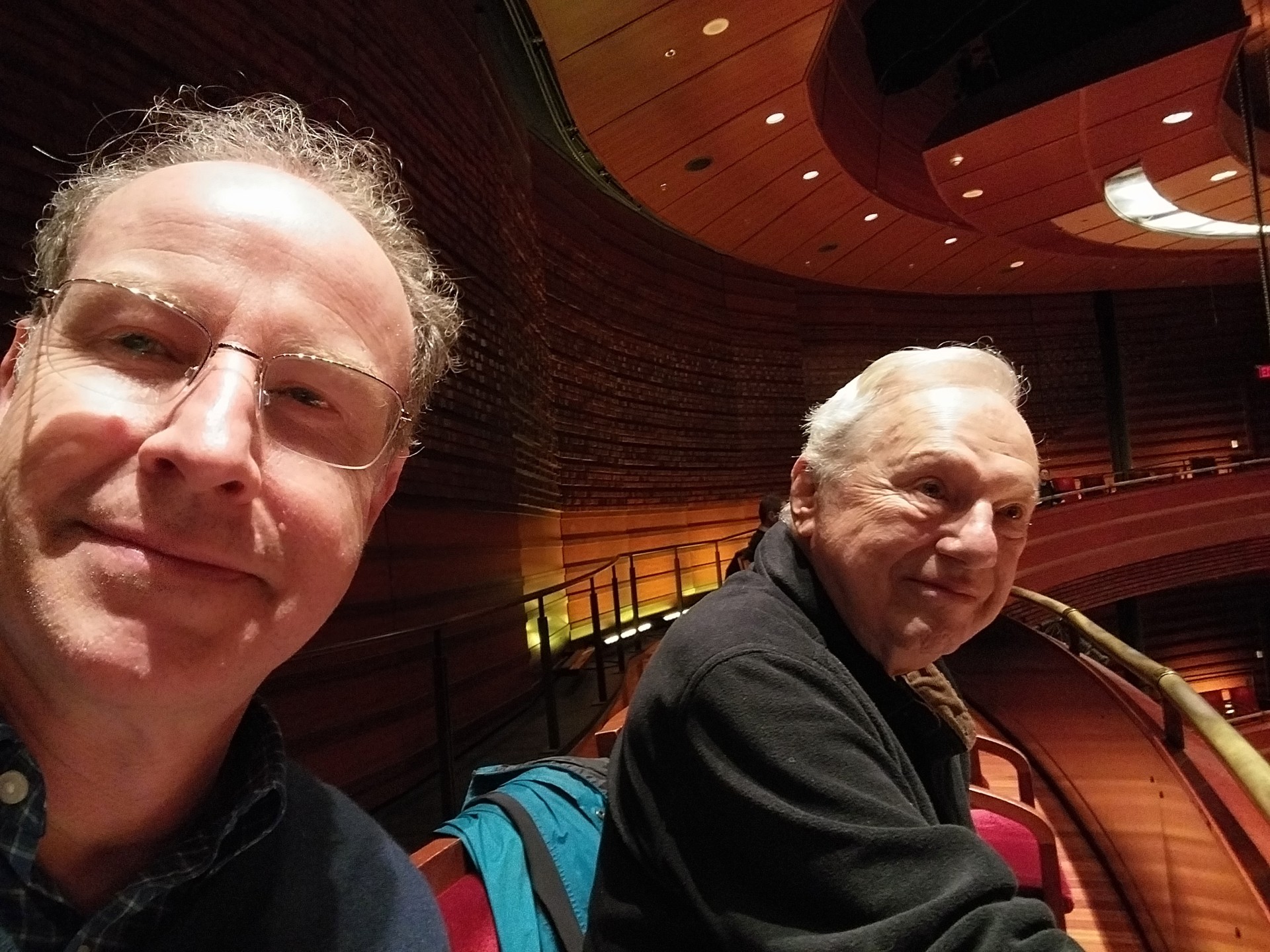
    With Robert Moran last night for Mahler 7 with The Philadelphia Orchestra, at the recently-rechristened Marian Anderson Hall at the Kimmel Center for the Performing Arts. Bob likes to get there early and, last night anyway, sit close, so here we are, all alone, in our “box” in the third tier, like Statler and Waldorf, overlooking the stage and waiting for the auditorium to fill. The vantage is not my preference, but it is within my price range, and – pleasant surprise – the sound did not suffer at all for it. The orchestra performed magnificently under its music director, Yannick Nézet-Séguin, but the brass players, in particular, must have had their super-serum. Everything was so immediate, which in my experience has not always been the case in this hall. Of course, Mahler, he does write big.

    The 7th has fun, outlandish touches in the orchestration, including parts for acoustic guitar, mandolin, and cowbells, for the pastoral “Nachtmusik” movements (there are two of them framing a central scherzo in a five-movement structure, which is why you will sometimes hear the work referred to as “Song of the Night”), and enormous, pendulous chimes for the rousing finale.

    The crowd, which included many young people, a number of whom looked like they were bused in together as part of a sizeable group, roared its approval, and a smiling Yannick, who looked all the world like a diminutive angel on the podium, as I gazed down on his blond hair, went from section to section to genuflect before all the principals. Percussionist Don Liuzzi was clearly an audience favorite for his thrilling mastery of the timpani.

    The orchestra will take its act to Carnegie Hall tonight at 8:00, but will return to Philly for two more performances, Saturday at 8:00 and Sunday at 2:00. You may not think that the 7th is anyone’s favorite Mahler, but if the orchestra plays with the energy and commitment it did last night, you could change your mind.

    Tickets and information here:

    https://www.philorch.org/performances/our-season/events-and-tickets/

    Don Liuzzi timpani teaser

    Look closely at the bird’s-eye, and you’ll see the guitar and mandolin on the left, next to the harps

  • Bruckner’s Triumph Phones and All

    Bruckner’s Triumph Phones and All

    Johannes Brahms described the mighty musical edifices of Anton Bruckner as “symphonic boa constrictors.” But at last night’s concert of The Philadelphia Orchestra, it was the audience that put on the squeeze.

    Music and artistic director Yannick Nézet-Séguin conducted a fascinating experiment, presenting a joint concert, without break, of Bruckner’s valedictory Symphony No. 9 and his almighty “Te Deum” (literally a dedication to God).

    He was not the first to do so. The symphony was presented that way at its first performance, in 1903, six years after the composer’s death. Bruckner, sensing the end was near, sanctioned the “Te Deum” as a makeshift finale for his symphony, the fourth movement of which he ultimately left unfinished – though most conductors, in their mature wisdom, grasp the poetic justness of simply letting the third movement trail away like incense on a reflective note. (Bruckner’s Roman Catholic faith was central to his life and work.)

    But it was Yannick’s own inspired idea to also affix one of Bruckner’s motets for a cappella chorus, “Christus factus est,” as a kind of preamble to the whole. The motet quotes material from the “Te Deum” and, thanks to a fortuitous key relationship, happens to dissolve seamlessly into the opening of the symphony. Then, on the other side, just as the mystic atmosphere of the symphony’s third movement is about to dissipate, the cathedral doors are blown wide open by the heaven-storming eruption that launches the sublime “Te Deum.”

    This conception of the three works as a kind of Holy Trinity transformed the evening into an epic parallel of Beethoven’s 9th Symphony, a work Bruckner clearly admired. And what a journey it was!

    Yannick’s evident mastery was all the more remarkable in that yesterday afternoon, he had just conducted his first ever “La bohème” – under the scrutiny of an international radio audience, no less – at New York’s Metropolitan Opera. The opera ended around 4 p.m. Yannick is well-known for his phenomenal energy. At 48, he goes and goes and goes until he can’t do it anymore, and then once in a blue moon he takes time off to recuperate from exhaustion – which is why he is one of the few conductors who can oversee both the Met and a major symphony orchestra – and yesterday was quite the demonstration of his superhuman stamina.

    The orchestra played like gods, and Yannick guided them like a diminutive Zeus, with a strength and an authority belying his 5-foot-five frame. The conductor later wore a wry, self-deprecating expression, acknowledging the physical contrast with choral director Joe Miller, who towered over him as the two took their bows during the rapturous ovations at the end of the concert.

    But before they could get there, there was some unexpected turbulence.

    Yannick and the orchestra were about half-way through the evening and totally in the zone – in the middle of what was shaping up to be the musical equivalent of a no-hitter – when, only about a minute into the symphony’s lofty third movement, at a particularly ethereal moment, someone in the row behind me and off to one side cried out. (I was sitting in row B in the orchestra tier.) Whether he was displeased with something he heard onstage or had a beef with somebody else in the audience or was unable to contain himself during a moment of personal disturbance is unclear, but it was disruptive enough that Yannick stopped the orchestra and began the movement over.

    A little uncomfortable, to be sure, but everyone was determined to carry on as if nothing had happened. Then, wouldn’t you know it, when the musicians arrived at the very same passage, from the other side of the hall, someone’s cell phone ringer went off. Loudly.

    At that point, Yannick let his baton arm drop to his side, his body went limp, and he turned resignedly to face that portion of the audience from which the disruption had originated. With evident exasperation, he remarked, “Can we just spend one hour of our lives without our DAMN PHONES????” To this, he added another sentence or two, while a large segment of the audience applauded. I wholeheartedly agree with the sentiment, but the applause only further served to break the spell cast by Bruckner.

    Nevertheless, Yannick raised his wand and the orchestra attempted to weave its magic a third time. Of course, by then the sustained atmosphere had been spoiled. I’m not sure if the musicians had difficulty regaining their involvement or if it was the natural aftermath of the disturbance that altered the mood in the hall, but it took a few minutes for everyone to slip back into Bruckner’s spiritual world.

    Thankfully, they did. It was a gorgeous performance. More fiery than usual, perhaps, in the ferocious scherzo (the symphony’s second movement), but if you’ve got it, flaunt it. This was young man’s Bruckner.

    I held my breath as the orchestra neared the transcendent final bars – the symphony ends quietly – feeling myself grow tense against the possibility of an overeager listener stomping the mood with a premature bravo, but after a mere pause, the Philadelphia Symphonic Choir again rose to its feet, on the tiered balcony behind the stage, where it had been sitting unobtrusively throughout the duration of the symphony, to join orchestra and organist in the explosive opening of the sublime “Te Deum.”

    It couldn’t have been easy for the soloists – soprano Elza van den Heever, mezzo-soprano Michelle DeYoung, tenor Sean Panikkar, and bass-baritone Ryan Speedo Green – who had also been sitting quietly. An awfully long time had passed since backstage warm-ups. Some of the singers drew water from metal thermoses, no doubt to ensure their voices wouldn’t catch in their throats. They sang beautifully, the individual and combined voices alternately blending and ringing out like silver clarions. The evening ended on a hair-raising tutti, with soloists, chorus, orchestra, and organ blazing. Goosebumps were palpable all across the auditorium. The audience reception was long, thunderous, and much deserved. The orchestra had overcome a double disruption in the symphony’s third movement to attain a lasting triumph.

    It is too bad that this rare Brucknerian experiment couldn’t be sustained quite as planned, as it really was something magnificent to experience. But looking back this morning, I find a touch of irony in Yannick’s wholly understandable expression of consternation at the disruption of a cell phone, as 15 minutes before the concert was scheduled to begin, I spotted him entering the lobby (as opposed to the stage door around the back of the building), smiling in a powder blue track suit and trailed by an assistant – or perhaps his husband – who was filming him, yes, on his phone.

    Hey, I’ve got no beef with that. Just noting that the damn phones are with us everywhere. But no doubt put to better use documenting Yannick, mid-marathon, on his way from the pit of the Metropolitan Opera to the podium of the Philadelphia Orchestra, than in the middle of Bruckner’s Ninth Symphony.

    Not all the drama was onstage, then, but all’s well that ends well. Flaws and all, this was one of the great Bruckner concerts of my life. Bravo, Philadelphia!

  • Dudamel to New York Philharmonic: The Dude Moves East

    Dudamel to New York Philharmonic: The Dude Moves East

    The Dude is headed to New York!

    It was announced yesterday that Gustavo Dudamel will be leaving the Los Angeles Philharmonic to take up the post of “music and artistic director” of the New York Philharmonic, beginning in 2026. The double-barrel title is bestowed in the same week as the announcement that Yannick Nézet-Séguin will now be “music and artistic director” of the Philadelphia Orchestra. Nézet-Séguin, who has been music director in Philly since 2012, renewed his contract through 2030.

    Granted, both these gentlemen do a lot of heavy-lifting, more than justifying the compound-if-cumbersome descriptors. Dudamel, 42, has been a transformative force in L.A. He is, with the possible exception of Nézet-Séguin, our most visible and energetic young man of the podium. (Yannick, 47, is also music director of the Metropolitan Opera and his home orchestra, the Orchestre Métropolitain de Montréal.) I don’t know if the East Coast can handle the combined kinetic energy of Yannick and The Dude.

    Dudamel carved out time for a whirlwind residency in Princeton in 2018. Although I got to meet him, our interview had to be conducted via email. Knowing Dudamel, he probably dashed off his responses in a limo on the way to the airport. You can learn more about The Dude and read our exchange at the link.

    https://www.communitynews.org/princetoninfo/artsandentertainment/princeton-concerts-celebrating-125-years-with-the-dude-gustavo-dudamel/article_a2905abc-098d-5bf5-a56c-20625675fdbe.html

    Brace yourselves, New York, and congratulations, Gustavo Dudamel!

    Press release from the New York Philharmonic

    https://nyphil.org/~/media/pdfs/newsroom/2223/GD-press-release-final.ashx?la=en

Tag Cloud

Aaron Copland (92) Beethoven (94) Composer (114) Film Music (116) Film Score (143) Film Scores (255) Halloween (94) John Williams (185) KWAX (228) Leonard Bernstein (99) Marlboro Music Festival (125) Movie Music (131) Opera (197) Philadelphia Orchestra (86) Picture Perfect (174) Princeton Symphony Orchestra (106) Radio (86) Ralph Vaughan Williams (85) Ross Amico (244) Roy's Tie-Dye Sci-Fi Corner (290) The Classical Network (101) The Lost Chord (268) Vaughan Williams (99) WPRB (396) WWFM (881)

DON’T MISS A BEAT

Receive a weekly digest every Sunday at noon by signing up here


RECENT POSTS