Tag: Yannick Nézet-Séguin

  • Philly Orchestra Celebrates 120 Years

    Philly Orchestra Celebrates 120 Years

    Happy birthday, The Philadelphia Orchestra! Looking pretty good for 120.

    The Fabulous Philadelphians gave their first public concert under Fritz Scheel on this date in 1900. The event took place at the orchestra’s former home of the Academy of Music, located on the southwest corner of Broad and Locust Streets. On the program were works by Carl Goldmark (“In Spring” Overture), Beethoven (Symphony No. 5), Tchaikovsky (Piano Concerto No. 1), Weber-Berlioz (“Invitation to the Dance”), and Wagner (“Entry of the Gods into Valhalla”).

    The soloist on that occasion was Ossip Gabrilowitsch. Gabrilowitsch’s teachers at the Saint Petersburg Conservatory included Anton Rubinstein and Nikolai Medtner. He then studied for two years in Vienna under the legendary pedagogue Theodor Leschitizky. Not only was Gabrilowitsch a prominent pianist, he was also offered the music directorship of the Boston Symphony Orchestra, which he politely declined. Later, he became founding director of the Detroit Symphony in 1918. He was also Mark Twain’s son-in-law. In my possession is a biography I picked up at a library sale a few years ago, “My Husband, Gabrilowitsch,” that I noticed had been inscribed by Twain’s daughter, Clara Clemens!

    Fritz Scheel was succeeded as music director of the Philadelphia Orchestra by Carl Pohlig in 1908. Leopold Stokowski (pictured) followed in 1912; Stoky would lead the group for the next 24 years. Then came Eugene Ormandy, who held the podium until 1980 – 44 years. Ormandy passed the baton to Riccardo Muti, who directed from 1980 to 1992. Muti was followed Wolfgang Sawallisch, who remained with the orchestra for the next decade. Sawallisch was succeeded by Christoph Eschenbach in 2003. Eschenbach was followed by Charles Dutoit, appointed “Chief Conductor” in 2008. And, bringing us up to the present, Yannick Nézet-Séguin arrived, with vitality to burn, in 2012. What a history!

    Looking forward to next week’s Digital Stage concert (available November 25-29), which will include the Philadelphia premiere of Florence Price’s Symphony No. 1. Price’s symphony was the first by an African American woman to be performed by a major orchestra (the Chicago Symphony, in 1933). Also on the program will be Samuel Barber’s “Adagio for Strings.” For more information on this and other Philadelphia Orchestra events, visit philorch.org.

    Thank you, Philadelphia, for taking a chance on substantial works by composers such as Price and Louise Farrenc. I was there, in the hall, for Farrenc’s Symphony No. 2. So sorry not to be able to attend the Price performance in person. Perhaps next year.

    Happy 120th!


    PHOTO: The Philadelphia Orchestra at the Academy of Music in 1916, ready to go for the American premiere of Gustav Mahler’s “Symphony of a Thousand”

  • Free Met Opera Streams This Week

    Free Met Opera Streams This Week

    Even during a pandemic, life can be so… operatic.

    Here’s this week’s schedule of Metropolitan Opera “Live in HD” encores. You know the drill. The operas stream free, for approximately 23 hours, beginning each day around 7:30 p.m. EDT at metopera.org. Though I have noticed that the switch more often takes place around 6:00. That said, once you hit play, even if it’s 5:00 or 5:30, it’s been my experience that you can watch until the end, provided you don’t try to break. “Nabucco” is available, allegedly, through 6:30 this evening.

    Here’s a complete schedule of this week’s offerings. You’ll find teasers and bonus materials when following the link.

    https://www.metopera.org/user-information/nightly-met-opera-streams/week-10/

    Monday, May 18
    Mozart’s Idomeneo
    Starring Nadine Sierra, Elza van den Heever, Alice Coote, and Matthew Polenzani, conducted by James Levine. From March 25, 2017.

    Tuesday, May 19
    Wagner’s Lohengrin
    Starring Eva Marton, Leonie Rysanek, Peter Hofmann, Leif Roar, and John Macurdy, conducted by James Levine. From January 10, 1986.

    Wednesday, May 20
    Verdi’s Un Ballo in Maschera
    Starring Sondra Radvanovsky, Kathleen Kim, Stephanie Blythe, Marcelo Álvarez, and Dmitri Hvorostovsky, conducted by Fabio Luisi. From December 8, 2012.

    Thursday, May 21
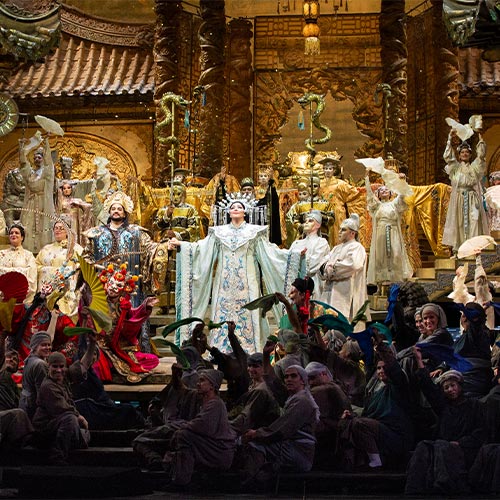
    Puccini’s Turandot
    Starring Christine Goerke, Eleonora Buratto, Yusif Eyvazov, and James Morris, conducted by Yannick Nézet-Séguin. From October 12, 2019.

    Friday, May 22
    Mozart’s Don Giovanni
    Starring Joan Sutherland, James Morris, and Gabriel Bacquier, conducted by Richard Bonynge. From March 16, 1978.

    Saturday, May 23
    Gounod’s Faust
    Starring Marina Poplavskaya, Jonas Kaufmann, and René Pape, conducted by Yannick Nézet-Séguin. From December 10, 2011.

    Sunday, May 24
    Massenet’s Manon
    Starring Anna Netrebko, Piotr Beczała, and Paulo Szot, conducted by Fabio Luisi. From April 7, 2012.

  • Philly Orchestra Farrenc Shines Beyond Beethoven

    Philly Orchestra Farrenc Shines Beyond Beethoven

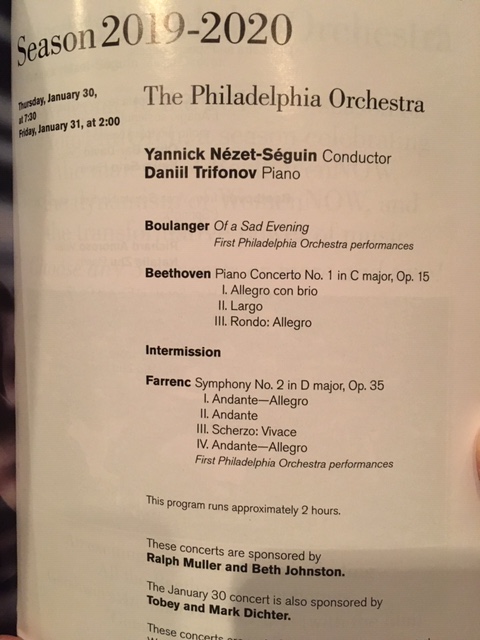
    Very interesting program at The Philadelphia Orchestra this weekend. Naturally, all promotions emphasize Trifanov and Beethoven (after all, they want to get butts in the seats), but I would like to shower the entire organization with rose petals for allowing the bulk of the concert to be devoted to music by Lili Boulanger and especially Louise Farrenc.

    If you’re unfamiliar with Farrenc, she was the only female professor at the Paris Conservatory in all of the 19th century. I have a preference for her Third Symphony, myself, but it was so good to be able to hear the Second performed live. It doesn’t always have to be Berlioz (her exact contemporary), for as much as I enjoy his music!

    Yannick, please check out Farrenc’s Symphony No. 3. And more adventurous programming, please! I understand the importance of new commissions for women composers, but there is still also plenty of worthwhile music by historical women that right now can only be experienced through recordings.

    The next time you have the urge to do Elgar, try your hand at Ethel Smyth. The overture to “The Wreckers” would make for a dynamic curtain-raiser. The “Serenade in D” is a symphony in all but name, with some pretty good tunes. If you prefer Czech, try Vítězslava Kaprálová. She inhabits a similar sound world to that of Martinu. And Poland’s Grazyna Bacewicz can stand toe-to-toe with just about any of the 20th century’s greatest composers.

    For the present, thank you, Philadelphia, for performing Boulanger and Farrenc. Now there are more, and perhaps even greater, treasures to be mined.

    As for the Beethoven concerto, of course the solo part held no terrors for Daniil Trifanov, the Rachmaninoff pianist du jour. But the orchestra also played with plenty of punch, under the muscular direction of Yannick Nézet-Séguin, and bubbled over with dynamism to the driving timpani of Angela Zator Nelson.

    The program is presented under the umbrella of the orchestra’s BeethovenNOW series. I’d be dismissive of the venture as a tired rehash of music that already gets raked over every year, all over the world, but if these musicians are energized by Beethoven the way they were on Thursday, then it will all probably be worth hearing, even by a jaded old bastard like myself. You can find more information at the orchestra’s website, philorch.org.

    PLEASE NOTE: For remaining performances of this particular program, tonight at 8 p.m. and tomorrow at 2 p.m., Trifanov will swap out Beethoven’s Piano Concerto No. 1 for the Piano Concerto No. 5, the popular “Emperor.”

    I am not able to access the review, since it’s paywalled, but if you already subscribe to the Philadelphia Inquirer, you can check out David Patrick Stearns’ impressions of the Thursday concert. From the headline, it looks as if he too was pleased to be able to hear Farrenc.

    https://www.inquirer.com/arts/philadelphia-orchestra-beethoven-now-daniil-trifonov-yannick-20200131.html

  • Yannick Nézet-Séguin New Met Music Director

    Yannick Nézet-Séguin New Met Music Director

    Yannick Nézet-Séguin has been named the new music director of the Metropolitan Opera. James Levine, who held the position for the past 40 years, agreed to step down at the end of this season because of health issues. Levine led his final performance as the Met’s music director, of Mozart’s “The Abduction from the Seraglio,” on May 7. He conducted the Met Orchestra in selections from Wagner’s “Ring” at Carnegie Hall on May 26.

    Yannick is a very fine conductor of opera and a seemingly unstoppable force, but even for such a fireball, maintaining his loyalty to Philadelphia (where his contract has been renewed through 2026) and the Orchestre Métropolitain in his native Montreal might be spreading things a bit thin. Congratulations, Yannick, and best of luck to you!

    Here’s the press release:

    YANNICK NEZET-SEGUIN NAMED THE METROPOLITAN OPERA’S MUSIC DIRECTOR

    The 41-year-old conductor will become only the third
    Music Director in the history of the Met

    New York, NY (June 2, 2016) – The Metropolitan Opera announced that the acclaimed conductor Yannick Nézet-Séguin will be the company’s new Music Director. The position has previously been held by only two artists in the company’s storied 133-year history—James Levine, who after 40 years in the position stepped down at the end of the recently concluded season to become the company’s first Music Director Emeritus, and Rafael Kubelik, who held the title briefly in the company’s 1973-74 season.

    In the Met’s 2017-18 season, Nézet-Séguin will assume the interim title of Music Director Designate. He will become Music Director in the 2020-21 season, the first season in which he is available to take over the full responsibilities of the position. However, he will immediately become involved in the company’s artistic planning, which happens many years in advance.

    As Music Director, Nézet-Séguin will be responsible for the overall musical quality of the Met. He will have artistic authority over the company’s orchestra, chorus, and music staff, and will work in tandem with Met General Manager Peter Gelb to oversee the planning and casting of each Met season, including repertoire choices, new productions (including the selection of creative teams), revivals, and commissions.

    Nézet-Séguin will initially conduct five different operas each season he is Music Director, as well as concerts with the Met Orchestra. In each of the seasons in which he is Music Director Designate, Nézet-Séguin will conduct two operas. Next season at the Met, he will conduct his first Wagner opera with the company, a revival of Der Fliegende Holländer.

    “Becoming the Music Director of the Metropolitan Opera is the fulfillment of a lifelong dream for me,” said Nézet-Séguin. “I am truly honored and humbled by the opportunity to succeed the legendary James Levine and to work with the extraordinary orchestra, chorus, and staff of what I believe is the greatest opera company in the world. I will make it my mission to passionately preserve the highest artistic standards while imagining a new, bright future for our art form.”

    “Yannick was the clear choice of the Company,” said Gelb. “He is the right artist at the right time to lead us forward into a new and what I believe will be a glorious chapter in the history of the Met.”

    “The Metropolitan Opera has been the great artistic love of my life, and it has been tremendously rewarding to see the company develop and improve over the past 45 years,” said Levine. “I offer my heartfelt congratulations to Yannick on taking the musical reins, and I look forward to seeing the good work continue under his watch.”

    “The MET Orchestra enjoys a tremendously fruitful, positive relationship with Maestro Nézet-Séguin, and we are delighted in his appointment as Music Director,” said Jessica Phillips, clarinetist and chair of the Met’s Orchestra committee. “He embodies the artistic leadership, musical excellence, and respect for rich tradition that opera lovers around the world have come to cherish. We eagerly look forward to working together to shape this new era at the Met.”

    “The singers and stage performers at the Met welcome Yannick Nézet-Séguin, joining the historic line of artists from James Levine’s great tenure back to Toscanini and Mahler,” said David Frye, tenor and chair of the Met’s chorus committee. “Yannick has led great performances with the company, and we’re eager to expand our collaboration.”

    Nézet-Séguin made his Met debut in the 2009-10 season, conducting a new production of Bizet’s Carmen. He has returned in every subsequent season, leading acclaimed performances of Verdi’s Don Carlo, Gounod’s Faust, Verdi’s La Traviata, and Dvořák’s Rusalka. He led the opening night performance of the Met’s 2015-16 season, a new production of Verdi’s Otello.

    Nézet-Séguin’s operatic career was launched when he was appointed Chorus Master and Assistant Conductor of the Montreal Opera at age 23. Since then, he has conducted a wide breadth of repertoire at a number of the leading companies, including the Vienna State Opera; the Royal Opera House, Covent Garden; La Scala; Dutch National Opera; and the Salzburg Festival, in addition to the Met. He is also a frequent guest conductor of the Berlin Philharmonic, the Vienna Philharmonic, the Bavarian Radio Symphony Orchestra, the London Philharmonic, and the Chamber Orchestra of Europe.

    Since 2012, Nézet-Séguin has been Music Director of the Philadelphia Orchestra, which announced today that he has extended his contract with them through 2025-26. (A separate press release on that announcement is available.) Given the close proximity of New York and Philadelphia, Nézet-Séguin will be able to easily commute between his two posts, and the Met and the Philadelphia Orchestra will also be exploring the possibilities for artistic collaboration between the two institutions.

    He is also the Music Director of Montreal’s Orchestre Métropolitain and of the Rotterdam Philharmonic, a position he will resign at the conclusion of the 2017-18 season.

    Each season, the Met presents more than 200 performances in its home at Lincoln Center and transmits 10 live performances to more than 2,000 movie theaters in 70 countries around the world.

  • Philadelphia Organ Delights

    Philadelphia Organ Delights

    It occurs to me that I haven’t had the time to acknowledge the passing of Minnesota composer Stephen Paulus, who died Oct. 19, nearly 16 months after suffering a debilitating stroke. Paulus, who made his home in the Twin Cities area (though born in Summit, NJ), was particularly noted for his choral and vocal works.

    The The Philadelphia Orchestra will perform Paulus’ Grand Concerto for Organ and Orchestra at the Kimmel Center tonight at 8. The work was composed in 2004. This will be its first performance by the orchestra. Ken Cowan will be the soloist. It comes at the end of a three-concert weekend celebrating the Verizon Hall’s magnificent Fred J. Cooper Memorial Organ, the largest mechanical-action concert organ in the United States.

    Each program includes a different organ work, each rendered by a world-class performer. Yesterday afternoon, Paul Jacobs joined the orchestra for Alexandre Guilmant’s Symphony No. 1 for organ and orchestra.

    I attended the first of the concerts on Thursday night, with Peter Richard Conte in Joseph Jongen’s Symphonie concertante, and it was a stunner. The work is well enough represented on recordings, though this is the first time I had an opportunity to enjoy it live. The soloist, choirmaster and organist at Philadelphia’s St. Clement’s Church and Grand Court Organist of the famed Wanamaker organ, was seated at a console situated right up between the cellos and the podium, which was wholly appropriate in a work with so much interplay between organ and the other instruments. It is an extremely well-written piece, and the orchestra, which played beautifully, with plenty of elegance in the winds, merged seamlessly with the organ, the King of Instruments on a genial stroll out among its subjects.

    All three programs open with Carlos Chávez’s orchestration of an organ piece by Dietrich Buxtehude, his Chaconne in E Minor. Buxtehude, of course, was an influential and revered organist. Composers travelled from all over Europe to hear him perform. There is a famous story, perhaps apocryphal, of Bach walking close to 300 miles for the privilege. It’s certainly possible, since Bach took off work for almost four months for the occasion!

    I have to say, I found Chávez’s arrangement to be surprisingly refreshing. Maybe I’m just suffering from Bach/Stokowski fatigue. Even the austere Schoenberg, for as much as I enjoy his arrangement of the “St. Anne” Fugue, is far too flashy for me not to feel a little cheap for enjoying it. Chávez‘s treatment is a model of good taste, allowing the music to speak for itself, without any attention-grabbing razzle dazzle. This kind of restraint in orchestrating a keyboard work is not to be undersold (though showmanship certainly does have its place). Of course it helps that the music in itself is extremely beautiful.

    Buxtehude’s use of ostinato influenced Bach, and the Chaconne in particular became the model for the final movement of Brahms’ Symphony No. 4.

    Here it is, played by a youth orchestra in Caracas:

    The Latin connection, both in the clip and in the ethnicity of the orchestrator, is fitting, since the chaconne had its roots in the Spanish colonies as a triple-meter dance of the 16th century. Of course, once the Germans got a hold of it, everything became very solemn.

    The concerts conclude with Sir Edward Elgar’s “Enigma Variations,” a work I never tire of hearing. On Thursday, the orchestra did the piece proud. Each variation was put across as characterful, sporatically witty or energetic, often melancholy, and always noble.

    I was a little worried toward the end, since music director Yannick Nézet-Séguin has a tendency to push, rather than allow a work’s grandeur to unfold naturally. Indeed, he launched into the finale in a vigorous manner, perhaps just to prove his players could keep up. For me, personally, this kind of thing has marred his interpretations of Shostakovich’s 5th and Mahler’s 1st, for instance, though from the ecstatic audience and critical reaction, I appear to be in the minority. Thankfully, it was only a momentary aberration, and the Elgar concluded with unforced grandeur and nobility as it should. The organ was heard once again in the progam’s finale, in all its “Star Wars” throne room pomp.

    While I have had mixed feelings about Yannick, his programs are often undeniably exciting in themselves. This was the second Philadelphia concert I attended this season to which I was enticed by the opportunity to experience unusual repertoire performed by a major orchestra. A couple of weeks ago, I shelled out my hard-earned dollars to hear Leoš Janácek’s “Glagolitic Mass,” an astonishing piece of music I never thought I’d be able to hear live without traveling to the Czech Republic (which also happens to feature a major part for organ, including a wild cadenza). The balance of the program was made up of symphonic poems by Sibelius and Dvorak.

    Sadly, on that occasion, as on this, the hall was half empty. Can it really be that audiences only want to hear Schubert’s 9th Symphony?

    PHOTO: Philadelphia’s King of Instruments

Tag Cloud

Aaron Copland (92) Beethoven (95) Composer (114) Film Music (123) Film Score (143) Film Scores (255) Halloween (94) John Williams (187) KWAX (229) Leonard Bernstein (101) Marlboro Music Festival (125) Movie Music (138) Opera (202) Philadelphia Orchestra (89) Picture Perfect (174) Princeton Symphony Orchestra (106) Radio (87) Ralph Vaughan Williams (85) Ross Amico (244) Roy's Tie-Dye Sci-Fi Corner (290) The Classical Network (101) The Lost Chord (268) Vaughan Williams (103) WPRB (396) WWFM (881)

DON’T MISS A BEAT

Receive a weekly digest every Sunday at noon by signing up here


RECENT POSTS