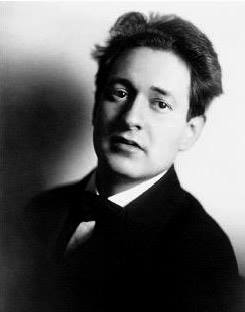
For the first edition of “The Lost Chord” for 2016, we revisit the music of Erich Wolfgang Korngold. Korngold, of course, was one of the great film composers. A two-time Academy Award winner, he provided music for such classics as “Captain Blood,” “The Prince and the Pauper,” “The Adventures of Robin Hood,” “The Sea Hawk” and “Kings Row.”
But before he settled in Hollywood, Korngold was the toast of Vienna, one of the most lauded of contemporary composers, and the city’s brightest hope for maintaining its fin de siècle supremacy in music.
Korngold was a child prodigy who had amazed audiences with such works as the ballet-pantomime “Der Schneemann” (or “The Snowman”), composed at the tender age of 11 (first performed at the Vienna Court Opera in the presence of Emperor Franz Josef); his Piano Trio, composed at the age of 13 (given its premiere by Arthur Schnabel and members of the Vienna Philharmonic); and the “Sinfonietta,” a symphony-in-all-but-name, composed at the age of 15 (first conducted by Felix Weingartner, Korngold sharing a box at that performance with an admiring Richard Strauss).
With the premiere of his opera “Die tote Stadt,” in 1920, at age 23, Korngold’s reputation seemed assured. He wrote a piano concerto for Paul Wittgenstein, undertook a revival of the operettas of Johann Strauss II, and was publicly honored by the president of Austria.
However, the trajectory of his career took an unexpected turn with the rise of Hitler. To escape the creep of fascism, Korngold embarked on a second career, settling in Hollywood to write film scores for Warner Brothers.
The first of these was composed at the invitation of famed impresario Max Reinhardt, with whom Korngold had collaborated on the Strauss revivals. Reinhardt was in the process of adapting Shakespeare’s “A Midsummer Night’s Dream” for the big screen, and he enlisted Korngold to rework Felix Mendelssohn’s famous incidental music.
In true Korngoldian fashion, the composer went well beyond what was expected, weaving in passages from Mendelssohn’s symphonies and “Songs Without Words,” writing his own connective material, and sprinkling the whole with fairy dust.
Korngold’s work on “A Midsummer Night’s Dream” led to an exclusive contract at Warner’s, where the composer revolutionized the language of film music, applying the kind of opulence, pageantry and romance characteristic of his operas to silver screen historical dramas and swashbucklers.
The result was kind of a pop cultural immortality, but to the detriment of his reputation as a serious composer. The center of European musical culture was off-limits, indeed severely limited by Nazi strictures, and the language of musical modernism, as exemplified by the output of his contemporary and compatriot Arnold Schoenberg, made Korngold seem positively old-fashioned. It would be decades before his reputation would recover, and unfortunately by then he was long dead.
From the same year as his greatest triumph, “Die tote Stadt,” 1920, comes an earlier foray into Shakespeare, written for a stage production of “Much Ado About Nothing.” “Much Ado” contains some of Korngold’s most charming music. A concert suite of some 20 minutes has been in circulation for decades.
However, what we have for you this evening is the first COMPLETE recording of the score, with spoken dialogue. A 2013 release, on the Toccata Classics label, it features actors and musicians of the University of North Carolina School of the Arts, conducted by John Mauceri.
I hope you’ll join me for “Much Ado About Korngold,” tonight at 10 ET, with a repeat Wednesday evening at 6; or that you’ll listen to it later as a webcast at wwfm.org.
Leave a Reply