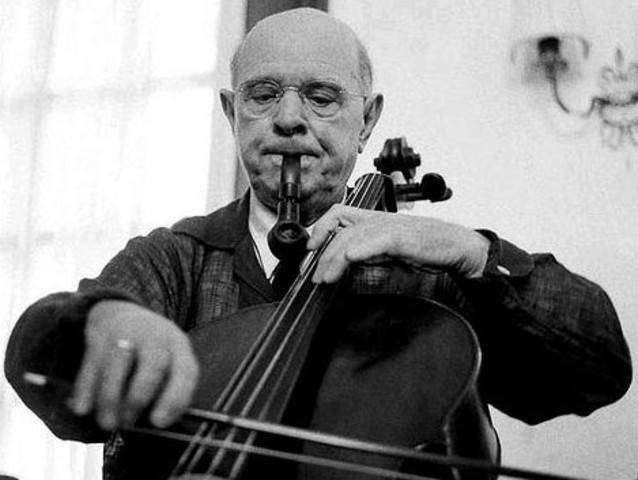
It’s hardly surprising that anyone would be moved to write music for Pablo Casals. Regarded by many as the greatest cellist of his time, perhaps ever, he was certainly a giant-of-an-artist, and of a man. Born in Catalonia, he stood up to the Franco regime, entering into self-imposed exile and refusing to perform in countries that recognized Franco’s authority. He rediscovered the Bach cello suites in a secondhand bookshop and made them famous. Over the span of his career, he played for both Queen Victoria and John F. Kennedy.
As a conductor and administrator, he founded the Prades Festival and the Casals Festival. He established the Puerto Rico Symphony and the Conservatory of Music in Puerto Rico. He gave master classes, conducted and recorded at Marlboro. He was even a talented composer.
This Sunday night on “The Lost Chord,” we’ll hear three works written for Casals by his notable friends and colleagues.
Ralph Vaughan Williams wrote his seldom-heard “Fantasia on Sussex Folk Tunes” around the time he was at work on his Piano Concerto and “Job: A Masque for Dancing.” Casals performed the piece in 1930. It was not heard again until 1983, the year of its world-premiere recording (featuring Julian Lloyd Webber). The composer later undertook a full-scale concerto for Casals. It was never completed, but the sketches for its slow movement were realized for a 2010 performance at the BBC Proms, under the title “Dark Pastoral.”
Donald Francis Tovey, who would achieve fame as a musicologist and writer on music, wrote quite a lot of music himself, most of it now forgotten. In 1935, he composed a concerto for Casals. At nearly an hour in length, the work may be the longest cello concerto ever written.
In 1912, Tovey was a houseguest of Casals and cellist Guilhermina Suggia, at their summer home at Playa San Salvador on the Mediterranean coast. There, he played tennis, swam and performed chamber music with the likes of Enrique Granados and Mieczyslaw Horzsowski. He also made great strides on his opera, “The Bride of Dionysus.” As a show of thanks, he composed for his hosts a Sonata for Two Cellos in G major, which became part of the evenings’ entertainments. The work’s second movement is a set of variations on a Catalan folk song. We’ll hear it performed by Marcy Rosen and Frances Rowell, from a Bridge Records, Inc. release.
Finally, Arnold Schoenberg, himself an amateur cellist, had done editorial work on three pieces by the 18th century composer Georg Matthias Monn for inclusion in the publication “Monuments of Music in Austria.” When Casals invited Schoenberg to conduct his orchestra in Barcelona, the composer set about arranging a “new” concerto, based upon a harpsichord work by Monn, written in 1746. We’ll hear Schoenberg’s transformation of the piece performed by Yo-Yo Ma.
Join me for “Casals’ Pals” – music written for Casals by notable composers, friends and colleagues – this Sunday night at 10 EDT, on WWFM – The Classical Network and at wwfm.org.
Leave a Reply