First of all, this is the first opportunity I’ve had to wish all of you who observe Rosh Hashanah a sweet new year!
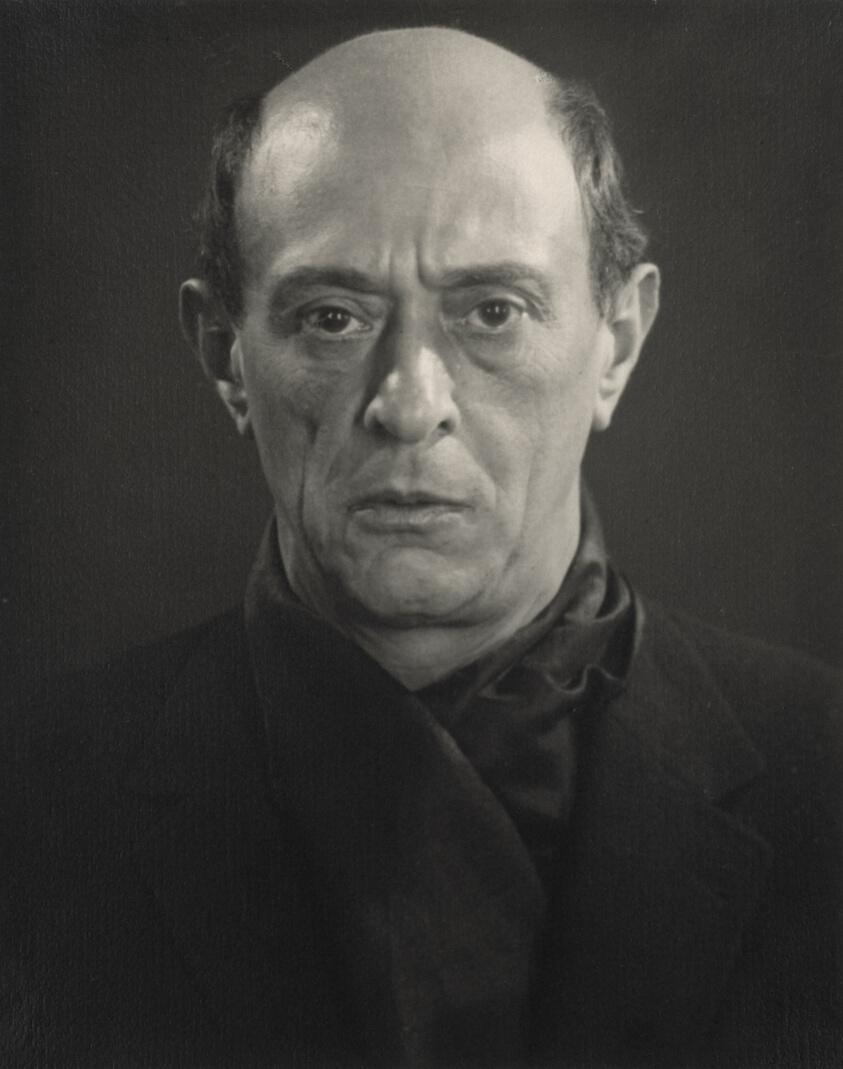
There’s been a lot going on the past couple of days. And now today is the birthday of dodecaphonic icon Arnold Schoenberg (1874-1951).
Schoenberg, who was born Jewish, converted to Lutheranism in 1898 – not, as might be assumed, for professional reasons or in an attempt to assimilate, but because of a nagging spiritual hunger.
He formally converted back to Judaism in defiance of the National Socialists, who came to power in 1933. He was on vacation in France, when he was warned that it would dangerous for him to return to Germany. He reclaimed membership in the Jewish faith in a Paris synagogue. Schoenberg was summarily denounced by the Nazis as a Jew and an exponent of degenerate art. He was dismissed from his post at the Prussian Academy of Letters, where he had taught since 1925.
Unbowed, he drafted a “Four-Point Program for Jewry,” calling for a united Jewish party and the creation of an independent Jewish state. He emigrated to the United States, eventually settling in Los Angeles, where he taught at U.C.L.A.
Throughout his career, Schoenberg produced a number of works on Jewish themes, including his opera “Moses und Aron” (which he worked at between 1930 and 1932, before his second conversion). In 1938, the year of Kristallnacht, he composed a setting of “Kol Nidre.” He also wrote an oratorio, “Die Jakobsleiter,” between 1917 and 1922.
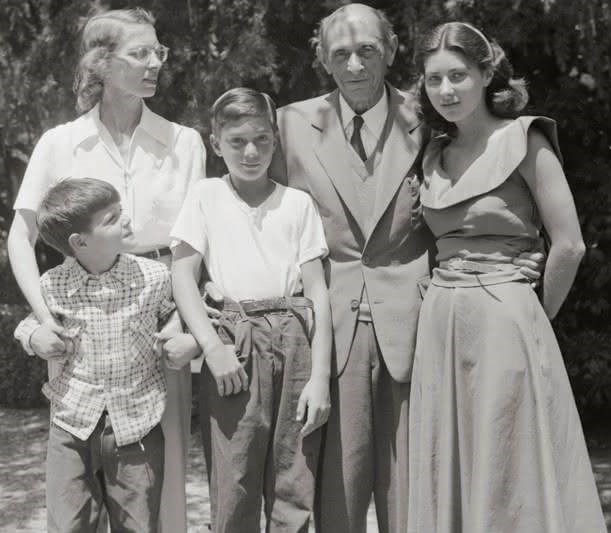
In reputation, in photographs, and in his music, Schoenberg can often come across as a somewhat forbidding figure. But once one learns of his fondness for tennis, his friendship with George Gershwin, his delight in Hopalong Cassidy, and his fear of the number 13, it’s impossible not to grasp his humanity. In home movies, he smiles with friends. In photos, he loves his children. His social circle included Charlie Chaplin and Groucho Marx.
There’s a section in Jeremy Eichler’s book “Time’s Echo” (published by Alfred A. Knopf in fall of 2023) – see the link below to learn more about it – that I guarantee will instill in a reader a greater affection for Schoenberg the man, possibly even a genuine curiosity to revisit his music. Because it turns out the somber godhead of serialism was actually a real mensch, a passionate humanitarian, even if touchingly blinkered by his idealism.
His cantata “A Survivor of Warsaw” proved to be so disturbing in 1947, with its uncompromising text relating the barbarity of a concentration camp, complete with beatings and gas chambers, that nobody knew what to do with it. More disturbing was a willful silence surrounding many of the atrocities committed against Jews, in particular, that was upheld seemingly everywhere.
When the Boston Symphony Orchestra hesitated to program the piece, which it had commissioned, it was picked up by a semi-amateur group, consisting of cowboys and farmhands, who mastered not only the twelve-tone idiom but Hebrew for its first performance – in Albuquerque, New Mexico! – in 1948. Time magazine reported that the work was performed twice, to allow the audience to better absorb what it was listening to, and that it responded with thunderous applause.
With all the division in our country right now, how can this image not charm one’s socks off: Schoenberg, possibly the most divisive composer in the history of classical music, connecting with the salt of the earth.
Happy birthday, Arnold Schoenberg, and shana tova!
———-
More impressions of Jeremy Eichler’s “Time’s Echo”
https://rossamico.com/2024/02/06/times-echo-music-the-holocaust/
Tag: Arnold Schoenberg
-

Princeton Symphony Brahms & Schoenberg
To open its 2025-26 season, the Princeton Symphony Orchestra is offering a rare opportunity to experience an established masterpiece from two very different perspectives.
Johannes Brahms’ Piano Quartet in G minor of 1861 was orchestrated by Arnold Schoenberg in 1937. Brahms was 28 when he wrote it. At the time of its transmogrification, Schoenberg was 63.
Despite his notorious reputation as the godfather of dodecaphonic music, Schoenberg greatly admired Brahms and indeed would celebrate him, emphasizing his underappreciated genius as a musical adventurer, in a series of 1947 talks titled “Brahms the Progressive.”
Schoenberg’s reimagining of the piano quartet is warm and affectionate. For most of the work, he manages a pretty good Brahms impression, if not a slavish one. It’s hard to imagine Brahms ladling on the percussion quite like that in the “gypsy rondo” finale. Furthermore, perhaps disorientingly, there is no piano in it. So it’s not Brahms, exactly, but it IS entertaining. Otto Klemperer, who conducted the premiere of the hybrid in Los Angeles, on Brahms’s birthday anniversary, May 7, 1938, paid tribute to Schoenberg’s accomplishment. “You can’t even hear the quartet,” he declared, “so beautiful is the orchestration.”
Brahms-Schoenberg will make up the second half of this weekend’s Princeton Symphony Orchestra concerts. The program will also include Antonín Dvořák’s Violin Concerto, with soloist Aubree Oliverson, who charmed audiences last year with her performances of the Tchaikovsky concerto. The concerts will open with “Orpheus’ Comet” by Bulgarian composer Dobrinka Tabakova.
To get the Brahms fresh in our ears and enhance our appreciation of Schoenberg’s achievement, the PSO will present Brahms’ Piano Quartet No. 1 in its original guise on Thursday night, with PSO favorite Natasha Paremski, along with violinist Marc Uys, violist Xandi van Dijk, and cellist John-Henry Crawford. The concert will include commentary by PSO music director Rossen Milanov – who, of course, will also conduct the weekend concerts.
Brahms’ chamber work will be performed at Trinity Church Princeton, 33 Mercer St., on Thursday at 7 p.m.
The orchestral program will be presented at Princeton University’s Richardson Auditorium, Saturday at 7:30 p.m. and Sunday at 4 p.m.
At another related event, storyteller Maria LoBiondo will refresh our memories of the Orpheus myth, in preparation for our brush with “Orpheus’ Comet,” as she weaves her spell at Princeton Public Library, this Wednesday at 7 p.m. Attendees will have the opportunity to enter a drawing to win free tickets for this weekend’s concerts.
Don’t look back with regret like Orpheus. For more information, visit princetonsymphony.org.
-

Music for Casals Composers Inspired by a Cello Legend
It’s hardly surprising that anyone would be moved to write music for Pablo Casals.
Regarded by many as the greatest cellist of his time, perhaps ever, Casals was certainly a giant of an artist and of a man. Born in Catalonia, he stood up to the Franco regime, entering into self-imposed exile and refusing to perform in countries that recognized Franco’s authority. He rediscovered the Bach cello suites in a secondhand bookshop and made them famous. Over the course of his career, he played for both Queen Victoria and John F. Kennedy.
As a conductor and an administrator, he founded the Prades Festival and Casals Festival. He established the Puerto Rico Symphony and Conservatory. He gave master classes, conducted and recorded at Marlboro. He was even a talented composer.
This week on “The Lost Chord,” we’ll hear works dedicated to Casals by three of his friends and colleagues.
Ralph Vaughan Williams wrote his seldom-heard “Fantasia on Sussex Folk Tunes” around the time he was at work on his Piano Concerto and “Job: A Masque for Dancing.” Casals performed the piece in 1930. It was not heard again until 1983, the year of its world-premiere recording (featuring Julian Lloyd Webber). The composer later undertook a full-scale concerto for Casals. It was never completed, but the sketches for its slow movement were realized for a 2010 performance at the BBC Proms, under the title “Dark Pastoral.”
Donald Francis Tovey, who would achieve fame as a musicologist and writer on music, wrote quite a lot of music himself, most of it now forgotten. In 1935, he composed a concerto for Casals. At nearly an hour in length, the work may be the longest cello concerto ever written.
In 1912, Tovey was a houseguest of Casals and cellist Guilhermina Suggia, at their summer home at Playa San Salvador on the Mediterranean coast. There, he played tennis, swam and performed chamber music with the likes of Enrique Granados and Mieczyslaw Horszowski. He also made great strides on his opera, “The Bride of Dionysus.” As a show of thanks, he composed for his hosts a Sonata for Two Cellos in G major, which became part of the evenings’ entertainments. The work’s second movement is a set of variations on a Catalan folk song. We’ll hear it performed by Marcy Rosen and Frances Rowell, from a Bridge Records, Inc. release.
Finally, Arnold Schoenberg (whose birthday it is today), himself an amateur cellist, had done editorial work on three pieces by the 18th century composer Georg Matthias Monn for inclusion in the publication “Monuments of Music in Austria.” When Casals invited Schoenberg to conduct his orchestra in Barcelona, the composer set about arranging a “new” concerto, based upon a harpsichord work by Monn, written in 1746. We’ll hear Schoenberg’s transformation of the piece performed by Yo-Yo Ma.
I hope you’ll join me for “Casals’ Pals” – music written for Pablo Casals by notable composers, friends and colleagues – on “The Lost Chord,” now in syndication on KWAX, the radio station of the University of Oregon!
Clip and save the start times for all three of my recorded shows:
PICTURE PERFECT, the movie music show – Friday at 8:00 PM EDT/5:00 PM PDT
SWEETNESS AND LIGHT, the light music program – Saturday at 11:00 AM EDT/8:00 AM PDT
THE LOST CHORD, unusual and neglected rep – Saturday at 7:00 PM EDT/4:00 PM PDT
Stream them, wherever you are, at the link!
-
Schoenberg Archive Burns in California Wildfires
The human cost of the California wildfires extends to the Arnold Schoenberg repository Belmont Music Publishers. Sadly, Larry Schoenberg, the composer’s son, who is 83, also lost his home. According to Larry’s press release, “The entire inventory of sales and rental materials – comprising some manuscripts, original scores, and printed works – has been lost in the flames.” Future efforts will emphasize digitization. Luckily, many original manuscripts and artifacts were transferred to the Arnold Schönberg Center, established in Vienna in 1998.
-
Pearl Harbor: Weill, Schoenberg, and Remembrance
December 7, FDR’s “day of infamy.”
On this date in 1941, a Japanese strike force of 353 aircraft laid waste to the United States naval base on Oahu, Hawaii. Thousands of American servicemen and civilians were killed, precipitating the country’s entry into World War II.
Although Europe, Russia, and the Far East were already at war, for the U.S. the attack on Pearl Harbor was an unanticipated catastrophe in peacetime. Days always start early in the service, but 7:48 on 12/7/41, a Sunday, will always be the wake-up call nobody wanted to get.
In past years, I’ve written about American-born composers with connections to those caught in the attacks or who memorialized those who perished in them. This year, I direct your attention to two European refugees who proudly embraced their adopted country in its time of need. Both were Jewish. Both got out of Nazi Germany early, in 1933.
Kurt Weill was denounced by the Nazis not only on racial grounds, but also for his leftist political leanings. After an interlude in Paris, he and his wife, Lotte Lenya, arrived in New York in 1935. There, he reinvented himself, embracing American popular song and stage music and finding success as a composer for Broadway. He became an American citizen in 1943.
Three of Weill’s Walt Whitman songs – “Beat! Beat! Drums!,” “Oh Captain! My Captain!,” and “A Dirge for Two Veterans” – were written in response to the Pearl Harbor attack. He composed a fourth, “Come Up from the Fields, Father,” in 1947. Weill went on to orchestrate the first three of them. Carlos Surinach orchestrated the last, following the composer’s untimely death, three years later, at the age of 50.
Arnold Schoenberg, who was actually Austrian, also left Germany in 1933. When the Nazis banned Jews from the universities, he lost his teaching position at the Prussian Academy of Arts. Furthermore, his music was branded “degenerate.” Schoenberg had actually converted to Lutheranism in 1898; but Nazi anti-Semitism caused him to swing back hard to Judaism, in defiance of Hitler. He became an American citizen in 1941.
In contrast to Weill, Schoenberg found the vulgarity and vacuity of much of American culture frustrating. Yet he was clearly grateful to have been “driven into paradise,” as he described it, where “my head can be erect.”
The attack on Pearl Harbor stirred him to reflect on his indebtedness to his adopted country. Leonard Stein, his assistant at the time, recollected a conversation they had had on December 7, following the bombing, which led him to believe that perhaps Schoenberg’s “Ode to Napoleon” was written in direct response to the event. More broadly, the composer’s setting of the poem by Lord Byron is a thrust in the face of tyranny that culminates in a commitment to the ideal of democracy as personified by George Washington.
Not popular entertainment, perhaps – sprechstimme would be a hard-sell for the masses – but clearly Schoenberg had his heart in the right place.
Weill, “Four Walt Whitman Songs” (orchestrated)
Schoenberg, “Ode to Napoleon”
PHOTOS: Schoenberg and family in the 1940s; Weill and Lenya at the piano
Tag Cloud
Aaron Copland (93) Beethoven (95) Composer (114) Film Music (144) Film Score (143) Film Scores (255) Halloween (94) John Williams (195) KWAX (229) Leonard Bernstein (104) Marlboro Music Festival (125) Movie Music (159) Mozart (90) Opera (212) Philadelphia Orchestra (89) Picture Perfect (174) Princeton Symphony Orchestra (109) Radio (88) Ross Amico (244) Roy's Tie-Dye Sci-Fi Corner (290) The Classical Network (101) The Lost Chord (269) Vaughan Williams (105) WPRB (397) WWFM (881)