Tag: Arnold Schoenberg

  • Schoenberg’s Lighter Side on Sweetness and Light

    Schoenberg’s Lighter Side on Sweetness and Light

    This week on “Sweetness and Light,” the focus is on… Arnold Schoenberg?!!! That’s right, the High Priest of Dodecaphonic Music.

    Schoenberg was born on September 13, 1874, 150 years ago. But before you scroll to the next post, I hasten to add, there will be no twelve-tone music on the program. Instead, we’ll enjoy the LIGHTER SIDE of this 20th century master.

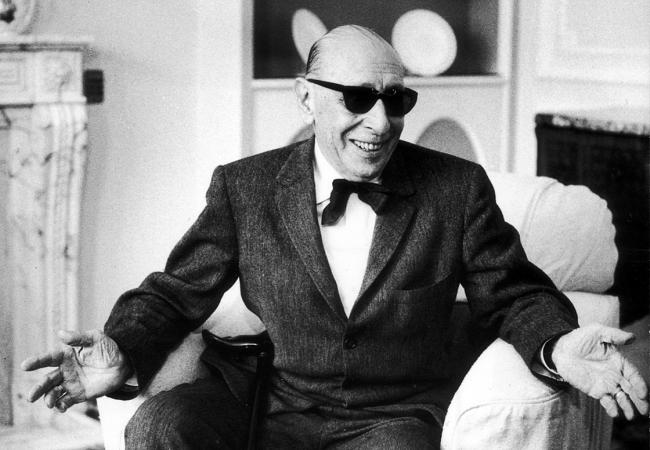
    And contrary to his many somber portraits and photographs, Schoenberg could indeed smile.

    We’ll hear arrangements of music by Johann Strauss II and Johann Sebastian Bach, a cello concerto freely adapted from a harpsichord piece by 18th century composer Georg Matthias Monn, and, since Schoenberg regarded himself as the artistic heir of Johannes Brahms, a German folk song setting – directed by Pierre Boulez, no less!

    We’re coming up on the 29th anniversary of my professional radio debut on September 28, 1995 (having honed my craft in the bush league of community radio for 9 years before that), so I thought I’d conclude with a Schoenberg cabaret song I programmed on that very first morning. The text is by none other than Emanuel Schikaneder, Mozart’s librettist for “The Magic Flute.”

    It’s Schoenberg for people who think they don’t like Schoenberg on “Sweetness and Light,” this Saturday morning at 11:00 EDT/8:00 PDT, exclusively on KWAX, the radio station of the University of Oregon!

    Stream it wherever you are at the link:

    https://kwax.uoregon.edu/


    Since yesterday’s post for Schoenberg’s actual birthday got no love, here it is again:

    https://www.facebook.com/photo?fbid=1381350726117320&set=a.883855802533484

    Then sample some Schoenberg paintings and drawings:

    https://www.schoenberg.at/index.php/en/schoenberg-2/bildnerischeswerk

    Schoenberg speaks (one of many such files on YouTube):


    PHOTOS (counterclockwise from top): Schoenberg on cello, horsing around with musician friends (including violinist Fritz Kreisler); with Charlie Chaplin; smiling with his daughter; and ready for a match (possibly with his frequent tennis partner, George Gershwin)

  • Schoenberg’s Ironic 150th Birthday

    Schoenberg’s Ironic 150th Birthday

    Even those who don’t enjoy his music will surely appreciate the irony that Arnold Schoenberg, whose twelve-tone method of composition continues to strike fear in the hearts of many, himself dreaded the number 13.

    Not only did his triskaidekaphobia likely hasten his demise – the superstitious Schoenberg died on Friday, July 13, 1951, at the age of 76 (he had been out of sorts all year, as his astrologer had alerted him that 7 + 6 = 13) – the irony is compounded, as today the world marks the sesquicentennial of his birth, on yet another Friday the 13th.

    Winston Churchill’s assessment of Russia in 1939 could just as easily have been applied to this most influential composer of the 20th century. Schoenberg was a riddle, wrapped in a mystery, inside an enigma – a man cloaked in irony and contradiction.

    For one thing, his very name, “Schoenberg,” translates as “beautiful mountain,” yet those who would characterize his music as such are distinctly in the minority.

    He was the greatest prophet of dodecaphonic music, yet he claimed an artistic kinship with Johannes Brahms.

    He preached the death of tonality, even as he orchestrated his share of Viennese operettas and arranged Strauss waltzes for performance by his friends.

    He was a Jew, who converted to Lutheranism, but swung back hard to Judaism, in defiance of Hitler.

    He was probably the least “popular” composer in the world, but his tennis partner was none other than George Gershwin. The two also shared a love of painting.

    Adding to this beautiful mountain of contradictions, Schoenberg, like that other titan of 20th century music, Igor Stravinsky, wound up living in Hollywood.

    Both men were suspicious of the movies (and each other), yet both were hoping to break into films. Stravinsky wrote cues for “The Song of Bernadette,” “Jane Eyre,” and “The North Star” (the latter ultimately scored by Copland). None of his music was used in the pictures – Stravinsky was too slow and demanded too much money – but some of it was recycled in his concert works.

    Likewise, Schoenberg was courted for a film adaptation of “The Good Earth,” but his proposed $50,000 fee put an end to that.

    Twelve-tone music did eventually make it into the movies, thanks to composers like Leonard Rosenman and David Raksin. Rosenman’s landmark score for “The Cobweb” (1955) is credited as the first predominantly twelve-tone score written for a motion picture. Raksin, the composer of “Laura,” also employed a tone row in the Edgar Allan Poe mystery, “The Man with a Cloak” (1951).

    Interestingly, Schoenberg, the creator of “Pierrot Lunaire” and “Moses und Aaron,” was also a great fan of Hopalong Cassidy. Like Walt Whitman, an admittedly strange comparison, Schoenberg contained multitudes.

    13 cheers for Arnold Schoenberg on the sesquicentennial of his birth!


    “Variations for Orchestra,” conducted by Bruno Maderna

    “Pierrot Lunaire”

    With goats!

    A kinder, gentler Schoenberg – the Suite for String Orchestra, given its premiere in Los Angeles in 1935:

    Schoenberg in home movies – on the tennis court, naturally – with Gershwin and others. (Gershwin appears around 2:20.)

    Still think Schoenberg’s not your bag? Put aside your trepidation and join me for an hour of his lighter music on “Sweetness and Light,” this Saturday morning at 11:00 EDT/8:00 PDT, on KWAX. Stream it wherever you are at the link!

    https://kwax.uoregon.edu/

  • Casals & His Composer Friends on The Lost Chord

    Casals & His Composer Friends on The Lost Chord

    He put his career on hold to stand up to Franco. He rediscovered the Bach cello suites. He played for Queen Victoria and John F. Kennedy. He founded the Prades Festival. He established the Puerto Rico Symphony and Conservatory. He gave master classes, conducted and recorded at Marlboro. He was even a talented composer.

    Pablo Casals was a giant of an artist and of a man. Is it any wonder so many of his colleagues were moved to write music for him?

    This week on “The Lost Chord,” we’ll hear works dedicated to Casals by three of his composer friends and colleagues.

    Ralph Vaughan Williams wrote his seldom-heard “Fantasia on Sussex Folk Tunes” around the time he was at work on his Piano Concerto and “Job: A Masque for Dancing.” Casals performed the piece in 1930. It was not heard again until 1983, the year of its world-premiere recording (featuring Julian Lloyd Webber). The composer later undertook a full-scale concerto for Casals. It was never completed, but the sketches for its slow movement were realized for a 2010 performance at the BBC Proms, under the title “Dark Pastoral.”

    Donald Francis Tovey, who would achieve fame as a musicologist, composed quite a lot of music himself, most of it now forgotten. In 1935, he wrote a concerto for Casals. At nearly an hour in length, the work may be the longest cello concerto ever written.

    In 1912, Tovey was a houseguest of Casals and cellist Guilhermina Suggia, at their summer home at Playa San Salvador on the Mediterranean coast. There, he played tennis, swam, and performed chamber music with the likes of Enrique Granados and Mieczyslaw Horszowski. He also made great strides on his opera, “The Bride of Dionysus.” As a show of thanks, he composed for his hosts a Sonata for Two Cellos in G major, which became part of the evenings’ entertainments. The work’s second movement is a set of variations on a Catalan folk song. We’ll hear it performed by Marcy Rosen and Frances Rowell, from a Bridge Records, Inc. release.

    Finally, Arnold Schoenberg, himself an amateur cellist, had done editorial work on three pieces by the 18th century composer Georg Matthias Monn, for inclusion in the publication “Monuments of Music in Austria.” When Casals invited Schoenberg to conduct his orchestra in Barcelona, the composer set about arranging a “new” concerto, based upon a harpsichord work by Monn, written in 1746. We’ll hear Schoenberg’s transformation of the piece performed by Yo-Yo Ma.

    Pau takes a bow! I hope you’ll join me for “Casals’ Pals” – music written for Pablo Casals by notable composer friends and colleagues – on “The Lost Chord,” now in syndication on KWAX, the radio station of the University of Oregon!


    Remember, KWAX is on the West Coast, so there’s a three-hour difference for the Trenton-Princeton area. Here are the respective air-times of my recorded shows (with East Coast conversions in parentheses):

    PICTURE PERFECT, the movie music show – Friday on KWAX at 5:00 PACIFIC TIME (8:00 PM EDT)

    THE LOST CHORD, unusual and neglected rep – Saturday on KWAX at 4:00 PACIFIC TIME (7:00 PM EDT)

    Stream them here!

    https://kwax.uoregon.edu/

  • Schoenberg’s Feud with Stravinsky & Hidden Passions

    Schoenberg’s Feud with Stravinsky & Hidden Passions

    He played tennis with Gershwin. He adored Hopalong Cassidy. He feared the number 13.

    That’s right, kids! It’s Arnold Schoenberg’s birthday!

    In common with many composers who fled political unrest in Europe, Schoenberg settled in Los Angeles. He was outspoken about his dislike of many of his contemporaries. Igor Stravinsky, similarly catty, lived only a few miles away. Earlier in their careers, they were on friendly, or at least cordial terms (by Schoenberg and Stravinsky standards), but after 1925, when Schoenberg wrote a “nasty verse” (according to Stravinsky) and set it as a canon, the friendship cooled. For his part, Stravinsky told the press that he viewed Schoenberg as more of a chemist than an artist. Their contempt for one another never mellowed, and the trash talk flowed.

    This is from Schoenberg’s “Three Satires.” “Vielseitigkeit” (“Versatility”) is a palindromic canon. It can be performed front to back or back to front by inverting the music and reading it backwards. Igor is savaged as “kleine Modernsky.”

    “But who’s this beating the drum?
    Why, it’s little Modernsky!
    He’s had his hair cut in an old-fashioned queue,
    And it looks quite nice!
    Like real false hair!
    Like a wig!
    Just like (or so little Modernsky likes to think)
    Just like Papa Bach!”

    Meow, boys!

    After Schoenberg’s death, Stravinsky apparently developed an interest in “chemistry,” as he began to assimilate Schoenberg’s twelve-tone system of composition into his later works.

    This one, “Requiem Canticles,” was given its first performance at Princeton’s McCarter Theater on October 8, 1966. In attendance were Aaron Copland and J. Robert Oppenheimer. Afterward, Oppenheimer requested that the piece be played at his funeral. The request would be honored only four months later. The “Requiem Canticles” would also be performed at Stravinsky’s funeral in Venice in 1971.

    Ironically, Stravinsky and Schoenberg shared a disciple in Robert Craft, who conducted this recording. Craft championed both composer’s music and apparently was accepted in both camps.

    I wonder if Schoenberg ever met Rachmaninoff? Now that would be a scowling contest I would pay to see.


    PHOTOS: Showboat Stravinsky and scowly Schoenberg

  • Friday the 13th Composer Bad Luck and Triskaidekaphobia

    Friday the 13th Composer Bad Luck and Triskaidekaphobia

    Suffering from triskaidekaphobia? On this Friday the 13th, here are just a few composers who were afflicted with extraordinarily bad luck.

    Jean-Baptiste Lully, also an accomplished dancer, injured his toe while pounding the floor with a heavy stick to mark time; the resultant infection killed him.

    Anton Webern violated curfew when he snuck out on his porch for a smoke and was shot by an American soldier.

    Ernest Chausson lost control of his bicycle and fatally slammed into a brick wall.

    Fire tore through Geirr Tveitt’s cabin and destroyed four-fifths of his compositional output, driving him to alcoholism.

    Friedrich Kuhlau blinded himself when he fell on a bottle at the age of seven; later, he died of complications after being left out in the cold all night as his house burned to the ground.

    Charles-Valentin Alkan was reaching for a copy of the Talmud, located on a high shelf, when his bookcase toppled, crushing him.

    Henry Purcell developed pneumonia after his wife locked him out of the house for coming home late after one too many pub crawls.

    Alexander Scriabin died of a septic carbuncle.

    Tchaikovsky drank cholera-contaminated water.

    Jean-Marie Leclair was found murdered in his room.

    Alessandro Stradella was set upon by unidentified assassins.

    None of these misfortunes occurred on Friday the 13th.

    On the other hand, Arnold Schoenberg, a notorious triskaidekaphobe, died on his 76th birthday, Friday the 13th, 1951. Earlier in the day, he had been informed by his astrologer that 7 plus 6 equals… 13.

    Paraskevidekatriaphobia – derived from the Greek words “paraskevi” (Friday) and “dekatria” (thirteen), with “-phobia” appended as a suffix to indicate “fear,” was coined in the early ‘90s by American psychotherapist Dr. Donald E. Dossey. He wryly remarked that when you’re able to pronounce the word, you’re cured.

    In the meantime, don’t open any umbrellas indoors and try not to walk under any ladders. I’ll check in to see how your day went tomorrow.

    BONUS! Giuseppe Verdi and the Evil Eye:

    https://www.classicfm.com/composers/verdi/guides/verdis-curse-evil-eye/

Tag Cloud

Aaron Copland (92) Beethoven (95) Composer (114) Film Music (120) Film Score (143) Film Scores (255) Halloween (94) John Williams (185) KWAX (229) Leonard Bernstein (100) Marlboro Music Festival (125) Movie Music (135) Opera (198) Philadelphia Orchestra (88) Picture Perfect (174) Princeton Symphony Orchestra (106) Radio (87) Ralph Vaughan Williams (85) Ross Amico (244) Roy's Tie-Dye Sci-Fi Corner (290) The Classical Network (101) The Lost Chord (268) Vaughan Williams (103) WPRB (396) WWFM (881)

DON’T MISS A BEAT

Receive a weekly digest every Sunday at noon by signing up here


RECENT POSTS