Suffering from triskaidekaphobia? On this Friday the 13th, here are just a few composers who were afflicted with extraordinarily bad luck.
Jean-Baptiste Lully, also an accomplished dancer, injured his toe while pounding the floor with a heavy stick to mark time; the resultant infection killed him.
Anton Webern violated curfew when he snuck out on his porch for a smoke and was shot by an American soldier.
Ernest Chausson lost control of his bicycle and fatally slammed into a brick wall.
Fire tore through Geirr Tveitt’s cabin and destroyed four-fifths of his compositional output, driving him to alcoholism.
Friedrich Kuhlau blinded himself when he fell on a bottle at the age of seven; later, he died of complications after being left out in the cold all night as his house burned to the ground.
Charles-Valentin Alkan was reaching for a copy of the Talmud, located on a high shelf, when his bookcase toppled, crushing him.
Henry Purcell developed pneumonia after his wife locked him out of the house for coming home late after one too many pub crawls.
Alexander Scriabin died of a septic carbuncle.
Tchaikovsky drank cholera-contaminated water.
Jean-Marie Leclair was found murdered in his room.
Alessandro Stradella was set upon by unidentified assassins.
None of these misfortunes occurred on Friday the 13th.
On the other hand, Arnold Schoenberg, a notorious triskaidekaphobe, died on his 76th birthday, Friday the 13th, 1951. Earlier in the day, he had been informed by his astrologer that 7 plus 6 equals… 13.
Paraskevidekatriaphobia – derived from the Greek words “paraskevi” (Friday) and “dekatria” (thirteen), with “-phobia” appended as a suffix to indicate “fear,” was coined in the early ‘90s by American psychotherapist Dr. Donald E. Dossey. He wryly remarked that when you’re able to pronounce the word, you’re cured.
In the meantime, don’t open any umbrellas indoors and try not to walk under any ladders. I’ll check in to see how your day went tomorrow.
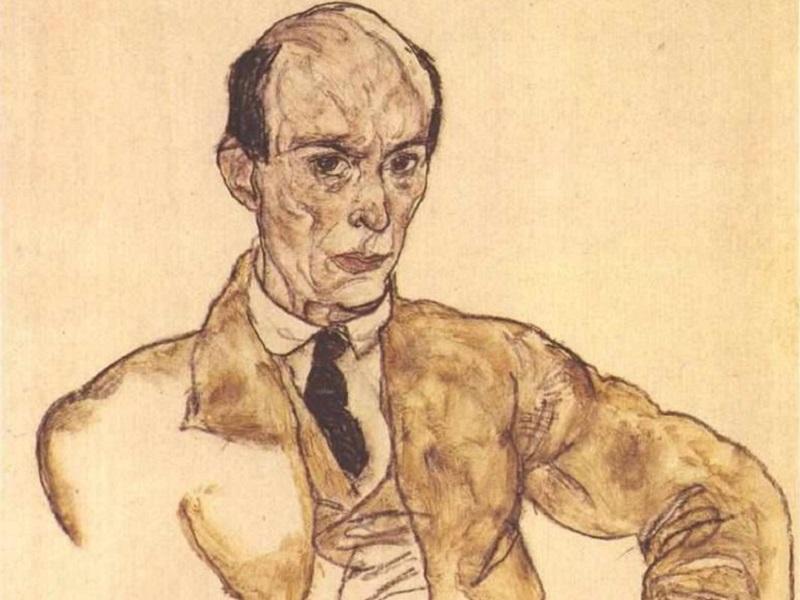
Okay, pointy heads! It’s back to school – the Second Viennese School – for the birthday of Arnold Schoenberg.
The dour high priest of twelve-tone music was full of surprises. I venture to guess that many would be nonplussed to learn that the greatest prophet of dodecaphonic music claimed artistic kinship with Johannes Brahms. But then, some conductors (notably Karajan and Solti) have tried to interpret him that way. Even so, he remains one of the most hated composers among concertgoers who prefer programs of unsullied Beethoven and Dvořák.
Schoenberg may have preached the death of tonality, but he composed at least three Romantic masterpieces, “Verklärte Nacht” (“Transfigured Night”), “Pelleas und Melisande,” and the opulent oratorio “Gurrelieder,” before venturing into Expressionism with works like his Chamber Symphony No. 1. In the meantime, he also orchestrated his share of Viennese operettas and arranged Strauss waltzes for performance by his friends.
By the time he came to America, Schoenberg was probably the least “popular” composer in the world (if one of the most influential), but at his new home in Los Angeles his tennis partner was none other than George Gershwin. The two also shared a love of painting.
Adding to this “beautiful mountain” of contradictions, Schoenberg, like that other titan of 20th century music, Igor Stravinsky, made a game attempt to break into films. He was courted to write music for the 1937 big screen adaptation of Pearl Buck’s “The Good Earth,” but his proposed fee of $50,000 put an end to that.
Schoenberg did once prophesy that one day “grocer’s boys would whistle serial music on their rounds.” Maybe he actually meant cereal music. While to my knowledge that has yet to pass, I did once catch myself walking down the street humming the Golden Calf music from “Moses und Aron.”
Happy birthday, Arnold Schoenberg!
Schoenberg remembers his friend, George Gershwin
Gershwin films Schoenberg
Schoenberg home movies (Gershwin appears at the 30-second mark)
Schoenberg in private
Schoenberg on Alban Berg
“Gurrelieder,” Part I (1900-03, 1910)
Chamber Symphony No. 1 (1909)
“Pierrot Lunaire” (1912)
“Variations for Orchestra” (1926-8), conducted by Bruno Maderna
“Moses und Aron” (1930-32), The Golden Calf
A kinder, gentler Schoenberg – the Suite for String Orchestra (1935)
TWELVE IMAGES FOR TWELVE TONES: As this gallery demonstrates, Schoenberg wasn’t always the grim, humorless figure his portraits would suggest (images identified when you click through)
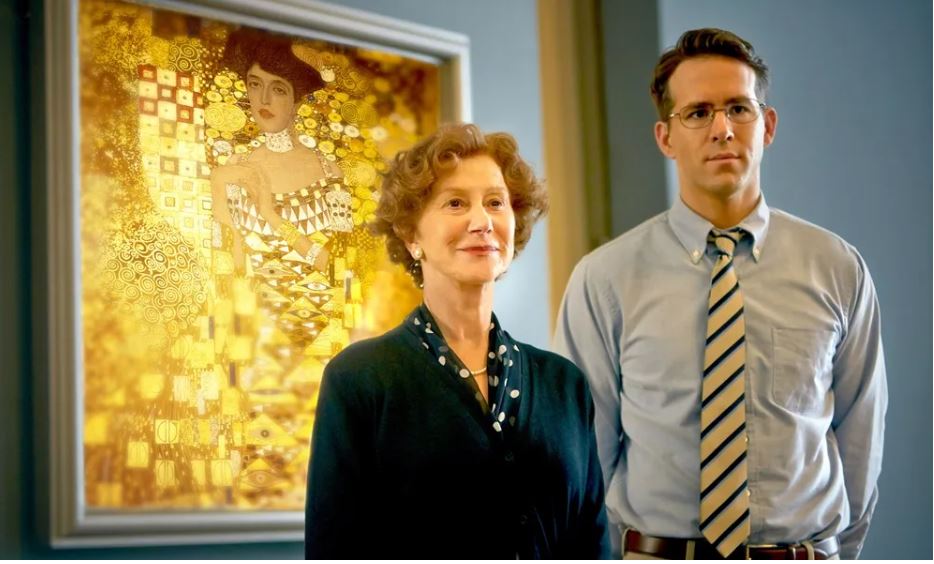
Would you believe Ryan Reynolds as Arnold Schoenberg’s grandson?
Another random discovery last night on Netflix: “Woman in Gold” (2015), a Helen Mirren film that somehow escaped my notice. Mirren plays Maria Altmann, an 82 year-old Jewish refugee living in Los Angeles in 1998, who fights to reclaim from the Belvedere Museum in Austria a portrait of her aunt, painted by none other than Gustav Klimt, that was stolen from her family sixty years earlier by the Nazis. Assisting her in her quest for justice is an untried underdog lawyer, played by Ryan, whose grandfather happened to be one of the 20th century’s most influential composers.
The painting in question was originally titled “Portrait of Adele Bloch-Bauer I,” more commonly known, both for simplicity’s sake and, for the Nazis, to hide the subject’s inconvenient ethnicity, as “Woman in Gold,” but described by one of the characters in the film as “The Mona Lisa of Austria.” Predictably, Austrian bureaucrats throw up any impediment they can to retain ownership of the painting.
Following the pattern of every rogue cop movie ever, young Schoenberg’s gruff boss (Charles Dance, who’s the actor you call for these things when Christopher Plummer is too busy) goes from bemused indulgence to forbidding him to pursue the case any further. In response, Schoenberg quits the firm and rides his scrappy gumption all the way to the Supreme Court – and beyond. Every time either he or Altmann are on the verge of throwing in the towel at the latest setback, they get one another riled up again and off they go.
The entire exercise is diverting enough for a slow evening when you’re not feeling particularly demanding, and it may get you thinking about injustices past and present, and the struggles for restitution for the survivors or descendants of families who lost everything, but I’m afraid on the whole the execution is rather TV movie-like.
All the traditional elements are in place; all the beats fall where expected – the very opposite, in fact, of Arnold Schoenberg’s music. There is lip-service paid to Schoenberg’s revolutionary twelve-tone method, but it’s telling that the only Schoenberg we actually hear is “Transfigured Night” – Schoenberg for people who think they don’t like Schoenberg. Tonal, romantic, and entirely movie-friendly. To compound the irony, the film’s unremarkable score is cranked out by Hans Zimmer and company.
Mirren is fine, as always, and I did get some enjoyment out of all the unexpected casting choices, as many familiar faces turn up, some for only a single scene – Charles Dance, Jonathan Pryce, Elizabeth McGovern, and Allan Corduner (who played Arthur Sullivan in Mike Leigh’s Gilbert & Sullivan homage “Topsy Turvy”). Katie Holmes has little to do as the crusading lawyer’s understandably concerned, but always supportive wife.
As for the lawyer himself, Schoenberg’s grandson, Reynolds does okay, especially when called on to be a fast-talker, but it’s hard to buy him as the actual real-life E. Randol Schoenberg. He has my respect for trying something different, I thought after the enormous success of “Deadpool.” But it turns out “Woman in Gold” was released the year before!
While we’re considering the timeline, the film is a Weinstein production, so I had to check the dates to see if Harvey’s recent woes may have had something to do with its comparative obscurity. But Weinstein’s sins didn’t really boomerang in a big way until 2017 – two years later. Then I thought maybe Covid had thrown a wrench in its distribution. Nope, that would have been 2020. Maybe I just wasn’t paying enough attention.
The director is Simon Curtis, whose credits include “My Week with Marilyn” (2011), for which Michelle Williams and Kenneth Branagh earned Oscar nominations for their portrayals of Marilyn Monroe and Laurence Olivier, respectively, and television adaptations of “Cranford” and “David Copperfield.” He also directed the most recent “Downton Abbey” movie. Ah, so he’s actually married to McGovern!
In the end, “Woman in Gold” is not much better than a by-the-numbers courtroom drama in which justice is inevitably served. (If you think that’s a spoiler, it’s recent history and the outcome has graced many a headline.) There are some lovingly shot Klimts, beside the predictable outrages, once the Nazis march into Austria, and also some fleeting suspense. Closer to the present, there’s the infuriatingly smug Austrians on the board of the Belvedere Museum who stand between Altmann and her stolen property. The film is well-intentioned, but winds up being fairly anodyne. Good for undemanding viewers who enjoy the kind of easy fuzzies you get from watching a Penny Marshall or Rob Reiner movie.
All told, it was definitely better than “Orca.”
A couple of parodies that actually hold Schoenberg in greater affection:
Poor Alexander Zemlinsky. Unlucky in love with Alma Schindler, later the wife of Gustav Mahler (among others), and overshadowed professionally by his pupil (and one-time brother-in-law) Arnold Schoenberg. On the 150th anniversary of his birth, he remains fin de siècle Vienna’s great musical outlier.
Zemlinsky is yet another very interesting composer whose profile has risen somewhat thanks to recordings. In particular, he received a boost during the compact disc era, a time when the market became oversaturated with endless duplications of the standard repertoire, and producers scrambled to exhume accessible music lurking at the fringes.
In himself, Zemlinsky was a remarkable talent. He studied theory with Robert Fuchs and composition with Anton Bruckner. Early on, he received support from Johannes Brahms. Later, he met Schoenberg, to whom he gave lessons in counterpoint. He was the only formal teacher Schoenberg ever had. Interestingly, he was also mentor to Erich Wolfgang Korngold, who went from toast-of-Vienna musical wunderkind to seminal Hollywood film composer.
Like just about everyone else, Zemlinsky became embroiled in a torrid love affair with Alma Schindler. He even proposed marriage. Alma seemed keen on the idea at first but was soon dissuaded by family and peers. Gustav Mahler became a champion of Zemlinsky’s music, despite the fact that both men happened to love the same woman.
By his own assessment, Zemlinsky was not an attractive man, and perhaps there was something autobiographical in his decision to set Oscar Wilde’s short story “The Birthday of the Infanta” as an opera, which he titled “The Dwarf.” (SPOILER ALERT: The Dwarf is spurned and dies of a broken heart.)
Zemlinsky is probably best known for his “Lyric Symphony,” for vocal soloists and orchestra, on texts of Rabindranath Tagore, and the large-scale symphonic poem “The Mermaid,” after Hans Christian Andersen.
However, I have always been partial to this early Symphony in B-flat, written in the shadow of Brahms and Dvořák:
The Clarinet Trio, Op. 3, frequently performed as a piano trio (with a viola taking the clarinet part)
“The Mermaid”
A recent performance of the “Lyric Symphony”:
Happy sesquicentenary, Alexander Zemlinsky!
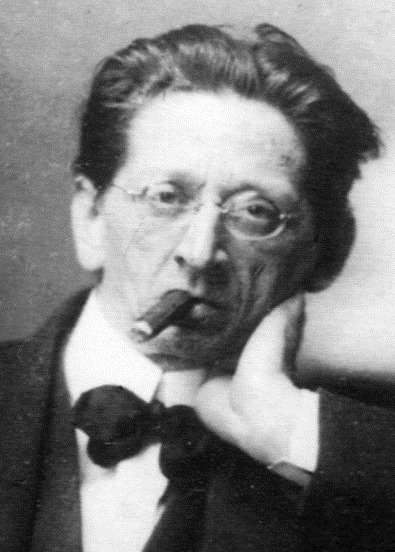
PHOTO: Zemlinsky smokes the sourest cigar in the world
He put his career on hold to stand up to Franco. He rediscovered the Bach cello suites. He played for Queen Victoria and John F. Kennedy. He founded the Prades Festival. He established the Puerto Rico Symphony and Conservatory. He gave master classes, conducted and recorded at Marlboro. He was even a talented composer.
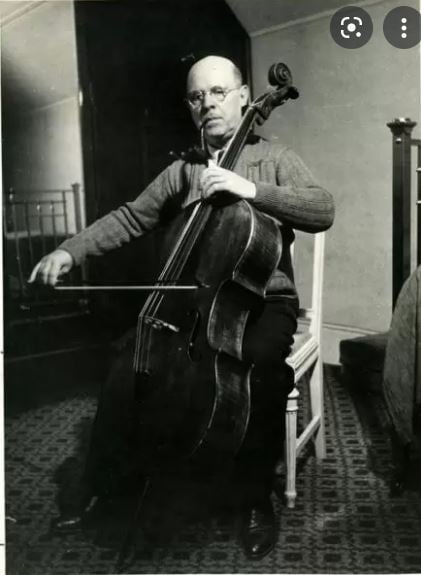
Pablo Casals was a giant of an artist and of a man. Is it any wonder so many of his colleagues were moved to write music for him?
This Sunday night on “The Lost Chord,” we’ll hear works dedicated to Casals by three of his composer friends and colleagues.
Ralph Vaughan Williams wrote his seldom-heard “Fantasia on Sussex Folk Tunes” around the time he was at work on his Piano Concerto and “Job: A Masque for Dancing.” Casals performed the piece in 1930. It was not heard again until 1983, the year of its world-premiere recording (featuring Julian Lloyd Webber). The composer later undertook a full-scale concerto for Casals. It was never completed, but the sketches for its slow movement were realized for a 2010 performance at the BBC Proms, under the title “Dark Pastoral.”
Donald Francis Tovey, who would achieve fame as a musicologist, composed quite a lot of music himself, most of it now forgotten. In 1935, he wrote a concerto for Casals. At nearly an hour in length, the work may be the longest cello concerto ever written.
In 1912, Tovey was a houseguest of Casals and cellist Guilhermina Suggia, at their summer home at Playa San Salvador on the Mediterranean coast. There, he played tennis, swam, and performed chamber music with the likes of Enrique Granados and Mieczyslaw Horszowski. He also made great strides on his opera, “The Bride of Dionysus.” As a show of thanks, he composed for his hosts a Sonata for Two Cellos in G major, which became part of the evenings’ entertainments. The work’s second movement is a set of variations on a Catalan folk song. We’ll hear it performed by Marcy Rosen and Frances Rowell, from a Bridge Records, Inc. release.
Finally, Arnold Schoenberg, himself an amateur cellist, had done editorial work on three pieces by the 18th century composer Georg Matthias Monn, for inclusion in the publication “Monuments of Music in Austria.” When Casals invited Schoenberg to conduct his orchestra in Barcelona, the composer set about arranging a “new” concerto, based upon a harpsichord work by Monn, written in 1746. We’ll hear Schoenberg’s transformation of the piece performed by Yo-Yo Ma.
Pau takes a bow! I hope you’ll join me for “Casals’ Pals” – music written for Pablo Casals by notable composer friends and colleagues – this Sunday night at 10:00 EDT, on WWFM – The Classical Network and wwfm.org.