Tag: Arnold Schoenberg

  • Schoenberg’s Serenade: Tradition & Tone

    Schoenberg’s Serenade: Tradition & Tone

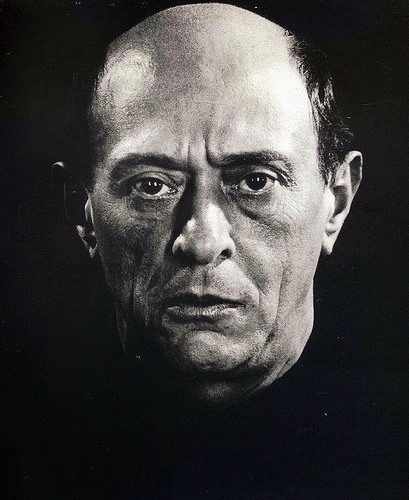
    Don’t call him revolutionary. He didn’t care for that. Arnold Schoenberg did not see himself as a troublemaker. Rather, if you could bring yourself to ask him, he might have described himself as a traditionalist who was merely extending the legacy of an inherited past. Then he might have painted your portrait or challenged you to a game of tennis.

    On this week’s “Music from Marlboro,” we’ll hear Schoenberg’s Janus-like Serenade, Op. 24. Sure, the Serenade contains the first published example of Schoenberg’s twelve-tone method to employ multiple instruments (and human voice): a setting of Petrarch’s Sonnet No. 217, according to the composer, always so concerned with precision. In actuality, it’s the Sonnet No. 256, if we’re to go by the standard Italian edition of the poet’s works, but who’s counting?

    The other five movements push tonality beyond the breaking point, true, but they are not “twelve-tone.” If you find yourself hanging on by your fingernails at the seeming lack of identifiable landmarks, it might be better for you to just let go and allow all the colors to wash over you. Schoenberg employs, in addition to a vocal basso in the three-minute Petrarch setting, B-flat and bass clarinets, mandolin, guitar, violin, viola, and cello.

    The composer looks back to classical form through the use of repetitions in the opening “March,” the second movement “Minuet,” and the fifth movement “Dance Scene.” There is also a seeming affirmation of the past through the deliberate choice of Petrarch as a source of inspiration for the fourth movement “Sonnet.” The third movement is a set of “Variations,” and the sixth a “Song (without Words).” A “Finale” caps the piece,” which, by Schoenberg standards, is fairly light and easygoing.

    We’ll hear a performance from the 1966 Marlboro Music Festival, with Leon Kirchner directing the ensemble. Coincidentally, today is Kirchner’s birthday.

    To round off the hour, we’ll also have a delightful work by Wolfgang Amadeus Mozart – his Sonata in B-flat for Bassoon and Cello, K. 292. The 1975 performance will feature bassoonist Alexander Heller and a 19 year-old cellist named Yo Yo Ma.

    Ma plays Mozart, and we take a shine to Schoenberg, on the next “Music from Marlboro,” this Wednesday evening at 6:00, on WWFM – The Classical Network and wwfm.org.

    Marlboro School of Music and Festival: Official Page


    Arnold Schoenberg: music’s menace loved his tennis
  • Music for Casals Giants Among Friends

    Music for Casals Giants Among Friends

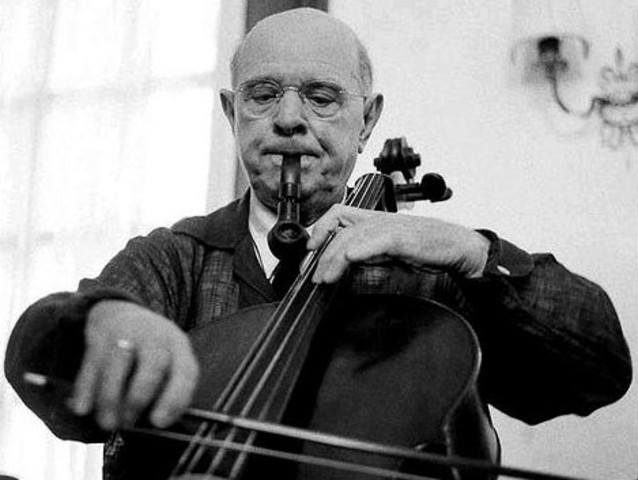
    It’s hardly surprising that anyone would be moved to write music for Pablo Casals. Regarded by many as the greatest cellist of his time, perhaps ever, he was certainly a giant-of-an-artist, and of a man. Born in Catalonia, he stood up to the Franco regime, entering into self-imposed exile and refusing to perform in countries that recognized Franco’s authority. He rediscovered the Bach cello suites in a secondhand bookshop and made them famous. Over the span of his career, he played for both Queen Victoria and John F. Kennedy.

    As a conductor and administrator, he founded the Prades Festival and the Casals Festival. He established the Puerto Rico Symphony and the Conservatory of Music in Puerto Rico. He gave master classes, conducted and recorded at Marlboro. He was even a talented composer.

    This Sunday night on “The Lost Chord,” we’ll hear three works written for Casals by his notable friends and colleagues.

    Ralph Vaughan Williams wrote his seldom-heard “Fantasia on Sussex Folk Tunes” around the time he was at work on his Piano Concerto and “Job: A Masque for Dancing.” Casals performed the piece in 1930. It was not heard again until 1983, the year of its world-premiere recording (featuring Julian Lloyd Webber). The composer later undertook a full-scale concerto for Casals. It was never completed, but the sketches for its slow movement were realized for a 2010 performance at the BBC Proms, under the title “Dark Pastoral.”

    Donald Francis Tovey, who would achieve fame as a musicologist and writer on music, wrote quite a lot of music himself, most of it now forgotten. In 1935, he composed a concerto for Casals. At nearly an hour in length, the work may be the longest cello concerto ever written.

    In 1912, Tovey was a houseguest of Casals and cellist Guilhermina Suggia, at their summer home at Playa San Salvador on the Mediterranean coast. There, he played tennis, swam and performed chamber music with the likes of Enrique Granados and Mieczyslaw Horzsowski. He also made great strides on his opera, “The Bride of Dionysus.” As a show of thanks, he composed for his hosts a Sonata for Two Cellos in G major, which became part of the evenings’ entertainments. The work’s second movement is a set of variations on a Catalan folk song. We’ll hear it performed by Marcy Rosen and Frances Rowell, from a Bridge Records, Inc. release.

    Finally, Arnold Schoenberg, himself an amateur cellist, had done editorial work on three pieces by the 18th century composer Georg Matthias Monn for inclusion in the publication “Monuments of Music in Austria.” When Casals invited Schoenberg to conduct his orchestra in Barcelona, the composer set about arranging a “new” concerto, based upon a harpsichord work by Monn, written in 1746. We’ll hear Schoenberg’s transformation of the piece performed by Yo-Yo Ma.

    Join me for “Casals’ Pals” – music written for Casals by notable composers, friends and colleagues – this Sunday night at 10 EDT, on WWFM – The Classical Network and at wwfm.org.

  • Schoenberg Innovator at WWFM

    Schoenberg Innovator at WWFM

    He was a painter, a lover of tennis, and a composer of light-hearted cabaret songs. Oh yes! And he also developed the twelve tone technique, which has intrigued musicians and alienated listeners ever since. We’ll peck around his diverse output this afternoon, between noon and 4 p.m. EDT, and try not to frighten the horses too much, on this, Arnold Schoenberg’s birthday, on WWFM – The Classical Network and at wwfm.org.

  • Strauss Disses Schoenberg Winter of Discontent

    Strauss Disses Schoenberg Winter of Discontent

    Richard Strauss being catty about Schoenberg (snow-related).

  • Schoenberg’s Christmas Music Surprise

    Schoenberg’s Christmas Music Surprise

    Arnold Schoenberg wrote Christmas music? If you’re an early riser, you’ll get to hear his “Weihnachtsmusik,” a delightful work based on German Christmas carols. It will be the first of a morning full of stocking stuffers, as we listen to five hours of music for the season.

    There will be serene choral music, contemporary settings of some very old texts, abundant sleigh bells, boar’s head carols, Christmas songs sung by some of the great voices, and music inspired by the writings of Charles Dickens (and perhaps not the ones you think).

    Join me for a Christmas pudding and “Partridge Pie” (literally, Richard Rodney Bennett’s take on “The Twelve Days of Christmas”) this morning from 6 to 11 ET, on WPRB 103.3 FM and at wprb.com. We’ll be stringing a garland of cranberries and popcorn – and you won’t have to worry about pricking your fingers – on Classic Ross Amico.

Tag Cloud

Aaron Copland (94) Beethoven (95) Composer (114) Film Music (151) Film Score (143) Film Scores (255) Halloween (103) John Williams (198) KWAX (233) Leonard Bernstein (105) Marlboro Music Festival (125) Movie Music (166) Mozart (91) Opera (217) Philadelphia Orchestra (91) Picture Perfect (174) Princeton Symphony Orchestra (110) Radio (90) Ross Amico (244) Roy's Tie-Dye Sci-Fi Corner (290) The Classical Network (101) The Lost Chord (269) Vaughan Williams (107) WPRB (397) WWFM (881)

DON’T MISS A BEAT

Receive a weekly digest every Sunday at noon by signing up here


RECENT POSTS