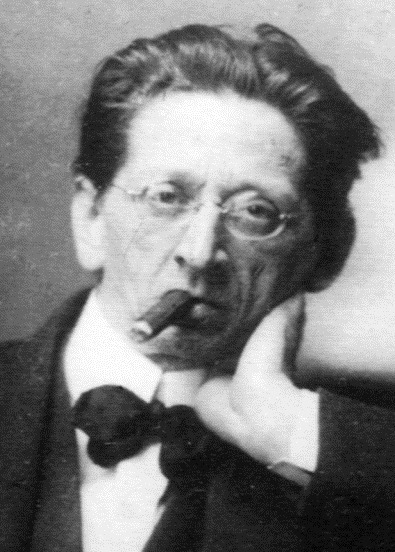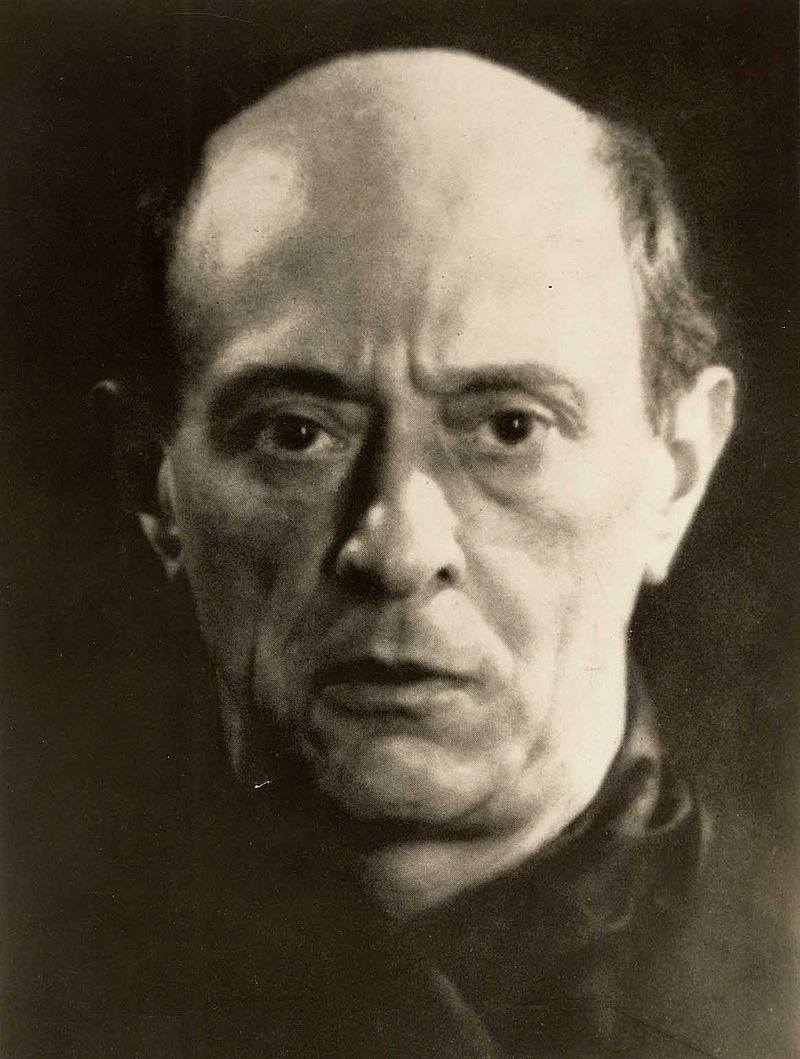
Today is the birthday of dodecaphonic icon Arnold Schoenberg (1874-1951). Schoenberg, who was born Jewish, converted to Protestant Christianity in 1898 – not, as might be assumed, for professional reasons or in an attempt to assimilate, but because of a nagging spiritual hunger.
He formally converted back to Judaism in defiance of the National Socialists, who came to power in 1933. He was on vacation in France, when he was warned that it would dangerous for him to return to Germany. He reclaimed membership in the Jewish faith in a Paris synagogue. Schoenberg was summarily denounced by the Nazis as a Jew and an exponent of degenerate art. He was dismissed from his post at the Prussian Academy of Letters, where he had taught since 1925.
Unbowed, he drafted a “Four-Point Program for Jewry,” calling for a united Jewish party and the creation of an independent Jewish state. He emigrated to the United States, eventually settling in Los Angeles, where he taught at U.C.L.A.
Throughout his career, Schoenberg produced a number of works on Jewish themes, including his opera “Moses und Aron” (which he worked at between 1930 and 1932, before his second conversion). In 1938, the year of Kristallnacht, he composed a setting of “Kol Nidre.” And in 1947, he wrote “A Survivor from Warsaw.” He also worked at an oratorio, “Die Jakobsleiter,” between 1917 and 1922.
Even through his period of religious experimentation, Schoenberg always identified as a Jew. It’s not quite Yom Kippur yet, but here is his “Kol Nidre.”
Happy birthday, Arnold Schoenberg.