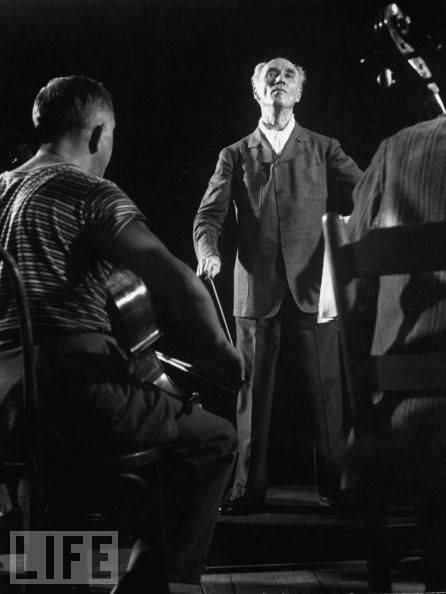
Born in New York City to German immigrant parents, Karl Krueger’s sympathies were never far from the American heartland. He served as artistic director and principal conductor of the newly founded Kansas City Symphony from 1933 to 1943, and his greatest legacy lay in a series of pioneering recordings he set down for the Society for the Preservation of American Musical Heritage.
His father wanted him to be lawyer, but the pull of music was too strong. Krueger studied in Vienna with Robert Fuchs and became the assistant of conductor Arthur Nikisch. Nikisch referred him to Franz Schalk, conductor of the Vienna State Opera. Krueger was appointed assistant conductor to the Opera and the Vienna Philharmonic. Schalk proclaimed, “I have no doubt that he will play an important role among the leading orchestral conductors of his time.”
Though he served as principle conductor of the Seattle Symphony, from 1926 to 1932, as music director of the Detroit Symphony Orchestra, from 1943 to 1949, and was invited back to guest conduct the Vienna Philharmonic, Krueger’s name is largely unrecognized today, beyond the sphere of collectors.
This Sunday night on “The Lost Chord,” we’ll listen to recordings Krueger made for the society he established in 1958. Its purpose was to document and promote works by neglected American composers, at the time little more than footnotes in our music history books. Significantly, the records were first distributed to libraries, rather than being made available for purchase through retailers. A number of the recordings have been reissued over the years by The Library of Congress. More recently, some have appeared on the Bridge Records, Inc. label.
Leave it to Krueger to unearth the most interesting work by Horatio Parker. Parker, the hidebound teacher and aesthetic nemesis of Charles Ives, wrote two symphonic poems, both of which were recorded by Krueger. Wholly unexpected is Parker’s treatment of “Vathek,” the early gothic novel by William Beckford. The novel blends elements of the supernatural, excess, and immorality in an Oriental setting.
Arthur Farwell, best remembered for his work inspired by Native American sources, wrote incidental music in 1916 for a play by Lord Dunsany, called “The Gods of the Mountain.” The work is another piece of Orientalism, in this case about a band of beggars who impersonate a city’s stone gods and partake of much sensual indulgence, until the real gods return and change the impostors to stone. In a final twist, the inhabitants of the city take the transformation of the beggars as verification of their status as genuine gods.
Finally, we’ll hear music by Arthur Foote, who has fared better than some other American composers of his era. His rarely-heard work from 1900, “Four Character Pieces after the Rubaiyat of Omar Khayyam,” is drawn from a piano cycle he composed the previous year. It was given its first performance by the Chicago Symphony, under the direction of Frederick Stock.
By the end of its run, Krueger’s Society had issued over 100 LPs of American music, with some of the repertoire dating as far back as the 18thcentury. Karl Krueger died in Illinois in 1979 at the age of 85.
Join me for “Pioneer Spirit” – landmark recordings by Karl Krueger – this Sunday night at 10 EDT, on WWFM – The Classical Network and at wwfm.org.
Leave a Reply to Få ersättning för din defekta bil direktCancel reply