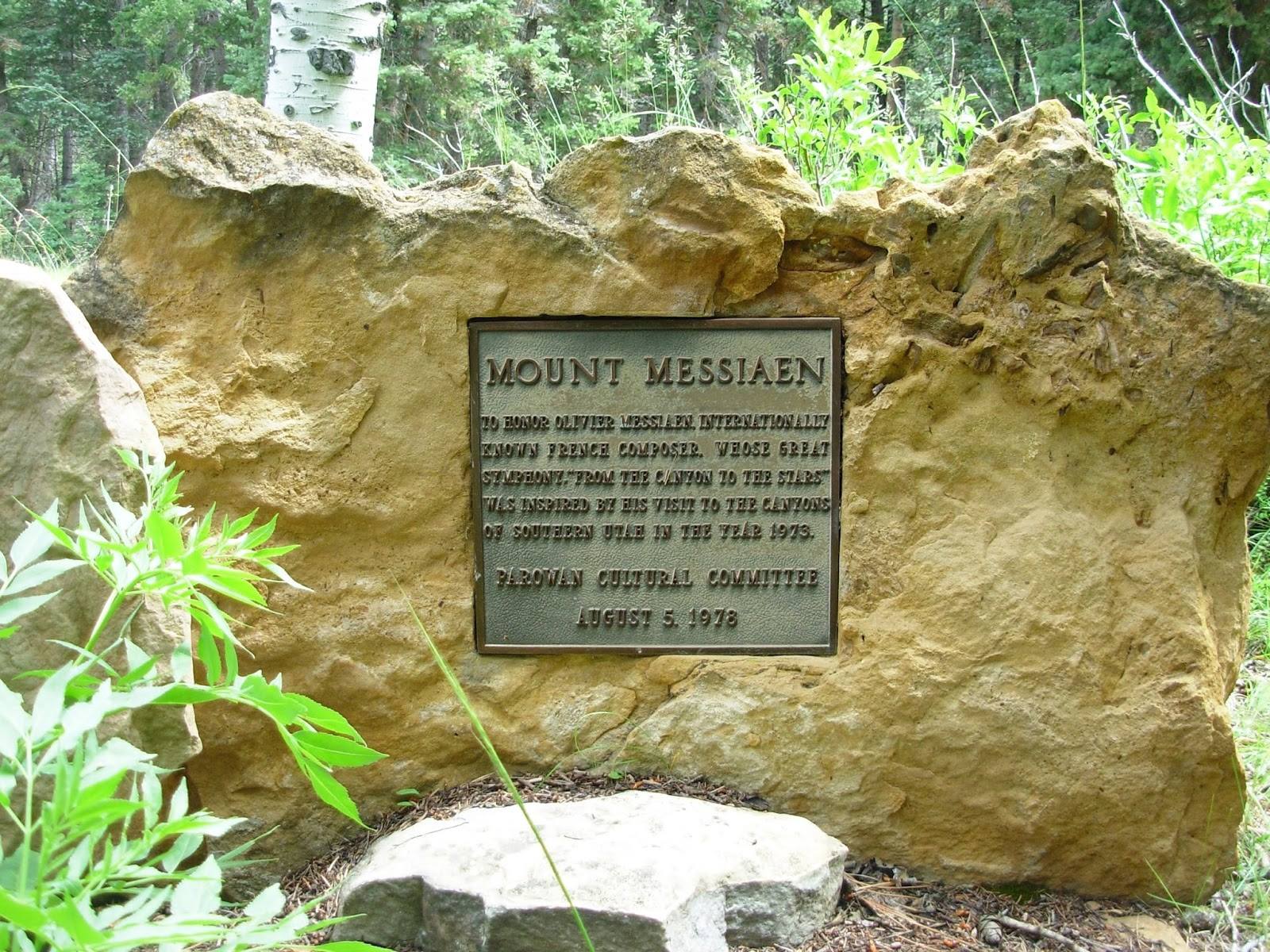
If the mountain will not come to Messiaen, then Messiaen must go to the mountain. Unusually, in this instance, both came to pass.
On this date in 1978, the White Cliffs of southern Utah, formerly known as Lion’s Peak, were renamed by the citizens of Parowan “Mount Messiaen,” in honor of the French composer, who had traveled to Utah in 1973 to lay the groundwork for his sprawling vista in sound, “Des canyons aux étoiles…” (“From the canyons to the stars…”). The work, which spans a good 90 to 100 minutes in performance, had been commissioned for the impending bicentennial of American independence.
Messiaen was inspired by the natural wonders of the region – its landscape, birdsong and night skies – but most particularly the colorful Bryce Canyon, which played to his sense of synaesthesia (cognitive perception of color in sound). Messiaen regarded it as the most mystical landscape he had ever encountered.
When asked if it would be all right to dedicate something in his honor, as a token of thanks, the composer thought perhaps a nature trail was in the offing. In the event, a bronze plaque was cast and a sandstone monument erected at the foot of the mountain, and the governor declared August 5 “Olivier Messiaen and the Beauty of Southern Utah Day.” The composer was unable to attend the dedication ceremony and concert. However, he had gone to the mountain, and the mountain had come to him.
Photos of Mount Messiaen:
http://kellyricks.blogspot.com/2015/07/mt-messiaen.html
The music:
Leave a Reply