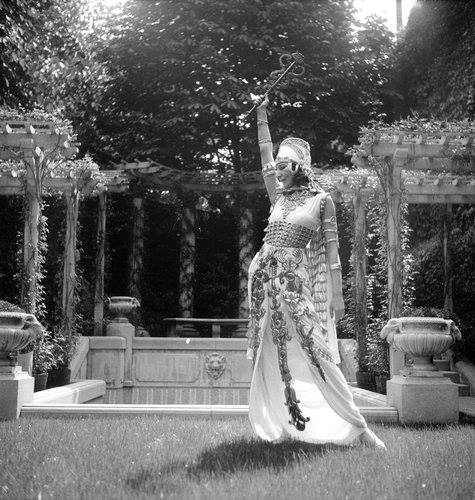
The actor and dancer Ida Rubinstein specialized in strong, often sultry heroines. A remarkable figure, this sugar heiress from a family of Ukrainian Orthodox Jews essentially willed herself onto the Parisian stage, where her acting ability and natural magnetism more than compensated for her limited ability as a dancer.
She was welcomed into the Ballets Russes in 1909, where she assumed the roles of Cleopatra and Scheherazade. Later, for her own company, she introduced Ravel’s “Bolero” and Stravinsky’s “Le Baiser de la fée” (“The Fairy’s Kiss”).
She gained notoriety for her often racy sensuality, stripping naked for the “Dance of the Seven Veils” in a production of Oscar Wilde’s “Salome” in 1908. Her performance in the title role in Gabriele d’Annunzio and Claude Debussy’s “The Martyrdom of Saint Sebastian” generated further scandal in 1911. The Archbishop of Paris prohibited all Catholics from attending, on account of Saint Sebastian being portrayed by a woman and a Jew.
This Sunday night on “The Lost Chord,” we salute Rubinstein with music that supported two of her lesser-known characterizations.
In 1924, she appropriated the symphonic variations “Istar,” by Vincent d’Indy. Originally composed in 1896, the subject was a natural fit for the Rubinstein image, with the Assyrian goddess of love and war descending into the underworld to rescue her lover. Along the way, she passes through seven doors. At each door, she removes a piece of jewelry or an article of clothing, until, as she passes through the last, she stands unadorned. So does the music arrive finally at a complete statement of the theme, turning the usual structure of theme and variations on its head to suit the narrative.
We’ll also hear “Sémiramis,” from 1934. This time Rubinstein played an Assyrian queen with insatiable carnal appetites. The music was by Arthur Honegger, and the instrumentation is quite striking: female narrator, vocal soloists, five-part mixed chorus, with orchestra including double bass clarinet, saxophone, two harps, two pianos, celesta, and two ondes Martenot – electronic keyboard instruments sounding very much like a couple of theremins.
This was the fifth commission the composer was to receive from Rubinstein The sixth and last brought forth his magnum opus, “Jeanne d’Arc au Bûcher” (“Joan of Arc at the Stake”).
“Sémiramis” was not a success, and the work remained unpublished during Honegger’s lifetime. In particular, a 15 minute monologue toward the climax, written by Paul Valéry, took all the air out of the room. This spoken interlude has been omitted from the recording we’ll hear of the piece’s first modern performance in 1992.
I hope you’ll join me as we celebrate Ida Rubinstein, with “Ida Danced All Night,” this Sunday night at 10:00 EDT, on WWFM – The Classical Network and wwfm.org.
PHOTO: Diaphanous dancer Ida Rubinstein
Leave a Reply