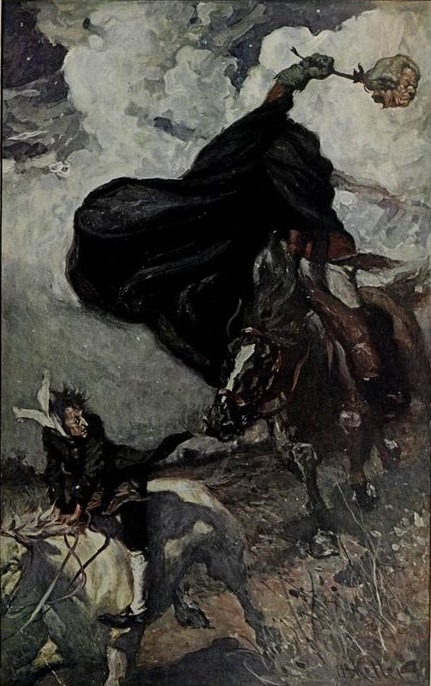
While the big show in American letters this year has unquestionably been the Walt Whitman bicentennial, an equally worthy subject seems not to have captured the imagination of either press or internet. On June 23, 1819, the first story appeared of what was to become Washington Irving’s “The Sketch Book of Geoffrey Crayon, Gent.” – more commonly known as “The Sketch Book.”
“The Sketch Book,” ultimately a collection of 34 stories and essays, was published serially, for a little over a year, through July 1820. Twenty years in advance of the first of James Fennimore Cooper’s “Leatherstocking Tales,” thirty years in advance of “Moby-Dick,” and a full sixty years before “The Adventures of Huckleberry Finn,” “The Sketch Book” was one of the first literary undertakings by an American to enthrall an international readership. William Makepeace Thackeray observed, “Irving was the first ambassador whom the New World of letters sent to the Old.”
Even those who have never encountered Irving’s work will be familiar with his creations, Rip Van Winkle, Ichabod Crane, and the Headless Horseman.
I divined the anniversary purely by chance two weeks ago, when searching for a suitable image for my post on Antonin Dvořák’s “The Specter’s Bride.” It turns out Irving treated the same subject, an old folktale, in his “Sketch Book” story “The Spectre Bridegroom.”
Naturally, I considered putting together a program of Irving-inspired works for “The Lost Chord.” But when I realized the material I have to work with is so thin, I was concerned it might come across a little bit like scraping the proverbial barrel.
These are the Irving-inspired pieces that sprang immediately to mind:
George Whitefield Chadwick: “Rip Van Winkle Overture” (1879)
Ferde Grofé: “Hudson River Suite:” Rip Van Winkle (1955)
Edgar Stillman Kelley: “Headless Horseman” (1891)
Apparently George Frederick Bristow composed a “Rip Van Winkle” opera in 1855, but if it’s even been recorded, I don’t have it. (And that’s saying something.) Ah! But here’s the overture!
Even so, that’s not a whole heck of a lot. Which means I would have had to fill out the rest of the hour with highlights from Kurt Weill’s “Knickerbocker Holiday,” which is very tangentially related indeed.
In any case, spare a thought for Washington Irving. Maybe even re-read one of his supernatural tales. It would be especially appropriate for St. John’s Eve. More on that jolly pagan celebration tomorrow.
CLOCKWISE FROM LEFT: “The Legend of Sleepy Hollow” (1906) by Arthur I. Keller; portrait of a dashing young Irving (1809) by John Wesley Jarvis; illustration from “Rip Van Winkle” (1921) by N.C. Wyeth
Leave a Reply