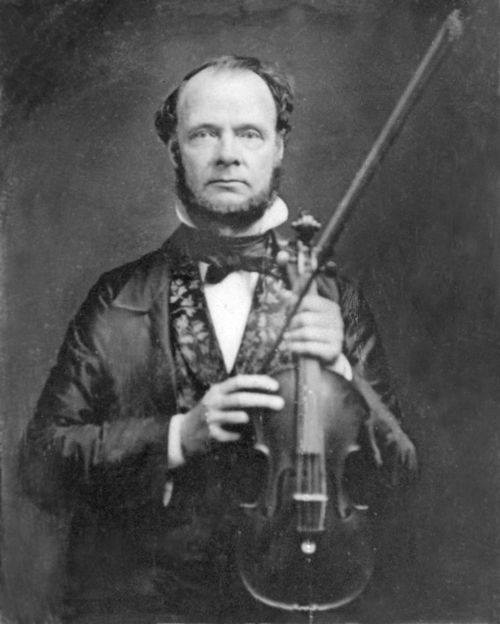
Historically speaking, most musicians have never had it easy. Consider the case of Ureli Corelli Hill.
Hill was born into an artistically-inclined family in Hartford, CT, in 1802. His father was a music teacher and composer (an 1810 New York newspaper ad trumpeted him as the “first performer on violin in America”), and his brother, George Handel Hill, a contemporary and colleague of John Wilkes Booth, achieved renown for his portrayal of a stereotypical rustic New Englander, which earned him the nickname “Yankee.”
One source states that Yankee Hill made his first appearance in character at the Arch Street Theatre in Philadelphia, around 1832. Others claim George had already assumed his persona a few years earlier, as he strode the boards in New York. (He had run away to Manhattan to get his start as an actor in 1826.) Unfortunately, Hill was not a temperate man. Wine, women, and precarious health led to his untimely demise in 1849, less than two weeks before his 40th birthday.
The other Hill, Ureli, also entered the theater, but on the other side of the footlights. At 19, he played violin in the pit. He was also in the orchestra for the first performances of Italian opera in New York City in 1825.
In 1831, he led the first complete American performance of Handel’s “Messiah” at New York’s St. Paul’s Chapel. He also introduced to the U.S. Mendelssohn’s oratorio “St. Paul.”
Hill studied in Germany with Louis Spohr and participated in a performance of Beethoven’s Ninth Symphony under the baton of Felix Mendelssohn, “an affable man,” who also spoke perfect English. Later, as first president of the New York Philharmonic Society, Hill would invite Spohr and Mendelssohn to conduct. Both politely declined, unable to make the trans-Atlantic journey. However, both responded with warm letters of thanks.
On the Philharmonic’s first concert in 1842 – a varied menu, mixing orchestral, chamber, and vocal selections – Hill conducted Beethoven’s Fifth Symphony and participated as a violinist in Johann Nepomuk Hummel’s Piano Quintet in D minor. Also on the program were orchestral works by Carl Maria von Weber and Johann Wenzel Kalliwoda, and some Italian operatic arias.
Hill arranged for the first American performance, with the Philharmonic, of Beethoven’s Ninth, in 1846. The symphony was conducted on that occasion by George Loder, Jr. Hill continued to conduct the Philharmonic, in alternation with six others, until he became embroiled in controversy for his advocacy of American composers of the era, including George Bristow and William Henry Fry.
Hill moved to Cincinnati, where he allowed things to cool down for three years. Then in 1850, he returned to New York and resumed his membership as a violinist in the orchestra. He was really hoping to make his fortune with a piano he invented that used tuning forks in place of strings. Instead, he lost his shirt, since, as fate would have it, Steinway & Sons was only just taking off.
By 1873, Hill was 71 years-old and unable to play at a standard worthy of the orchestra. In retirement, he moved to Paterson, NJ. There, he had difficulty finding students. Unable to support his family, he died of his own hand, of an opium overdose, on this date in 1875. Hill left a note, in which he stated, “Why should or how can a man exist and be powerless to earn means for his family?”
It is possible for an artist to achieve much in this life but still have nothing.
Leave a Reply