Tag: New York Philharmonic

  • John Williams’ Piano Concerto at the New York Philharmonic

    John Williams’ Piano Concerto at the New York Philharmonic

    It wasn’t until 6 p.m. Saturday that it occurred to me I might have a concert in New York City on Sunday. The thought popped into my head as I was adjusting some magnets on the refrigerator in order to lift the page on the calendar and have a glimpse at March.

    Huh. No musical events listed until the weekend.

    But I knew I had committed to see Emanuel Ax perform John Williams’ new piano concerto at the New York Philharmonic, and I thought it was sometime around the beginning of the month. So I went to the calendar I carry with me in my computer bag, and lo and behold, there it was, scrawled on March 1, at 2 p.m. Somehow I had missed it when copying over my appointments to the other calendar!

    How could that possibly happen? If you’re wondering why it didn’t pop up on my Google calendar, then you really don’t know Classic Ross Amico. I still chisel all my commitments onto stone tablets.

    Be that as it may, my mind immediately shifted into business mode. Should I drive or take the train? What time should I leave? What do I need to do in the morning? If I drive, where do I park? Where should I grab lunch? What should I eat, and when, in order to satisfy hunger without inducing drowsiness during the performance? How should I time my afternoon coffee? Shouldn’t I be thinking about getting to bed?

    In the end, I decided to drive. Meters are free in New York on Sunday, and it turned out to be a lovely day, weather-wise, despite a chance of rain and snow in the morning forecast. So I zipped in, in about 70-75 minutes, Giuseppe Sinopoli conducting the “Enigma Variations” on my CD player, and parked on the street, a stone’s throw from Lincoln Center, at around 12:30. A grab-and-go lunch later, I had strolled as far north as Verdi Square, to have a glimpse at the monument in the March Sunday sunshine, despite a chill in the air, its warm glow promising the imminent arrival of spring. I visited the Strand Bookstore at its satellite at 2020 Broadway to grab a cup of coffee and run my eye over the sidewalk stalls, and then headed back down to Geffen Hall by 1:30.

    There, I met my concert companion, H. Paul Moon, who was very kind to make all the ticket arrangements, and we made our way to our seats on the second tier, stage right (the left side of the auditorium). How narrow and perilous the path was, with a single row of seats angled for an easier view of the stage and a low rail beckoning me to just end it all already.

    But I resisted.

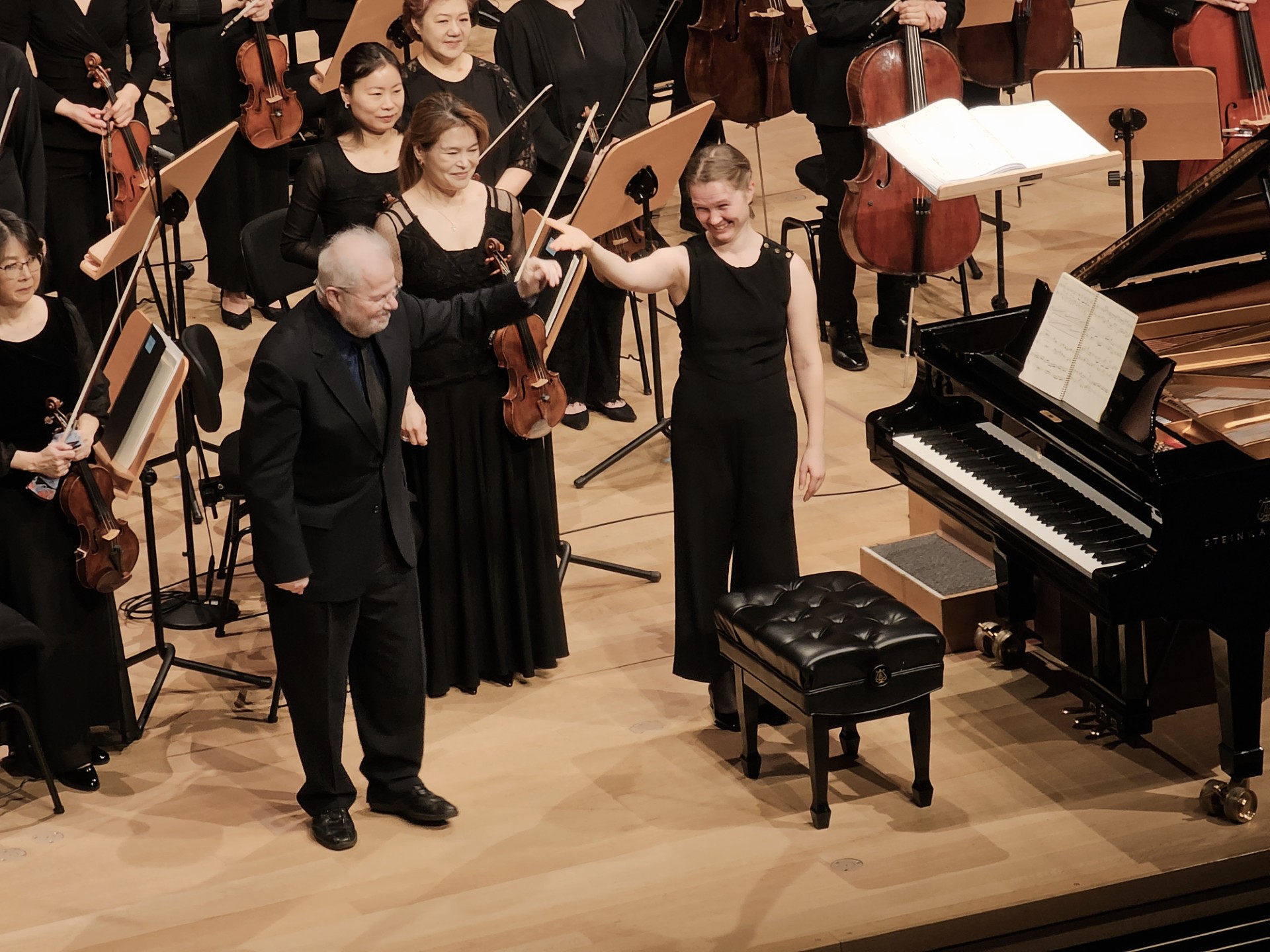
    The conductor of the program was the somewhat elfin Lithuanian Mirga Gražinytė-Tyla, a Dudamel protégée in Los Angeles, who spread her wings as music director of the City of Birmingham Symphony Orchestra. Youthful and expressive, at times capricious even, she manages to stay tethered to reality, with interpretive decisions that seem grounded in practicality. It’s afterward, as she acknowledges the musicians, that she extends an open palm to the various sections and players, as if to offer them fey honey cakes.

    The concert opened with Ralph Vaughan Williams (yay!): his “Fantasia on a Theme by Thomas Tallis,” with nine string players sequestered upstage, behind the larger body of musicians, the better to achieve the work’s antiphonal effects.

    The work suggests the interplay of sacred voices in a cathedral, evocative of Renaissance church music, yet at the same time manages to convey kind of a transcendent radiance that lends it a certain timelessness. The music sways and swells in its Phrygian modality, alternating between austerity and a certain lushness that parallels the bygone English countryside so often celebrated and idealized by the pastoral school. Hearing it again only confirms its greatness. There’s a reason it’s Vaughan Williams’ most famous piece (alongside “The Lark Ascending”).

    Gražinytė-Tyla’s interpretation was gorgeous without teetering into sentiment. Hers was a holistic approach. Unlike some, she didn’t attempt to whip the music into ecstasies. But as with all the great works, the piece stands up to different interpretive philosophies.

    Stepping off the podium to acknowledge the musicians, the conductor was again full of smiles and asides to the first chair players. She seems to be a positive force, and though the Philharmonic has been known to be notoriously jaded, they responded well to her.

    Here’s an excerpt of Gražinytė-Tyla conducting Vaughan Williams in Birmingham.


    Next came John Williams – no relation to Vaughan Williams, though based on some of his film scores, the composer clearly admires English music.

    It’s probably safe to say that few from the “Star Wars”/”Harry Potter” crowd that attend performances of Williams’ concert works are going to come out of them feeling wholly satisfied. Not that there aren’t touches in his concert music that could betray the voice of the composer to those exceptionally well-versed in his film scores. But there are no heroic marches or sweeping love themes. More often, the music is impressionistic, rather than cinematic.

    In this new work, Williams also risks disappointing the jazz crowd, as each of the three movements is tied to an admired jazz pianist – Art Tatum, Bill Evans, and Oscar Peterson – all of whom Williams heard live. It might be perceived as another bait-and-switch, as there is very little “jazz” in it. Or when there is, it’s been internalized, processed, and given back as something else. Williams takes as his starting point his memories of the essence of each of these keyboard titans.

    He certainly gives the soloist plenty to do, in a cadenza-heavy first movement and another virtuosic cadenza at the end. Of course, there’s more to classical piano than leaping technical hurdles and playing fast and loud, so there are also introspective passages and reflective interludes throughout. Emanuel Ax played the piece with the safety net of sheet music, but he did so with such confidence that it made you wonder why he thought it necessary.

    When it comes to Williams’ concert music, which he has been writing since the 1960s, prior to his blockbuster successes as a film composer, one almost feels as if he protests too much, and for as much as I love just about every note this guy ever wrote (with a few exceptions), I sometimes wish he would indulge his natural melodic gift more in his concertos. I would recommend the Tuba Concerto as a good starting point for the uninitiated. His other works have lyrical passages – some more than others – but few will leave you humming.

    For me, the work under consideration becomes more appealing as it progresses. In the second movement, the piano supports the principal viola (here Cynthia Phelps), who is given a substantial lyrical passage, before the movement gradually expands into the woodwinds and then the lower strings. Ax ruminates, until eventually the strings begin to swell. The woodwinds return, somewhat ethereally, and then the viola reappears to round off the movement.

    I also like how Williams builds up to the end of the piece. For as large as the orchestra is – with no less than six percussionists, another piano within the orchestra, and a celesta – it’s remarkable just how restrained and precise the composer is in conjuring the different timbres. Say what you want about John Williams, he’s a master colorist and the guy really knows his way around the orchestra. More viscerally, he does give us a race to the finish and a satisfying “bang” to let us know when to applaud.

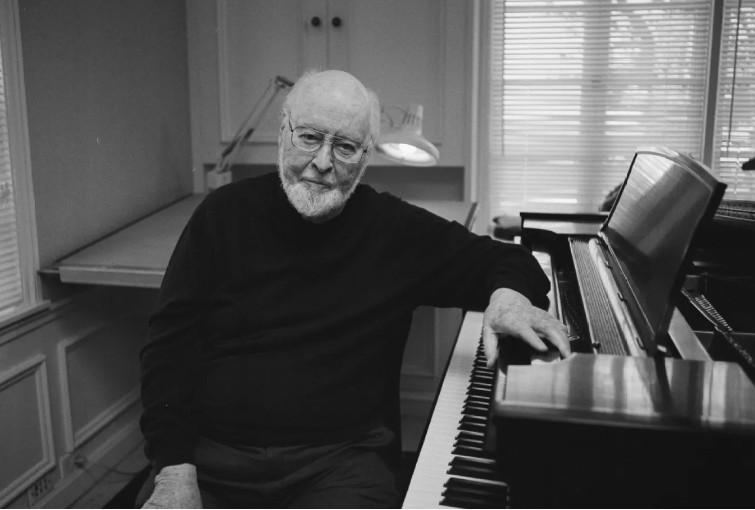
    That Williams, who turned 94 on February 8, still has the intellectual rigor to pull off a work on this scale is astonishing. The concerto was introduced by Ax at Tanglewood last summer. Word is that a recording was made for commercial release. If you’re interested in checking it out, the premiere performance is posted on YouTube.


    If you want to hear it live, Ax will be bringing it to the Philadelphia Orchestra next season.

    The piano has always been Williams’ own instrument. He studied seriously with Juilliard’s Rosina Lhévinne, while also playing jazz piano and serving as a session pianist for innumerable singers. From well before he was a household name, you can hear him playing on the soundtracks to “Peter Gunn,” “Breakfast at Tiffany’s,” “West Side Story” (the film), “The Big Country,” “To Kill a Mockingbird,” and so many others. This is a man who’s had nine creative lives.

    One wonders what kind of concerto he would have written for the keyboard had he tackled it 40 years earlier. But what we’ve got is a good one, even if it will never enter the public consciousness the way his film scores have. At least it was written with dignity and craftsmanship, and it never teeters into kitsch.

    Even so, I can’t help but wonder what one of his concertos would sound like if he had he been writing a hundred years ago, when a significant number of major composers were still creating vital music in a tonal idiom. I’m all for composing a work that reveals more and more on repeated listening, but the surest way to get repeat performances is to be sure to give listeners something the first go-round that they’ll want to hear again.

    For an encore, Ax offered Schubert’s “Ständchen” (“Serenade”), which was beautifully played, an ideal palate-cleanser, even if some nearby idiot thought it necessary to hum along off-key.

    The second half of the program was devoted to the Symphony No. 5 by Mieczyslaw Weinberg, yet another composer who walked a perilous line in Soviet Russia. Weinberg fled the Nazi invasion of Poland – his parents and sister were killed – and throughout his life, even in “safety,” there were periods during which he weathered harrowing encounters with anti-Semitism and Stalin’s dangerous whims. Weinberg’s father-in-law was murdered by the secret police and he himself was arrested. His friend and colleague, Dmitri Shostakovich, went above and beyond, putting himself at risk to defend Weinberg to Stalin himself. Who knows what would have happened to Weinberg had Stalin not died unexpectedly.

    While clearly laboring under the same tense reality as Shostakovich and many of his peers, Weinberg’s creative voice is very much his own. It is notable in his symphony that he actually supplies some melodic material to the piccolo, as opposed to merely using the instrument expressively, to pierce the listener’s eardrums, as Shostakovich is prone to do. Furthermore, Weinberg doesn’t descend into grotesquerie. Even so, despite having been composed under Krushchev’s “thaw,” it is a gloomy work. Following the somber, unsettled adagio that forms the symphony’s second movement, I noted at least six people heading for the exits on the ground floor. It is certainly worthwhile music, however, and in its way, often quite beautiful.

    I probably have more Weinberg recordings in my library than most, but before yesterday I confess I had not heard the Symphony No. 5. There are a number of recordings of it on YouTube.


    Gražinytė-Tyla has been a steadfast Weinberg champion. Her first recording for Deutsche Grammophon was of Weinberg’s Symphonies Nos. 2 & 21. A subsequent release documents her performances of his Symphonies Nos. 3 & 7 and his Flute Concerto.

    Yesterday’s was quite a significant program – the last of a four-concert series, at that. Hats off to the New York Philharmonic for investing in such serious fare. Gražinytė-Tyla will continue with the orchestra, conducting music by György Kurtág (who just turned 100 last week), his “Brefs messages,” Elgar’s Cello Concerto (with soloist Vilde Frang), and Schumann’s Symphony No. 1 (the “Spring” Symphony), March 5-7.

    For those in search of unusual and neglected repertoire, with a welcome appetizer in the form of a delectable modern classic, this was one Sunday matinee that very much satisfied.

    Bravi, Mirga Gražinytė-Tyla and Emanuel Ax, and thank you, New York Philharmonic!

    ———

    Photo of Emanuel Ax and Mirga Gražinytė-Tyla, courtesy of Paul Moon

  • A Convergence of John Williams Concert Music

    A Convergence of John Williams Concert Music

    This is a good season for John Williams’ concert music, at least where I live. I’m not talking about his film scores, which are likely being listened to somewhere in the world every day. I’m talking about his concertos, of which he has composed many, beginning with the Flute Concerto of 1969. My personal favorites are his first Violin Concerto (in its original version of 1974-76), the bassoon concerto “Five Sacred Trees” (1995), the Cello Concerto (1994; still undecided between the original and revised versions), and the Trumpet Concerto (1996).

    I’ve been lucky enough to attend performances of the revised Violin Concerto, the Cello Concerto (in both versions), and Violin Concerto No. 2 (2021) on concerts of the Philadelphia Orchestra. However, the first one I ever actually heard was on the radio, when the Tuba Concerto (1985) was included on a broadcast of the Cleveland Orchestra. Somehow, over 40 years later, I have never heard it live.

    This is perhaps the most immediately appealing of Williams’ concertos for those who enjoy his film scores. The first movement, especially, shares some of the wide-open exuberance of, for instance, the lighter moments in “Jaws.” So it is with some pleasure that I look forward to finally hearing it on Friday afternoon on a concert of the Philadelphia Orchestra, with principal tubist Carol Jantsch.

    The performance will take place at Philadelphia’s Kimmel Center for the Performing Arts. Also on the program will be Julius Eastman’s Symphony No. 2 and Felix Mendelssohn’s “Italian” Symphony. Dalia Stasevska will conduct.

    Friday afternoon no good for you? The program will be repeated on Saturday at 8:00. The Tuba Concerto and “Italian” Symphony will also be performed, without the Eastman, as part of the orchestra’s Happy Hour Concert series on Thursday at 6:30. Get there at 5:00 for pre-concert specials on food and drink and free activities. Happy Hour concerts are followed by post-concert talks with the artists.

    I’m also locked in for Williams’ new Piano Concerto, given its premiere this past summer at Tanglewood. Soloist Emanuel Ax will be bringing it to the New York Philharmonic for four performances at Lincoln Center’s David Geffen Hall, February 7-March 3. Also on the program will be Ralph Vaughan Williams’ “Fantasia on a Theme by Thomas Tallis” and Mieczyslaw Weinberg’s Symphony 5. Mirga Gražinytė-Tyla will conduct.

    As a little cherry on top, I hold a ticket to a Philadelphia Orchestra concert on May 1 that will open with a suite from Williams’ “Close Encounters of the Third Kind.” I don’t generally like Williams’ arrangements of his film scores for the concert hall. There are exceptions, but I don’t think he’s always the best at distilling what makes his movie music so magical, beyond the recognizable themes, and translating it for use on symphony concerts. This is frustrating, because the music is excellent, as it was written, and I do wish it could be worked into something more along the lines of “The Firebird Suite.” A lot could be done with 20 minutes. Williams takes 10.

    Anyway, it’s on the same program with Aaron Copland’s Symphony No.3 and, in between, Matthias Pintscher’s “Assonanza” for Violin and Orchestra. Leila Josefowicz will be the soloist, and Pintscher himself will conduct. There will be three performances, April 30-May 2.

    I am only in the last 35 pages or so of Jane Austen’s “Persuasion,” which I picked up dutifully to honor the 250th anniversary of her birth. I really want to knock it out today, because I’m dying to start the new John Williams biography by Tim Greiving, a 640-page doorstep issued by Oxford University Press.

    February 8 will mark the composer’s 94th birthday. Williams is said to be at work on the score for Steven Spielberg’s upcoming extraterrestrial opus “Disclosure Day,” which has been slated for a June 12 opening.

  • Ives in New York: Dudamel Fever Is Real!

    Ives in New York: Dudamel Fever Is Real!

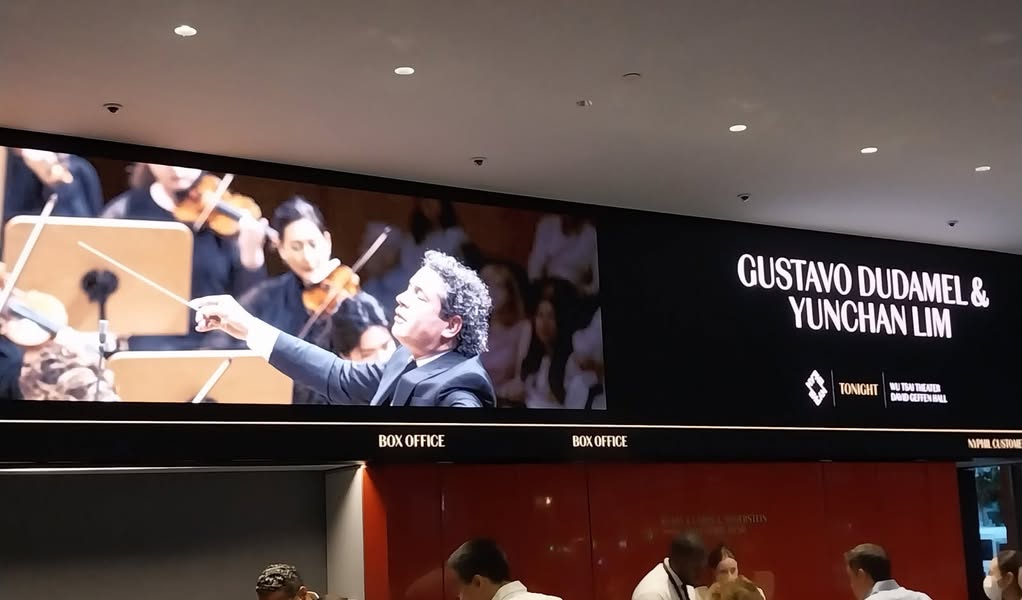
    My expectations were high for last night’s concert of the New York Philharmonic (which included Béla Bartók’s Piano Concerto No. 3, with supernova soloist-du-jour Yunchan Lim, and one of my favorites, Charles Ives’ Symphony No. 2, with Gustav Dudamel on the podium), so I thought it prudent to dial it down a bit, on my drive in, by listening to the most torturous performance of the Ives I know – Bernard Herrmann’s turgid account from 1972. (I love you, Benny, and you were a genius as a composer, but my, did you make some bad records as a conductor.)

    I’m not kidding about the Herrmann. Listening to it again made me feel psychologically and physically awful. Everything about it is just so wrong – it’s stodgy, interminable, and astonishingly ill-conceived, so much so that you wonder if Herrmann the conductor had any familiarity with any of the music that Ives stitched into this crazy quilt of hymns, folk songs, patriotic tunes, parlor melodies, and classical music standards that should come together as a musical self-portrait of the artist as a young man – but I keep it as a party record and also because, for as bad as it is, it reveals a lot about the music you don’t hear in other recordings.

    Anyway, after Herrmann’s Ives, I knew even a tepid performance would be less disappointing. Thankfully, Dudamel exceeded all expectations.

    Ives’ symphony offers so many allusive layers that it’s easy to get lost in the details – straining to identify a certain wisp of melody and where you may have heard it before – at the expense of a true appreciation of the composer’s broader, structural brilliance. It’s kind of like he took a pile of weathered lumber and hammered it onto the sturdy frame of a New England barn. It’s only after years of listening to the piece that I began to recognize its formal accomplishment. The counterpoint alone should signal that Ives’ learned his academic exercises well (under Horatio Parker at Yale), now twisting them and bending them to his will. The foundation is set in tradition, but it’s all beneath the ground.

    Conversely, if a conductor gets too caught up in the structural aspects of the piece, as does, to some extent, Herrmann, and as did Leon Botstein at Carnegie Hall last season, conducting The Orchestra Now, the work, which should be a moving and uplifting charmer, can turn into a real slog.

    I wonder too if, in certain respects, the symphony would have had greater resonance with listeners of earlier generations, when the songs of Stephen Foster were still sung in music class and Popeye was clobbering foes to “Columbia, the Gem of the Ocean.” Audiences still brighten in recognition of Ives’ quotation of “America the Beautiful” – even the Asian listeners around me last night perked up – and certainly classical music people will know the snippets of Brahms, Beethoven, and Wagner. But you really have to be steeped in American musical lore to wring everything out of it. Even I, who have heard the work countless times over four decades, am still wringing, as last night I heard things I hadn’t noticed before.

    One of my principal concerns with Dudamel conducting Ives was that, as he is not an American (he was born in Venezuela and his home is in Madrid), he would not be familiar with a lot of the source material. It would be like a conductor born and bred in the United States attempting an analogous work in South America, with only a superficial grasp of the native culture. But the Dude acquitted himself marvelously. (He recorded the Ives symphonies a few years ago, but I have yet to hear those recordings.) Last night, he kept the textures lucid, and the mood buoyant. In fact, so comfortable was he with his command of the idiom that he conducted without a score. In the last movement, he was so loosey-goosey that he communicated one passage quoting “Turkey in the Straw” using only his torso (shades of Bernstein conducting the last movement of Haydn’s Symphony No. 88 with his eyes)!

    I also want to add that the work is beautifully, warmly, and affectionately orchestrated. That might not be at first apparent with all the symphony’s other bells and whistles. Members of the wind and string sections have opportunities to charm and move with their various solos and duets. Toward the end of the second movement, a snare drum crackles like the reports of fireworks.

    One final observation: for most of the symphony, Ives keeps his avant-garde impulses in check, right up, that is, until the final note, which out-surprises Haydn’s “Surprise” Symphony, and I’m happy to report Dudamel unleashed one hell of a raspberry – the best I’ve heard, probably, since Bernstein’s classic recording from the late 1950s.

    It occurred to me that if I were a music director with Dudamel-like power, an interesting program might couple Ives’ 2nd with Dvořák’s “New World” Symphony, separated by an intermission, with perhaps George Whitefield Chadwick’s “Jubilee” as the curtain-raiser. With programming acumen like that, it’s probably good that I will never be music director!

    On the evidence of last night’s concert – the last of a season-opening weekend series – the orchestra is in very good hands. Sceptics may grumble about the cult of Dudamel and his PR machine, but one should never discount the power of celebrity. On the merits of what I experienced, the hype, such that it is, is a self-fulfilling prophecy, as the energy in the room was exceptional, and musicians feed off that. Despite my having to break the piggy bank for a seat in the last row of the top tier, the evening proved to be worth every penny. The combination of repertoire and performers, and the audience response, made the concert for this commuter from Princeton unmissable. It was a lovefest from start to finish, with riotous applause and hoots for Dudamel and his soloists, for the pianist Yunchan Lim, and even for composer Leilehua Lanzilotti, who received quite the curtain call for her new piece – not that I thought the work itself, fine as it was, was all that. It was just an extraordinarily receptive crowd. Dudamel Fever is real!

    Lim has his own kind of charisma, which is harder to explain. He’s like a Pied Piper of the piano. He plays so well that even us rats in the top back row will follow him anywhere. Bartók’s piano works can sometimes be prickly and percussive. Not so the Piano Concerto No. 3. If you harbor fears of this composer, this one is good therapy. Written toward the end of the composer’s life, when he was battling terminal leukemia, he crafted a radiant exit in this neoclassical, folk-inflected farewell. It’s a tuneful, life-affirming work, reflective, but not without passages of fiery virtuosity. Lim’s touch was light and lithe – there was real poetry in outer sections of the “Adagio religioso” second movement (interrupted by a whirl of bird song) – but the third built to a concluding run that worked the crowd, and they responded as if they had been listening to Tchaikovsky.

    Lim is an artist without flash – even his bows are charmingly awkward and a tad self-conscious – but on the piano bench he mesmerizes. I can’t imagine that such humility could be affected. May he never fully believe he is as good as he is!

    Astonishingly, when he finally sat down to silence the applause with an encore, it was with Ennio Morricone’s theme from “Love Affair” (the Warren Beatty-Annette Bening remake you’ve probably already forgotten).

    I have Lim’s recordings of Liszt’s “Transcendental Etudes” (captured live at the Cliburn competition; it’s so good, it’s terrifying) and Chopin’s “Etudes,” and he is the real deal, one of those all-too-rare phenomena that makes me hopeful – enthusiastic even – for the continuing health of the art form. Somewhere down the line, I hope he gives us a recording of his encores.

    The concert opened with an attractive work by Philadelphia-born Hawaiian native Leilehua Lanzilotti. Allowing some slack for the now-tired cliché of the all-lower-case title, “of light and stone” is agreeable music dressed up with an unnecessary dog-and-pony show, as in one of the central sections, the brass players blow into their instruments without playing any tones. It’s just the sounds of their exhalations, while a percussionist runs a pair of brushes over a snare drum, when combined suggestive of the Hawaiian surf. How much of this is music, and how much just sound effects? Elsewhere, the percussionist plays a Zen pyramid, a relative of the triangle, that sounds all the world like a bell. What can I say? It was interesting.

    In common with Bartók and Ives, Lanzilotti assimilates native materials in her attempt to communicate universally. Drawing its inspiration from the history of her native land, “of light and stone” reflects on music actually composed by members of Hawaii’s royal families, especially Queen Liliʻuokalani, who was deposed and imprisoned by imperial forces for her attempts to abrogate the Bayonet Constitution (a document as slimy as it sounds). There is no anger in Lanzilotti’s music, only meditation and at times a certain mournfulness. The audience didn’t appear to have any reservations. They loved it.

    Lending to my enjoyment of the evening was the chance placement of my seat, next to that of a young law student from Taiwan, with whom I enjoyed some nice conversation before the concert and between pieces. A violinist from the age of 5, he spoke impeccable, accent-free English (perhaps attributable to the fact that his grandparents had lived in the United States). We talked about Chopin and Bach and Henryk Szerying (his favorite interpreter of the Bach violin sonatas). It knocked me backward that he even knew who Szeryng was. I would think he’s hardly a widely-recognized name anymore – no aspersions on his excellence – save perhaps to aficionados. At intermission, I offered him a hasty introduction to Charles Ives, in the hope of increasing his appreciation of the symphony. We also swapped email information, parting with a pledge that he would check out Ives’ violin sonatas. We may try to meet up for another concert later in the season.

    I arrived early, at a time I knew I could snag a free parking spot considerably north of Lincoln Center. That gave me time to grab a coffee, have dinner, and read a few chapters. For an hour or more before the concert, there was a company of dancers, dressed informally, out on the plaza. I don’t know if they were students, but I assume they were. It is a strange set of circumstances when New York City suddenly seems like the center of normalcy. Pedestrians still may not meet your gaze on the streets, but gather a few dozen talented kids from a variety of backgrounds and ethnicities to express themselves gracefully to Bach, and it still draws a crowd and people react warmly. Even in New York – ESPECIALLY in New York – people hunger for hope and beauty. No one who knows me would ever accuse me of being kumbaya, but isn’t this how life should be?

    It also occurred to me in watching the orchestra how much it has changed over the years. When you watch the Young People’s Concerts with Bernstein, you see a bunch of middle-aged white men in suits and glasses. Undoubtedly they brought the goods, but they all looked like a bunch of dentists. Now the violins are mostly women. The orchestra sounded great and seemed to be in high spirits – not always the case with this notoriously fickle band. Let’s hope the honeymoon with Dudamel – who will return several times this season, before officially assuming musical and artistic directorship next year – continues. We can use all the positive energy we can get.


    NOTE: Yunchan Lim will perform the Bartók concerto with Marin Alsop and the Philadelphia Orchestra at the Kimmel Center for the Performing Arts, October 3-5.

  • John Williams Piano Concerto Premiere NYC

    John Williams Piano Concerto Premiere NYC

    It’s that time of year again. All the musical arts organizations have been sending out emails to announce their 2025-26 seasons, hoping to entice us to subscribe. In fact, I get so many of these, I often just wind up scrolling quickly through them or putting them aside for later and then forgetting all about them. Catalogues and brochures that show up in the actual, honest-to-goodness U.S. Post receive closer scrutiny.

    For me, computer screens are just so claustrophobic. And inconvenient. I hate having to scroll up and down and click through endless links while trying to compile a fantasy subscription season. I especially dislike when marketers reduce otherwise interesting programs to yawn-inducing teasers such as “Mitsuko Uchida Plays Mozart.” And then you have to click on the link to see if there’s anything else actually worth hearing. Because if you don’t, you just know it’s going to be some opulent, hour-long, fin-de-siècle symphonic poem that will only get programmed once in a lifetime.

    For the big orchestras that offer some 130 concerts a season, the whole online process is infuriatingly inconvenient. It’s a waste of my time and it’s not good for my blood pressure.

    But I digress. With a quick flash of the middle finger to the marketers, I now move on to the exciting news that it looks like John Williams finally finished his Piano Concerto for Emanuel Ax, as it will be performed by the New York Philharmonic on a series of concerts, February 27 – March 3, 2026, not long after the composer’s 94th birthday (on February 8 ). Ax is slated to give the work its world premiere with the Boston Symphony Orchestra at Tanglewood in July.

    Why it’s taken Williams so long to get around to writing a concerto for his own instrument is anyone’s guess. Over the past 50 years, he’s written concertos for violin, viola, cello, flute, oboe, clarinet, bassoon, trumpet, French horn, tuba, and maybe a few others I’m forgetting, since the works are not always titled “concerto.”

    The New York Philharmonic program will also include Ralph Vaughan Williams’ “Fantasia on a Theme by Thomas Tallis” and Mieczyslaw Weinberg’s Symphony No. 5. Mirga Gražinytė-Tyla will conduct. The whole prospect is so thrilling that I don’t know how I’m supposed to wait an entire year!

    How do the marketers drain all the excitement out of it? They’re titling it “Mirga Gražinytė-Tyla & Emanuel Ax.” That’s guaranteed to get butts in the seats.

    Despite their best efforts to keep me away, I will be there.

    https://www.nyphil.org/concerts-tickets/2526/mirga-grazinyte-tyla-and-emanuel-ax/

  • Adolphus Hailstork An American Composer

    Adolphus Hailstork An American Composer

    I’ve been a fan of Adolphus Hailstork since the 1980s. That’s when I first heard “Done Made My Vow,” as part of a concert broadcast over the radio.

    “Done Made My Vow” (1985) is often described as a gospel oratorio, inspired in part by speeches of Martin Luther King, Jr. So uplifting is the marriage of words and music, I hoped for years that it would be recorded. Then one day I stumbled across a copy in the Baltimore Symphony Orchestra gift shop.

    Hailstork has been part of the fabric of American music since at least the 1970s. Born in Rochester, New York, in 1941, he earned his BA from Howard University, his MA from the Manhattan School of Music – where his teachers included Vittorio Giannini and David Diamond – and his doctorate from Michigan State, where his studied with H. Owen Reed. Then he was off, like so many of his great American forebears, to study at Fontainebleau with Nadia Boulanger.

    For many years, Hailstork was composer-in-residence at Old Dominion University in Norfolk, Virginia, where he taught. He is perhaps best known for his choral music, though it was the wistful slow movement of his Symphony No. 1, composed for a summer music festival in Ocean Grove, New Jersey, that next caught my ear.

    I was elated to finally hear “Done Made My Vow” live with the New York Philharmonic last season, with the composer in attendance. A week later, I actually got to meet him at the premiere of his Symphony No. 4 at Alice Tully Hall. As succinctly as I could, I tried to express how much I admired his music and for how long. He listened graciously and as he signed a few of my CD booklets admitted that it’s good to be appreciated. It seems his music has always been performed, but in recent years, with arts organizations increasing their efforts to be more inclusive in their programming, Hailstork, now 82, is finally receiving some much-deserved high-profile recognition.

    The text for “Done Made My Vow” was tweaked for the New York Philharmonic performance, but to my knowledge that version has yet to be recorded. Enjoy the Baltimore Symphony Orchestra recording at the link. The music is hale, but the sentiments are King.


    A Hailstork miscellany:

    Symphony No. 1 (1988): Mov’t II, Lento ma non troppo

    “Sonata da Chiesa” (1992), inspired by the composer’s love of cathedrals (especially the one he sang in as a boy in Albany, New York)

    “Motherless Child” (2002)

    “Celebration!” (1974)

    “Epitaph for a Man Who Dreamed: In Memoriam Martin Luther King, Jr.” (1979)

Tag Cloud

Aaron Copland (92) Beethoven (95) Composer (114) Film Music (119) Film Score (143) Film Scores (255) Halloween (94) John Williams (185) KWAX (229) Leonard Bernstein (99) Marlboro Music Festival (125) Movie Music (134) Opera (198) Philadelphia Orchestra (87) Picture Perfect (174) Princeton Symphony Orchestra (106) Radio (87) Ralph Vaughan Williams (85) Ross Amico (244) Roy's Tie-Dye Sci-Fi Corner (290) The Classical Network (101) The Lost Chord (268) Vaughan Williams (102) WPRB (396) WWFM (881)

DON’T MISS A BEAT

Receive a weekly digest every Sunday at noon by signing up here


RECENT POSTS