Tag: New York Philharmonic

  • Thomas Stacy Acclaimed English Hornist Dies

    Thomas Stacy Acclaimed English Hornist Dies

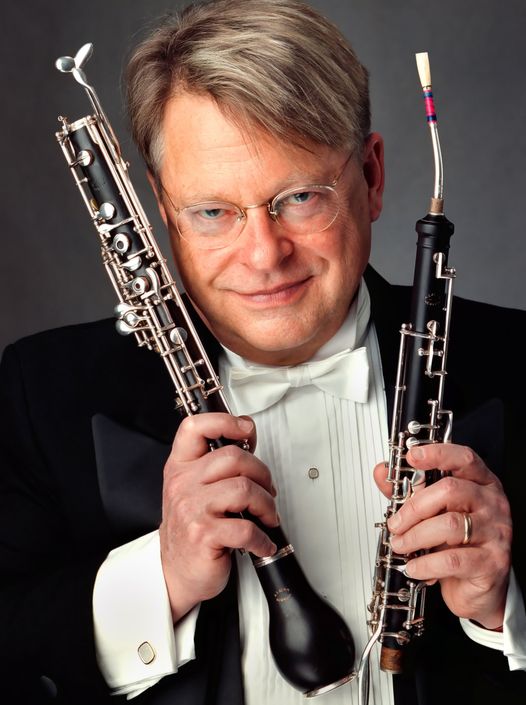
    “The Heifetz of the English horn” has died. Thomas Stacy was a member of the New York Philharmonic from 1972 to 2011. He was a featured soloist with the orchestra more than 70 times. He also appeared as guest soloist with many other ensembles.

    More than 30 new works were written specifically for him. He was the most-recorded English hornist in the world. In 2005, he was nominated for a Grammy Award for Best Instrumental Soloist for his recording of Kenneth Fuchs’ Concerto for English Horn, “Eventide.”

    Stacy was also a virtuoso on the oboe d’amore. His final performances as a soloist with the Philharmonic were during the orchestra’s 2008-09 season, in an oboe d’amore concerto by Georg Philipp Telemann.

    Growing up in Augusta, Arkansas – population 3000 – he listened to the New York Philharmonic Sunday afternoon radio broadcasts with his mother, a church organist. He sold his motorcycle in junior high school to buy his first English horn.

    Leonard Bernstein characterized Stacy as “a poet among craftsmen.” Stacy died on April 30. He was 84 years-old.


    Sibelius, “The Swan of Tuonela”

    Copland, “Quiet City”

    Dvorak, “New World” Symphony (video)

    Kenneth Fuchs, “Eventide”

  • Dudamel to New York Philharmonic: The Dude Moves East

    Dudamel to New York Philharmonic: The Dude Moves East

    The Dude is headed to New York!

    It was announced yesterday that Gustavo Dudamel will be leaving the Los Angeles Philharmonic to take up the post of “music and artistic director” of the New York Philharmonic, beginning in 2026. The double-barrel title is bestowed in the same week as the announcement that Yannick Nézet-Séguin will now be “music and artistic director” of the Philadelphia Orchestra. Nézet-Séguin, who has been music director in Philly since 2012, renewed his contract through 2030.

    Granted, both these gentlemen do a lot of heavy-lifting, more than justifying the compound-if-cumbersome descriptors. Dudamel, 42, has been a transformative force in L.A. He is, with the possible exception of Nézet-Séguin, our most visible and energetic young man of the podium. (Yannick, 47, is also music director of the Metropolitan Opera and his home orchestra, the Orchestre Métropolitain de Montréal.) I don’t know if the East Coast can handle the combined kinetic energy of Yannick and The Dude.

    Dudamel carved out time for a whirlwind residency in Princeton in 2018. Although I got to meet him, our interview had to be conducted via email. Knowing Dudamel, he probably dashed off his responses in a limo on the way to the airport. You can learn more about The Dude and read our exchange at the link.

    https://www.communitynews.org/princetoninfo/artsandentertainment/princeton-concerts-celebrating-125-years-with-the-dude-gustavo-dudamel/article_a2905abc-098d-5bf5-a56c-20625675fdbe.html

    Brace yourselves, New York, and congratulations, Gustavo Dudamel!

    Press release from the New York Philharmonic

    https://nyphil.org/~/media/pdfs/newsroom/2223/GD-press-release-final.ashx?la=en

  • Plimpton, Bernstein, and Tchaikovsky

    Plimpton, Bernstein, and Tchaikovsky

    After posting about Tchaikovsky’s “Little Russian” Symphony this morning, on the 150th anniversary of the work’s first performance, I recollected an anecdote once shared by the writer George Plimpton.

    Plimpton, of course, was most famous for his forays into “participatory journalism” – getting his hands dirty, with the occasional gash or broken bone, in pursuit of a better understanding of the subject he happened to be writing about, whether it be what it would be like to box with Archie Moore, train to be a goalie with the Boston Bruins, or to play quarterback with the Detroit Lions.

    The guy had guts, without the posturing of a Hemingway or a Mailer, and he wasn’t afraid to look foolish. Or if he was, he made pride subservient to the experience. It was an endearing quality in a man who spoke with a patrician accent, cofounded The Paris Review, and could trace his lineage to the Mayflower.

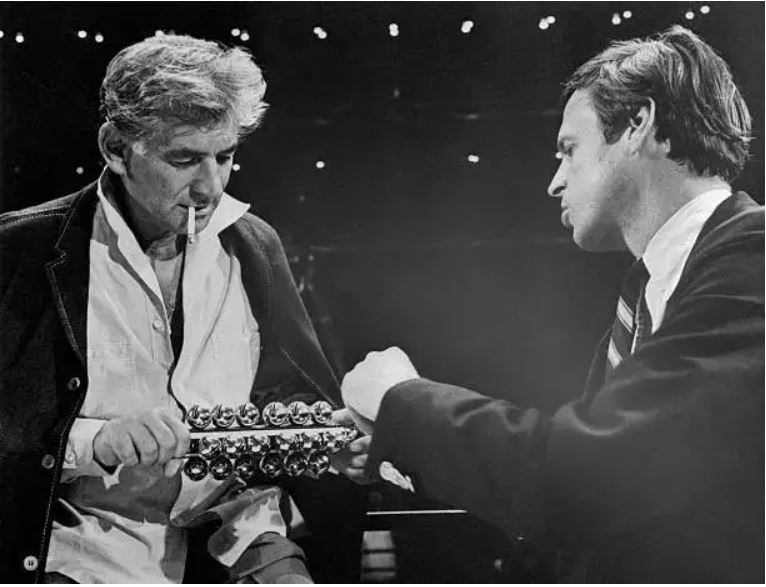
    When Plimpton took an interest in what it would be like to be an orchestra musician, he was allowed to tag along with the New York Philharmonic as a percussionist on its Canadian tour. In this capacity, he played the sleigh bells in the opening movement of Mahler’s Symphony No. 4 – very badly, it turned out, which infuriated the conductor, Leonard Bernstein.

    But Plimpton redeemed himself when he was assigned the gong in Tchaikovsky’s “Little Russian” Symphony. He was so keyed-up in the work’s final movement, as his big moment approached, that when he received his cue from the podium, he struck with such force that he claimed he could see the shock wave travel across the rows of stunned musicians to Bernstein himself, whose eyes widened in surprise. The conductor had to wait for the sound to decay before he could launch into the symphony’s final bars. Bernstein was so pleased with the result that he invited Plimpton to be on the recording of the piece that he and the orchestra subsequently made.

    But I’m only paraphrasing from the words of a very capable writer. Here’s the story from Plimpton’s own lips. Enjoy!

    https://www.c-span.org/video/?c4539798/user-clip-george-plimpton-joins-york-philharmonic


    PHOTO: Plimpton (right) with Bernstein and the Mahler 4 sleigh bells

  • Stanley Drucker Legendary Clarinetist Dies at 93

    Stanley Drucker Legendary Clarinetist Dies at 93

    Another piece of living history has left us. Clarinetist Stanley Drucker died on Monday, at the age of 93.

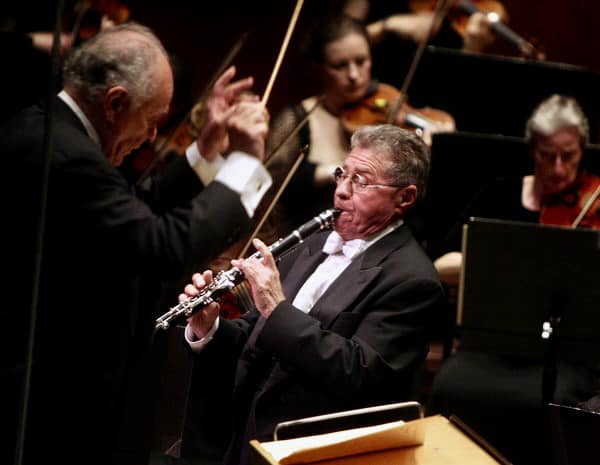
    Drucker played with the New York Philharmonic for over 60 years. For 49 of those, he served as principal (beginning in 1960). In total, he played some 10,200 concerts in New York. He appeared as soloist with the orchestra some 150 times. On June 4, 2009, he was acknowledged with a Guinness World Record for longest career as a clarinetist, logging his Philharmonic career at 62 years, 7 months, and 1 day.

    Prior to his New York tenure, he played with the Indianapolis Symphony (from the age of 16!). On the journey from Indianapolis to New York, he also managed to work with Adolf Busch’s Busch Little Symphony and serve as principal clarinetist with the Buffalo Philharmonic.

    In 2007, Gustavo Dudamel said of Drucker, “He’s a legend. The history of the orchestra is in him.”

    R.I.P.


    Drucker, described here by Leonard Bernstein as “our orchestra’s high-priced soloist,” playing his signature piece, the Copland Clarinet Concerto (following a four-minute Bernstein intro)

    The Carl Nielsen concerto (done all in one take, in an era before digital editing)

    The world premiere of the John Corigliano concerto (written for him)

    New York Philharmonic tribute

    Profile on ABC News, upon his retirement from the Philharmonic at the age of 80

  • Leonard Bernstein A Life with Not Enough Time

    Leonard Bernstein A Life with Not Enough Time

    “To achieve great things, two things are needed: a plan and not quite enough time.”

    Leonard Bernstein ought to have known. He had only 72 years to become this country’s most visible, extraordinarily versatile classical musician, as a conductor, composer, pianist, Broadway luminary, educator, author, and humanitarian. (I’m sure I left something out.)

    Happy birthday, Lenny. Thanks for making the most of the time you were given.


    Bernstein talks Beethoven at the piano with Maximilian Schell – and ever-present cigarette

    “Rhapsody in Blue” from the keyboard, with the fearless Stanley Drucker on clarinet

    Bernstein conducts “Prelude, Fugue and Riffs” on “Omnibus” in 1955

    Bernstein and Aaron Copland create demo record of “Fancy Free” for Jerome Robbins. Stick around for commentary at the end, with self-incriminating interjection by Copland!

    Bernstein’s sensational eleventh-hour debut with the New York Philharmonic, at 25, in 1943

    Bernstein’s European conducting debut, with the Czech Philharmonic in 1946

    An entire playlist of Bernstein rarities!

    Conducting Shostakovich in Tokyo

    Conducting Haydn – with his face

    Lauren Bacall sings “The Saga of Lenny,” lyrics by Stephen Sondheim (with apologies to Kurt Weill), for Bernstein’s 70th birthday celebration

    Bernstein’s death reported on ABC News in 1990

    Bernstein conducts his recently-composed “Candide Overture” on a televised Young People’s Concert in 1960

    Bernstein conducts Mahler’s “Resurrection Symphony” as a memorial tribute, broadcast live, two days after the assassination of President Kennedy in 1963

    https://www.youtube.com/watch?v=qruHjywjE_g

    Bernstein on the future of music, from one of his Harvard lectures. The answer is yes!

    Bernstein celebrates the fall of the Berlin Wall with a multinational ensemble and Beethoven’s 9th

Tag Cloud

Aaron Copland (92) Beethoven (95) Composer (114) Film Music (119) Film Score (143) Film Scores (255) Halloween (94) John Williams (185) KWAX (229) Leonard Bernstein (99) Marlboro Music Festival (125) Movie Music (134) Opera (198) Philadelphia Orchestra (87) Picture Perfect (174) Princeton Symphony Orchestra (106) Radio (87) Ralph Vaughan Williams (85) Ross Amico (244) Roy's Tie-Dye Sci-Fi Corner (290) The Classical Network (101) The Lost Chord (268) Vaughan Williams (102) WPRB (396) WWFM (881)

DON’T MISS A BEAT

Receive a weekly digest every Sunday at noon by signing up here


RECENT POSTS