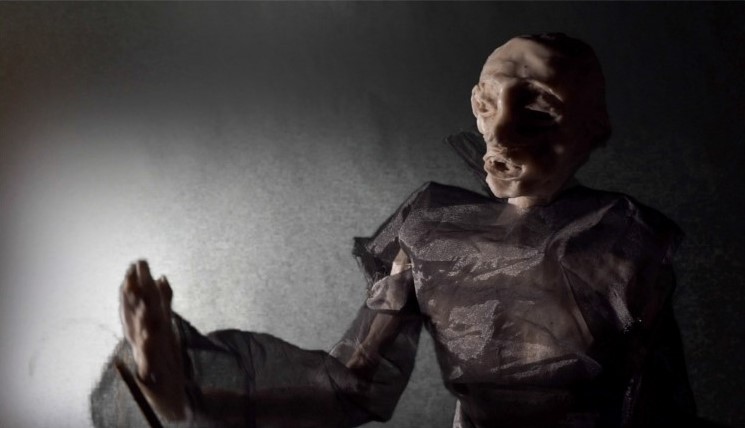
If, like me, you think Dvořák’s “The Spectre’s Bride” is too long – with not enough puppets! – then this should be the very thing for you.
At 43, Dvořák was at the peak of his creative powers (he had only just completed the Symphony No. 7) when he composed his dramatic cantata, and its premiere, in London, in 1885, was an astonishing success. In fact, Dvořák claimed it was the greatest success he had enjoyed up to that time. The Victorians always were rather mad for their oratorios.
I have listened to “The Spectre’s Bride” a number of times on recordings and have found it to be only fitfully interesting. This is especially surprising to me, since the story is so lurid it should grip my inner eight year-old and not let go. The tale may be a familiar one from many European folk tales: a maiden is abducted by the ghost of her fiancé, who gallops off with her, through the air and across a forbidding landscape, with the aim of reaching the phantom’s “castle” – in reality, a graveyard. At the work’s macabre climax, the maiden wrests free and bolts herself inside a cottage, spirits howling at the door. Inside, a corpse, prepared for burial, stirs to do their bidding.
Admittedly, this is an effective setpiece, but until then, I must say, it’s not just the graves that are yawning. And I offer this as someone who generally admires Dvořák. No doubt there are those who have sung the work who could be of a different opinion, and perhaps hearing it in concert is a more compelling experience than listening to it at home.
Dvořák’s setting is based on a poem by Karel Jaromir Erben. Erben, who lived from 1811 to 1870, was an important figure in the development of a Czech national identity. He served as a kind of Brothers Grimm to the Czech people, synthesizing works based on traditional and folkloric themes, into gruesome ballads full of witches, goblins and ghosts. So far, so good.
In my opinion, however, Dvořák was much more inspired when writing his other, more colorful, Erben-influenced pieces, including the comparatively compact symphonic poems “The Water Goblin,” “The Noon Witch,” “The Golden Spinning Wheel,” and “The Wild Dove,” and the enchantingly melancholy, ceaselessly melodic opera “Rusalka.”
Therefore it is with great relief that I stumble across this lean, 29-minute distillation. From its fragmentary nature, I assume that it was designed to be projected at certain key moments during live performance. Maybe that’s what a guy like me needs. Visual aids. But I don’t think so. I just think it’s not that interesting a piece, to demand an investment of 80 minutes. It seems like a miscalculation by a less experienced composer. And I offer this as someone who is generally captivated by Dvořák’s operas, or at least the ones I have seen and own. Of those, “Rusalka” must be near the top of my list of favorites, by any composer.
The puppets are designed by Francesca Borgatta, and they’re all crafted from “recycled objects and materials taken from nature.” Good. If you’re going have them dragged into the gaping maw of Hell, it’s best that they’re biodegradable.
You can learn more about Borgatta at her website, puppetfigures.com.
Leave a Reply to SBOBET เหมาะกับใครCancel reply