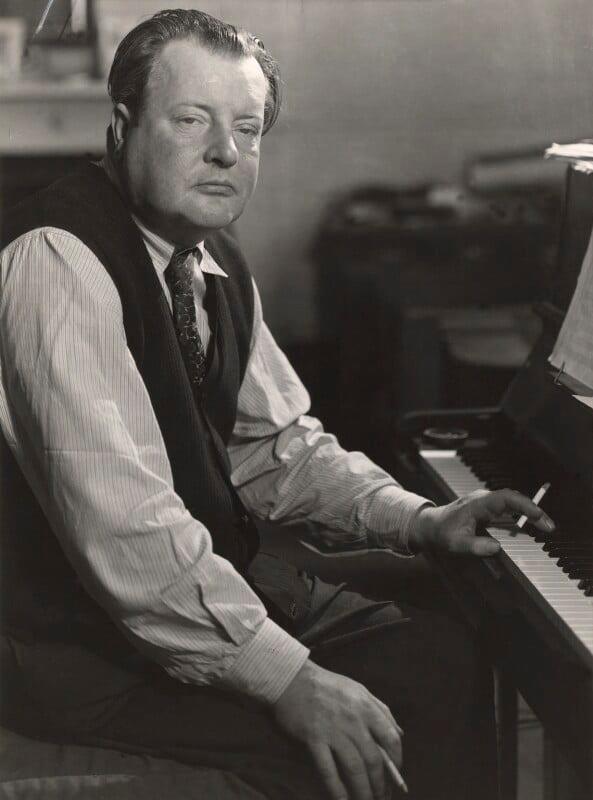
As composer, conductor, critic, brilliant conversationalist, and connoisseur of European culture, Constant Lambert proved himself to be one of the most versatile figures in English music.
This Sunday night on “The Lost Chord,” we’ll benefit from but one facet of this multitalented individual.
Lambert, born in 1905, emerged from an introverted childhood, marred by illness, and blossomed into a preternaturally-gifted musician. At 13, he was writing orchestral works. At 20, he composed a ballet, “Romeo and Juliet,” for Serge Diaghilev and the Ballets Russes.
He gained further notoriety as a reciter of Edith Sitwell’s patter verses for William Walton’s “Façade” (which was dedicated to him). His piano concerto with voice and orchestra, “The Rio Grande,” unashamedly incorporated jazz elements, at a time when it could still provoke scandal. He also directed the first recording of Peter Warlock’s “The Curlew.”
His book, “Music, Ho!,” written at the age of 28, offers concise and witty commentary on the “decline” of modern music. In it, he favors jazz and popular idioms, praises the music Liszt and Sibelius, savages Stravinsky and Les Six, lauds the Marx Brothers, and pokes holes in what he perceives as an artificial “symphonic folk” tradition.
In 1931, he was appointed music director of the Vic-Wells Ballet, soon to become the Sadler’s Wells. While he achieved great acclaim in this capacity, his responsibilities cut into his activities as a composer. Instead, he became largely occupied with the arranging of others’ music. An exception, his gloomy and sardonic choral work, “Summer’s Last Will and Testament,” was coolly received, following as it did so closely on the death of George V. Lambert took the failure to heart, and began to have serious doubts about his talent.
Further, the outbreak of war, alcoholism, and undiagnosed diabetes all took their toll on his vitality and creativity. A long-held fear of doctors, stemming from his childhood experiences, only hastened his decline. Lambert died on August 21, 1951, two days shy of his 46th birthday.
At Sadler’s Wells, he was integral to the planning of each new production, in many cases providing arrangements of lesser-known works by worthy composers. He also became something of an artistic mentor to dancers Margot Fonteyn and Robert Helpmann. In the case of Fonteyn, their relationship developed beyond teacher-pupil. In defiance of his personal demons and deteriorating health, Lambert’s conducting – like his celebrated conversation – remained buoyant and inspired.
We’ll sample vintage recordings of ballet music after Tchaikovsky, Meyerbeer, Boyce, and Rossini. Lambert is the only constant, on “Lambent Lambert,” this Sunday night at 10:00 EST, on WWFM – The Classical Network and wwfm.org.
“Music Ho!,” thanks to Project Gutenberg:
https://gutenberg.ca/ebooks/lambert-music/lambert-music-00-h.html
PHOTO: I only just noticed that Lambert has two cigarettes going at the same time!
Leave a Reply