William Shakespeare certainly has legs. As England’s greatest playwright, his works have been performed, more or less continuously, for 400 years. He’s trod the boards of the Globe, and he’s circumnavigated the globe. This week on “Picture Perfect,” the Bard gets the “the boot,” with film adaptations scored by composers from the Italian Peninsula.
Just about everyone knows about Orson Welles’ difficulties in Hollywood after skewering William Randolph Hearst in “Citizen Kane.” For flying too close to the sun, all at once cinema’s boy wonder was persona non grata. As a result, Welles spent the bulk of his career trying to secure his own funding and devise creative solutions when the money ran out.
There is plenty of ingenuity on display in Welles’ “Othello” (1949). The film was shot on and off in Italy and Tunisia over a period of three years, as Welles periodically halted production to earn yet another paycheck by acting in somebody else’s picture. When at a point the costumes were repossessed, Welles pivoted by staging a key sequence in a Turkish bath, with the actors clad only in towels.
For the music, Welles employed Angelo Francesco Lavagnino, a classically-trained musician who turned to film in the 1950s. He was soon to become one of the best-known Italian film composers of the era. Lavagnino would be engaged by Welles for several other projects, including a television movie of “The Merchant of Venice.”
Lavagnino received very little or even no payment for his work with Welles, though he was honored to collaborate with the legendary director. For his part, Welles was only too happy to work with Lavagnino, whose music he admired, certainly. But there was an additional incentive in that, in Italy, it was the practice that record companies would pay for everything – orchestration, copying parts, and recording – since they kept the rights.
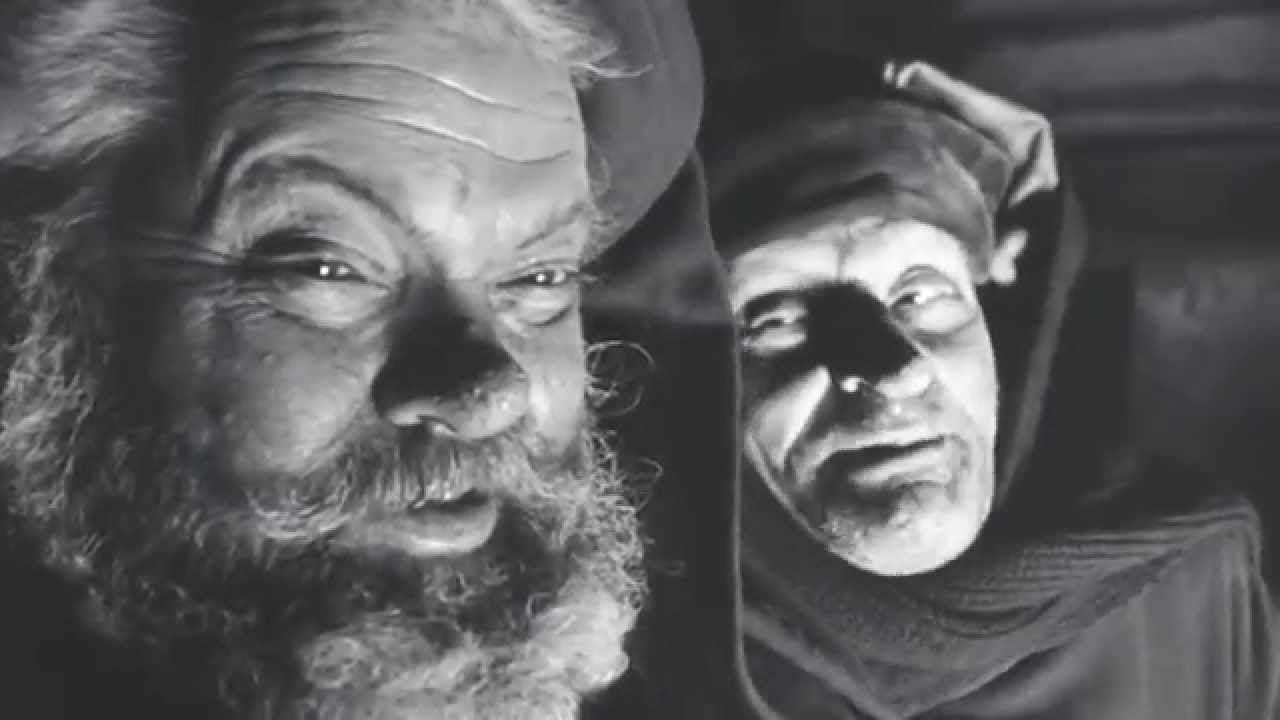
“Chimes at Midnight” (1965), Welles’ compilation of the Falstaff plays, this time a Spanish-Swiss production, was also scored by Lavignino. Welles’ performance in the picture is considered to be one of his finest. Also in the cast were John Gielgud, Jeanne Moreau, and Margaret Rutherford. Vincent Canby of the New York Times wrote that “Chimes at Midnight” “… may be the greatest Shakespearean film ever made, bar none.” Lavagnino modeled much of his score on Early Music, since Welles had used a lot of it on the temp track.
Much less frugal was Franco Zeffirelli, who enjoyed notable success adapting the Bard, both for film and the operatic stage. He directed a lively version of “The Taming of the Shrew,” with Elizabeth Taylor and Richard Burton, and an inexorable one of Verdi’s “Otello,” with Placido Domingo recreating one of his most celebrated roles.
Ennio Morricone was Zeffirelli’s composer of choice for “Hamlet” (1990). The film featured a venerable supporting cast, with Glenn Close, Ian Holm, Helena Bonham Carter, Alan Bates and Paul Scofield, and Mel Gibson did a surprisingly respectable job as the lead. At the time, Gibson was known for his action roles.
Zeffirelli’s biggest success with Shakespeare came with “Romeo and Juliet” (1968). Much was made of the fact that the film’s leads, Leonard Whiting and Olivia Hussey, were closer than usual to the age of the characters in the play. “Romeo” became one of the great date movies and retains its broad appeal. The score, by Nino Rota, spawned a popular hit, “A Time for Us.”
All the world’s a stage! I hope you’ll join me for “Shakespeare Italian-Style,” on “Picture Perfect,” music for the movies, this Saturday evening at 6:00 EST, on WWFM – The Classical Network and wwfm.org.
Leave a Reply