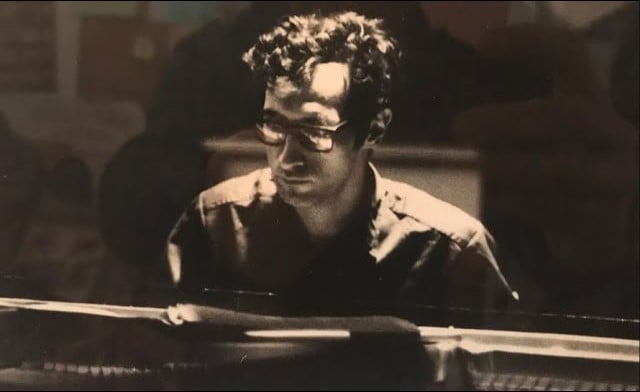
Composer and pianist Frederic Rzewski has died.
A child prodigy from Westfield, Massachusetts, Rzewski (pronounced “ZHEF-skee”) studied at Harvard, with Randall Thompson and Walter Piston, and Princeton University, with Roger Sessions and Milton Babbitt.
In 1960, he fell in with Luigi Dallapiccola and the Italian avant-garde. He was a founding member of Musica Elettronica Viva, or MEV, a collaborative experimental ensemble that prominently featured electronic instruments and benefited from his genius as an improviser. The group achieved notoriety in Italy for its ability to generate riots.
He also taught composition at the Royal Conservatory of Music in Liège, Belgium, and held a number of visiting professorships, at Yale, the University of Cincinnati, the California Institute of the Arts, the University of California, San Diego, the Royal Conservatory of the Hague, and Trinity College of Music London.
His own works often grew out of social or political themes. His best-known music is the titanic set of piano variations on a Chilean protest song, “The People United Will Never Be Defeated!” The work was conceived as a companion piece to Beethoven’s “Diabelli Variations.”
Nicolas Slonimsky described him as a “a granitically overpowering piano technician, capable of depositing huge boulders of sonoristic material across the keyboard without actually wrecking the instrument.” Michael Schell called him as one of America’s greatest living composers, and more specifically one of its most important living composers of piano music.
Rzewski was 83 years-old.
An appreciation by Tim Page in the Washington Post:
Rzewski plays Rzewski:
Rzewski plays Beethoven:
Rzewski with Musica Elettronica Viva:
Leave a Reply