Once they have sufficiently recovered from New Year’s, a lot of people take down their Christmas lights and dismantle their trees. (On the other hand, too many seem to leave them up until spring.) After all, Christmas is past, right? Wrong!
January 5, the eve of Epiphany, is Twelfth Night – the Twelfth Day of Christmas – or is it? Well, it depends on when you start the count. Is Christmas Day the First Day, or should we begin counting the day after? The day after would make January 6, Epiphany (the Christian feast commemorating the visit of the three Magi to the Baby Jesus), the Twelfth Day, which would seem to make sense.
But is Epiphany the Twelfth Day, or should Twelfth Night, a night of reveling to mark the last day of Christmas, really to be observed on the eve of Epiphany, just as Christmas Night, in England anyway, is actually Christmas Eve? The Christian world is divided – and that is only taking into account the West!
Then there’s “Old Twelfth Night” (January 17), but that’s for another post.
In any case, according to tradition, it’s perfectly fine to still have the tree and lights up, but it is bad luck to keep Christmas decorations on display beyond Epiphany. Apparently it was the Victorians who first said so, as a signal that it’s time for everyone to get back to work. The Tudors, on the other hand, kept partying right on through February 1, the eve of Candlemas (the presentation of the Christ Child at the Temple in Jerusalem).
As for Shakespeare’s play, “Twelfth Night,” which would seem to have nothing at all to do with Christmas, it is a charming corollary of a season of merriment, masked balls, and misrule. The first performance took place on Candlemas, 1602.
We may not be able to come to a consensus on the Twelfth Day, but we can say with certainty that the night of January 5 marks the arrival of Befana, the Christmas witch. Befana is the wizened crone who bestows gifts and happiness upon the good children of Italy. If the children are bad, they get a lump of coal. (If the family is poor, they get a stick.) It’s traditional to leave a glass of wine and a tasty morsel for Befana. In return, she will sweep the floors with her broom, symbolically sweeping away the problems of the old year.
Think about that when you worry that your tree is losing too many needles.
Johan Wagenaar, “Twelfth Night Overture”
Mario Castelnuovo-Tedesco, “Twelfth Night Overture”
Glenn Gould, “Twelfth Night: Incidental Music”
Samuel Barber, “Twelfth Night”
Henry Purcell, “If music be the food of love”
Sir Thomas Morley, “O mistress mine”
Erich Wolfgang Korngold, “O mistress mine”
Roger Quilter, “O mistress mine”
Amy Beach, “O mistress mine”
Sir Charles Villiers Stanford, “The rain, it raineth everyday”
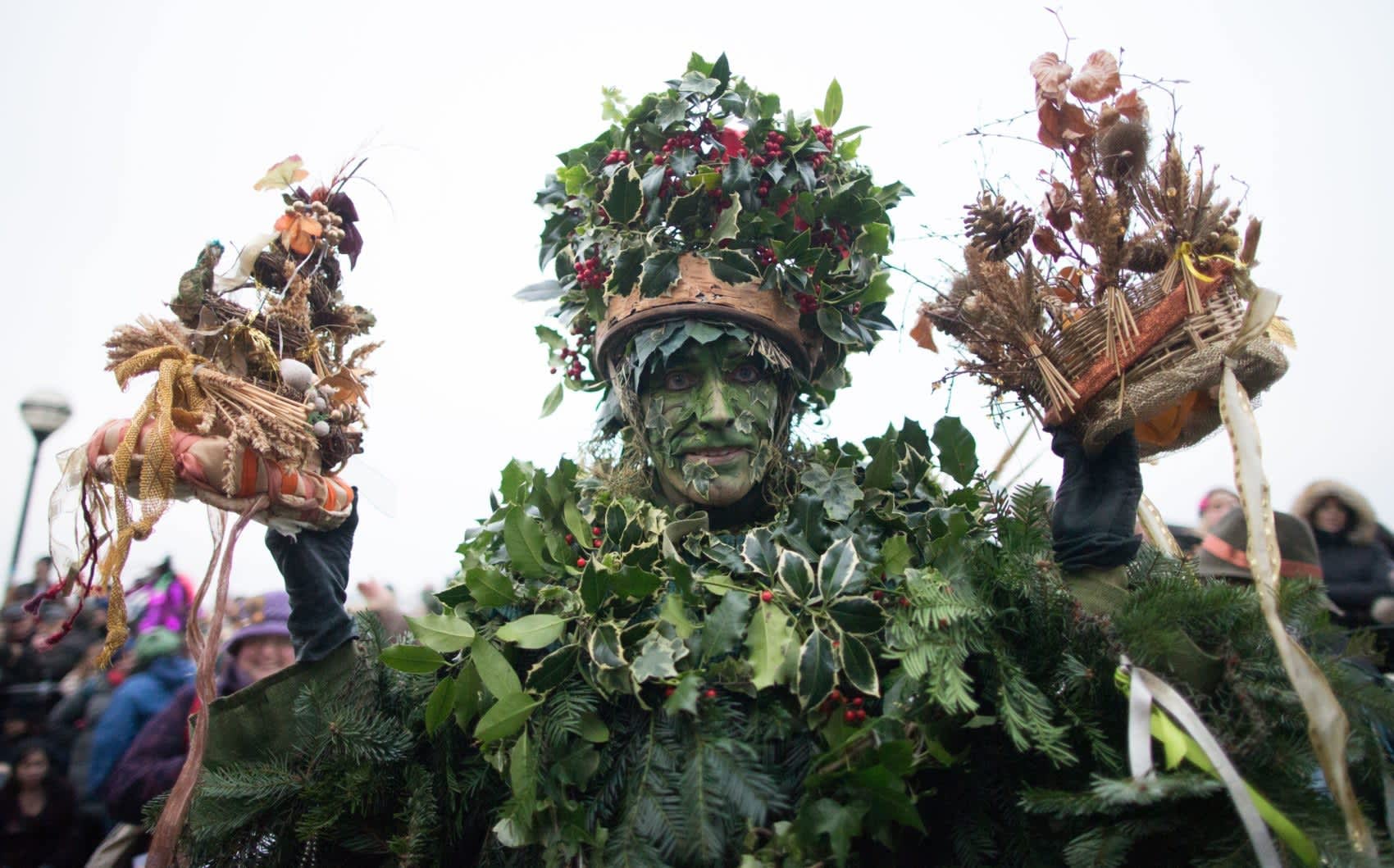
PHOTO: Make way for the Holly Man!
Leave a Reply