Tag: Twelfth Night

  • Old Twelfth Night Wassailing Traditions

    Old Twelfth Night Wassailing Traditions

    Just in case you missed out on this year’s Twelfth Night revels on the 6th (or the 5th, depending on the tradition), you’ve got one more chance tonight!

    January 17th is Old Twelfth Night, a time of joyous celebration, marking the last day of the medieval Christmas festivities and the end of Twelfthtide, the Twelve Days of Christmas, which follows on the heels of Christmas Day.

    What’s that, you say? Christmas is on December 25th? This Anglo-Saxon custom pre-dates the Gregorian calendar. Charmingly, it is still observed in parts of the United Kingdom, particularly in southwest England.

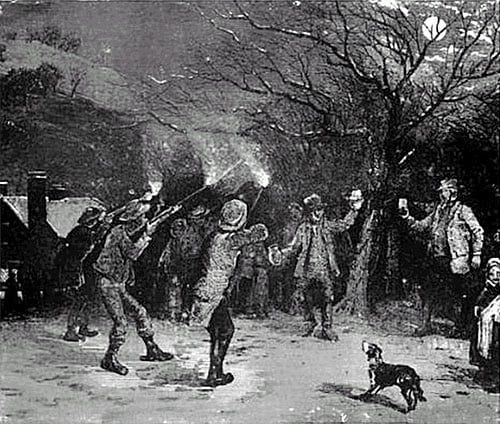
    Families feast on cakes and cider and ale. When they’ve imbibed enough, they go out and wassail the trees. They sing and dance and maybe fire off a few guns (loaded with powder, but no shot), in the certitude that the racket will wake the trees for the coming season and drive off any bad energy.

    Of course, to make the most of it, you’ll have to assemble a gang of folks as steeped in arcane Christmas lore as yourself, unless your idea of a good time is banging pots and pans in the woods alone while wearing yellow stockings and cross-garters.

    A final Merry Christmas to you, until November 27th!

    The resurgence of wassailing in Sussex:

    https://www.youtube.com/watch?v=TezVYpojqSQ

    Wassailing the apple trees in Somerset:

    By the way, according to tradition it’s bad luck to leave your Christmas decorations up beyond Twelfth Night. In order to avert misfortune, if you forget, you’ll need to leave them in place all year. Horrors!

    Perhaps of interest, I found this article in praise of wassailing:

    https://www.theguardian.com/lifeandstyle/2012/feb/08/wassailing-weird-folk-rituals

    And an explanation of Old Christmas Day:

    http://www.christmas-time.com/cp-old.html


    IMAGE: Wassailing the apple trees in Devonshire (1902)
  • Twelfth Night: Traditions, Music, and Befana the Witch

    Twelfth Night: Traditions, Music, and Befana the Witch

    Once they have sufficiently recovered from New Year’s, a lot of people take down their Christmas lights and dismantle their trees. (On the other hand, too many seem to leave them up until spring.) After all, Christmas is past, right? Wrong!

    January 5, the eve of Epiphany, is Twelfth Night – the Twelfth Day of Christmas – or is it? Well, it depends on when you start the count. Is Christmas Day the First Day, or should we begin counting the day after? The day after would make January 6, Epiphany (the Christian feast commemorating the visit of the three Magi to the Baby Jesus), the Twelfth Day, which would seem to make sense.

    But is Epiphany the Twelfth Day, or should Twelfth Night, a night of reveling to mark the last day of Christmas, really to be observed on the eve of Epiphany, just as Christmas Night, in England anyway, is actually Christmas Eve? The Christian world is divided – and that is only taking into account the West!

    Then there’s “Old Twelfth Night” (January 17), but that’s for another post.

    In any case, according to tradition, it’s perfectly fine to still have the tree and lights up, but it is bad luck to keep Christmas decorations on display beyond Epiphany. Apparently it was the Victorians who first said so, as a signal that it’s time for everyone to get back to work. The Tudors, on the other hand, kept partying right on through February 1, the eve of Candlemas (the presentation of the Christ Child at the Temple in Jerusalem).

    As for Shakespeare’s play, “Twelfth Night,” which would seem to have nothing at all to do with Christmas, it is a charming corollary of a season of merriment, masked balls, and misrule. The first performance took place on Candlemas, 1602.

    We may not be able to come to a consensus on the Twelfth Day, but we can say with certainty that the night of January 5 marks the arrival of Befana, the Christmas witch. Befana is the wizened crone who bestows gifts and happiness upon the good children of Italy. If the children are bad, they get a lump of coal. (If the family is poor, they get a stick.) It’s traditional to leave a glass of wine and a tasty morsel for Befana. In return, she will sweep the floors with her broom, symbolically sweeping away the problems of the old year.

    Think about that when you worry that your tree is losing too many needles.


    Johan Wagenaar, “Twelfth Night Overture”

    Mario Castelnuovo-Tedesco, “Twelfth Night Overture”

    Glenn Gould, “Twelfth Night: Incidental Music”

    Samuel Barber, “Twelfth Night”

    Henry Purcell, “If music be the food of love”

    Sir Thomas Morley, “O mistress mine”

    Erich Wolfgang Korngold, “O mistress mine”

    Roger Quilter, “O mistress mine”

    Amy Beach, “O mistress mine”

    Sir Charles Villiers Stanford, “The rain, it raineth everyday”


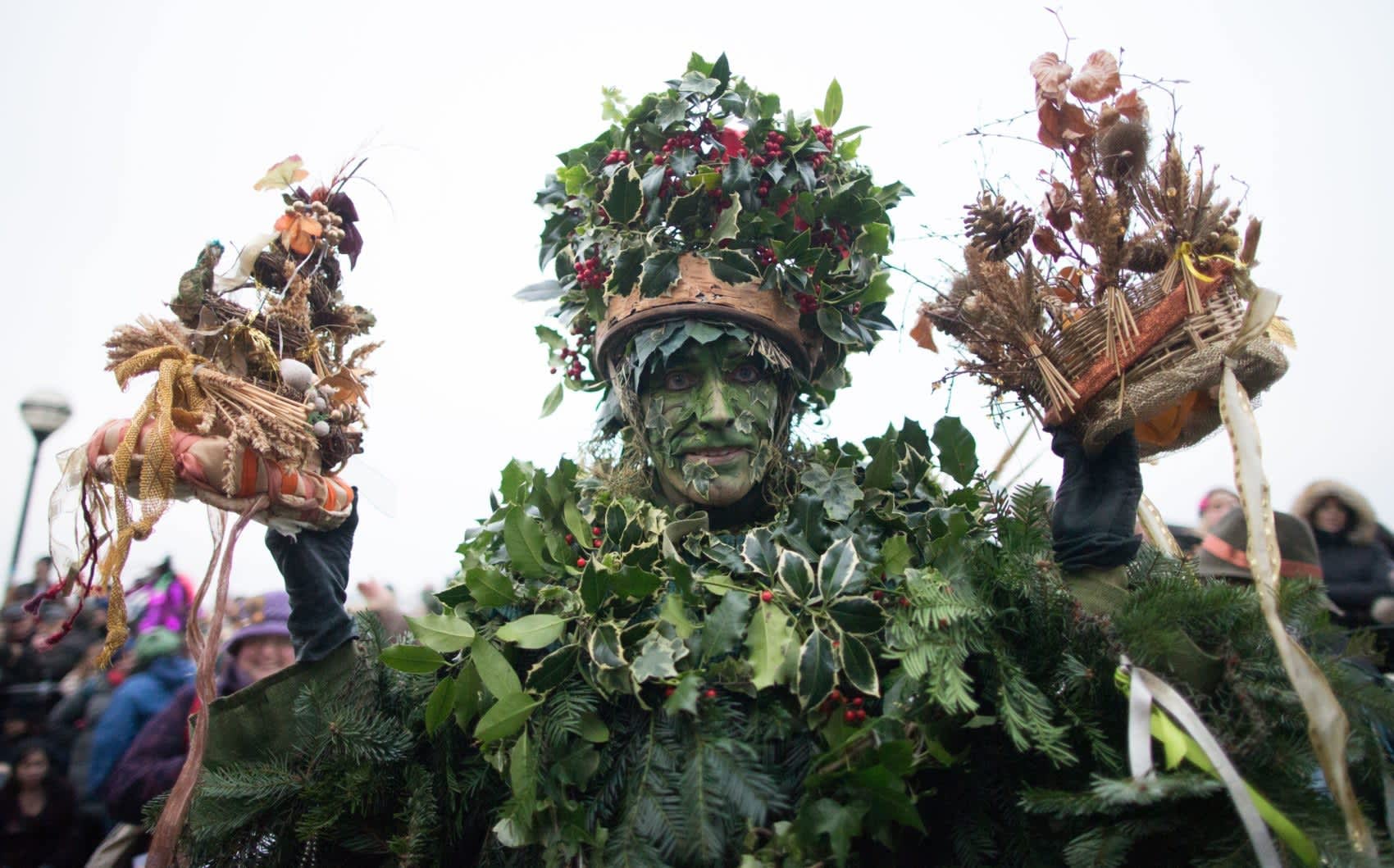
    PHOTO: Make way for the Holly Man!

  • Twelfth Night Christmas Traditions and Folklore

    Twelfth Night Christmas Traditions and Folklore

    Once they have sufficiently recovered from New Year’s, a lot of people take down their Christmas lights and dismantle their trees. (On the other hand, too many seem to leave them up until spring.) After all, Christmas is past, right? Wrong!

    December 5, the eve of Epiphany, is Twelfth Night – the Twelfth Day of Christmas – or is it? Well, it depends on when you start the count. Is Christmas Day the First Day, or should we begin counting the day after? The day after would make January 6, Epiphany (the Christian feast commemorating the visit of the three Magi to the Baby Jesus) the Twelfth Day, which would seem to make sense.

    But is Epiphany the Twelfth Day, or should Twelfth Night, a night of reveling to mark the last day of Christmas, really to be observed on the eve of Epiphany, just as Christmas Night, in England anyway, is actually Christmas Eve? The Christian world is divided – and that is only taking into account the West!

    Then there’s “Old Twelfth Night” (January 17), but that’s for another post.

    In any case, according to tradition, it’s perfectly fine to still have the tree and lights up, but it is bad luck to keep Christmas decorations on display beyond Epiphany. Apparently it was the Victorians who first said so, as a signal that it’s time for everyone to get back to work. The Tudors, on the other hand, kept partying right on through February 1, the eve of Candlemas (the presentation of the Christ Child at the Temple in Jerusalem).

    As for Shakespeare’s play, “Twelfth Night,” which would seem to have nothing at all to do with Christmas, it is a charming corollary of a season of merriment, masked balls, and misrule. The first performance took place on Candlemas, 1602.

    We may not be able to come to a consensus on the Twelfth Day, but we can say with certainty that the night of December 5 marks the arrival of Befana the Christmas witch. Befana is the wizened crone who bestows gifts and happiness upon the good children of Italy. If the children are bad, they get a lump of coal. (If the family is poor, they get a stick.) It’s traditional to leave a glass of wine and a tasty morsel for Befana. In return, she will sweep the floors with her broom, symbolically sweeping away the problems of the old year.

    Think about that when you worry that your tree is losing too many needles.


    PHOTO: Make way for the Holly Man!

  • Twelfth Night Confusion Christmas Day Count?

    Twelfth Night Confusion Christmas Day Count?

    Okay, as a lover of all things Christmas, I’m confused. What day of Christmas is it anyway?

    I know it’s Epiphany, but isn’t it supposed to be the Twelfth Day of Christmas, as well? Did I miss my Twelfth Night revel? Was I supposed to start counting on Christmas Day, or the day after? My certainty of Christmas lore is shaken.

    According to what I glean from Wikipedia (which is never wrong), nobody quite knows the correct answer – or they think they do and that everyone else is full of s***.

    I’d better put on my yellow stockings and cross garters just in case.

    http://en.wikipedia.org/wiki/Twelfth_Night_(holiday)

    Perhaps that explains the Shakespearean subtitle, “What You Will.”

Tag Cloud

Aaron Copland (92) Beethoven (95) Composer (114) Film Music (123) Film Score (143) Film Scores (255) Halloween (94) John Williams (187) KWAX (229) Leonard Bernstein (101) Marlboro Music Festival (125) Movie Music (138) Opera (202) Philadelphia Orchestra (89) Picture Perfect (174) Princeton Symphony Orchestra (106) Radio (87) Ralph Vaughan Williams (85) Ross Amico (244) Roy's Tie-Dye Sci-Fi Corner (290) The Classical Network (101) The Lost Chord (268) Vaughan Williams (103) WPRB (396) WWFM (881)

DON’T MISS A BEAT

Receive a weekly digest every Sunday at noon by signing up here


RECENT POSTS