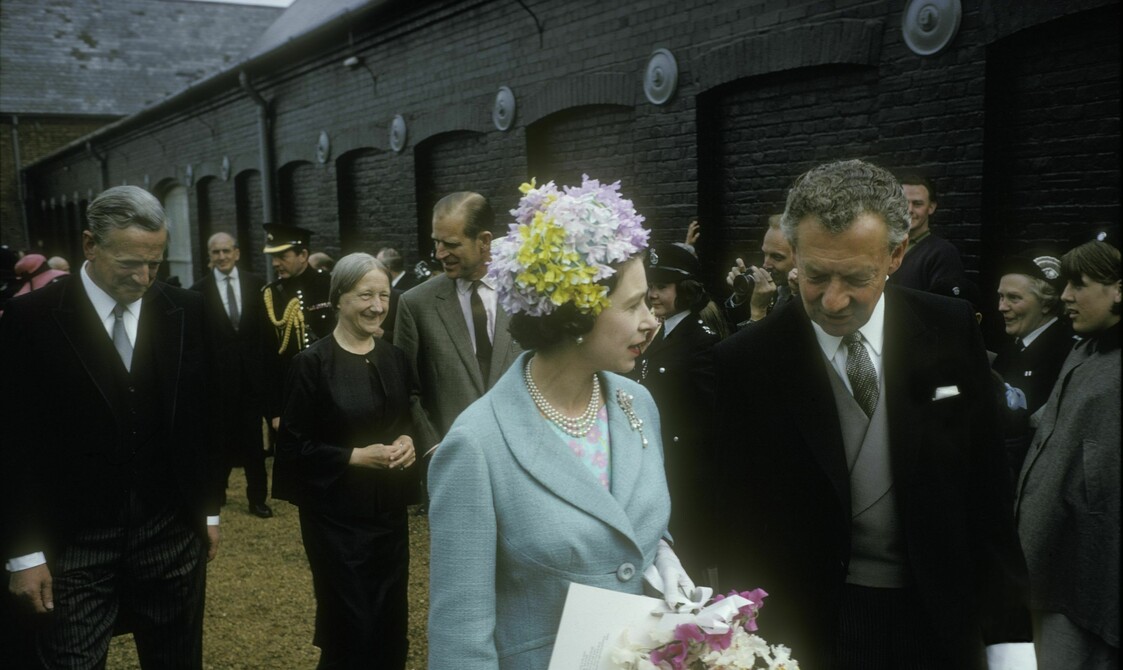
Thank you so much to Colin Curless, who directed me to this touching article (linked below) about Queen Elizabeth II and her exceptional kindness to Benjamin Britten toward the end of his life. Britten enjoyed a special relationship with the Royal Family. The Queen Mother was a patron of the Aldeburgh Festival, founded by Britten in 1948, and the Queen, by all appearances, was a good friend over at least the course of his last decade.
Britten wrote an opera, “Gloriana,” as part of the celebrations surrounding Elizabeth’s coronation in 1953. It was given its premiere at Covent Garden with members of the Royal Family, including the Queen, in attendance. The opera, which portrayed Elizabeth I in what many considered an uncomfortably human light, was downbeat and “modern” and rather coolly received. If Elizabeth II didn’t care for it, she didn’t hold it against him. In fact, the composer was left with the impression that she was “delighted and flattered.”
The Queen opened the Snape Maltings Concert Hall at Aldeburgh in 1967, for the festival’s 20th anniversary. After the hall was damaged by fire in 1969, again she was in attendance at its reopening in 1970.
Britten never spoke publicly about his sexuality and was very careful about public displays of affection with his muse and life partner, the tenor Peter Pears. Nevertheless, the couple came under scrutiny of the police and at one point Britten wondered if Pears would have to be set up in a sham marriage.
It was only in 1967 that same-sex relationships were decriminalized in England. (In Scotland, it was not until 1981, and in Ireland 1993.) Although homosexuality was illegal in the UK for the first 54 years of Britten’s life, the Queen tacitly acknowledged his and Pears’ relationship, and after the composer’s death, she sent Pears a personal message of condolence. In all, Britten and Pears were creative and personal partners for almost 40 years.
When Britten died in 1977, his memorial service at Westminster Abbey was headed by the Queen Mother. It’s believed that Britten had declined a knighthood some years earlier (oddly, there doesn’t seem to be a record of it), but toward the end of his life, he accepted a life peerage.
This article is the first time I ever heard that he was offered the post of Master of the Queen’s Music – unusually, by Elizabeth herself, rather than an assistant, in advance of a public announcement – which Britten felt he had to turn down in light of his failing health.
You can read more about the Queen and Britten here:
No one seems to have posted online the definitive recording of Britten’s “A Birthday Hansel,” with Pears and harpist Osian Ellis, the work composed for the Queen Mother referenced in the article. (There are other performances available if you search on YouTube.) However, I did come across this interesting 10-minute documentary, full of fascinating footage and commentary. The Queen makes an appearance around the 7-minute mark.
PHOTO: Britten and the Queen at Aldeburgh. In the background, left to right, Peter Pears, Imogen Holst (daughter of Gustav, a composer herself who served as Britten’s assistant), and Prince Philip
Leave a Reply