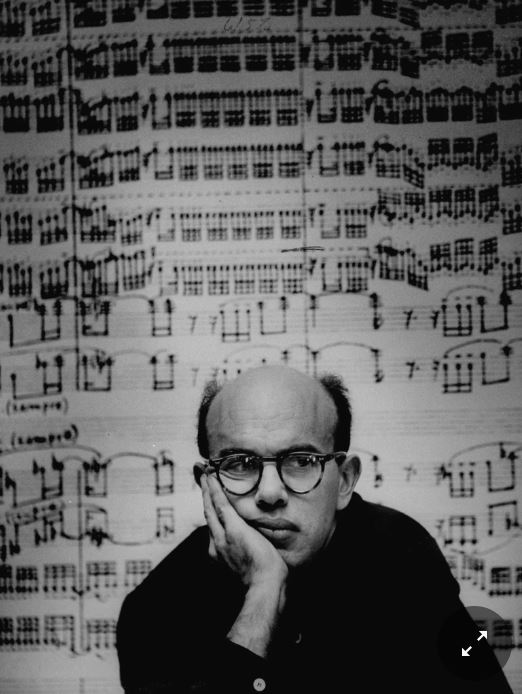
75 years ago today, the greatest American symphony no one knows was given its debut by the Boston Symphony, conducted by Leonard Bernstein.
Harold Shapero was 27 at the time his “Symphony for Classical Orchestra” received its premiere in 1948. He was one of the so-called “Boston Six,” a loose collective of composers that, along with Shapero and Bernstein, included Arthur Berger, Aaron Copland, Irving Fine, and Lukas Foss.
Shapero met Bernstein while a student at Harvard, where he studied composition with Walter Piston. He was also a student of Paul Hindemith at the Berkshire Music Center at Tanglewood, kind of a home away from home for the Six, and with Nadia Boulanger at the Longy School of Music. He even managed to secure some critiques from his idol, Igor Stravinsky.
Copland was perplexed by Shapero’s symphony, which may have been steeped in Stravinsky’s then-prevalent Neoclassicism, but clearly tipped its hat to Beethoven, with elements modelled on Beethoven’s Symphonies Nos. 3, 5, 7 & 9. Describing the composer as “the most gifted and baffling of his generation,” Copland added, “Stylistically, Shapero seems to feel a compulsion to fashion his music after some great model. He seems to be suffering from a hero-worship complex – or perhaps it is a freakish attack of false modesty.”
Bernstein would record Shapero’s 45-minute magnum opus with the Columbia Symphony Orchestra (in glorious mono). In the 1980s, the work was revived by André Previn and the Los Angeles Philharmonic (who also recorded it), and I know David Zinman and Leon Botstein conducted it in concert. There’s also a very fine album of some of Shapero’s other orchestral music, issued within the past few years by Boston Modern Orchestra Project (BMOP), conducted by Gil Rose. And if you’re a trumpet player, you may have encountered Shapero’s compact and appealing Trumpet Sonata.
Still, orchestras don’t seem to be beating a path to this worthwhile music, a fate shared by works of too many of Shapero’s mid-century colleagues. It’s all about name recognition, and if you’re not Copland, Barber, or Bernstein, you’re out of luck. (Gershwin died earlier, in 1937.) Why break your back and your budget rehearsing unfamiliar music when to play the standard repertoire is pure muscle memory, that also guarantees butts in seats?
The ascendency of serialism and a relative lack of interest in Shapero’s music caused him to gradually back off of composition. Like Sibelius, his last decades could be viewed as a great silence. Only in Sibelius’ case, he was a victim of his own success. Shapero never found himself in the enviable, albeit paralyzing position of trying to top his own, lavishly-praised masterworks. Largely neglected until the Previn revival, save for an occasional recording of a chamber or instrumental piece on New World Records, Shapero died in 2013 at the age of 93.
It’s a shame about the symphony. The orchestration is bright and cheerful, the tone is optimistic, the graceful craftsmanship is imbued with warmth and charm, and there are glints of wit in its abundant vitality. Check it out. You’ll be glad you did.
https://www.youtube.com/watch?v=L5mVXYLeMko
Portrait of Harold Shapero by Gordon Parks
Leave a Reply