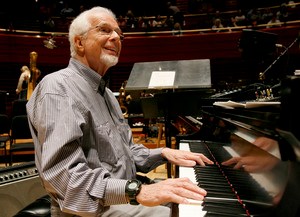
This Nero didn’t play as Philly burned.
Peter Nero, who conducted the Philly Pops for 34 years, is dead. At the orchestra’s founding in 1979, it was Nero’s intention to take on Arthur Fiedler and the Boston Pops. For decades, Boston had been ensconced as the very model of a modern major pops orchestra. With a touch of hubris, Nero stated at the time, “I’d like to beat the pants off them.” Granted, by then, Fiedler was tottering into the homestretch of a 50-year career as Boston’s music director. Nevertheless, the pants stayed on. Nero left the Philly Pops in 2013, when the orchestra could no longer afford his salary.
A multifaceted musician, Nero started out as a piano prodigy. He earned the respect of no less than Vladimir Horowitz, and Roy Charles would cite him as one of his favorite pianists, alongside Art Tatum.
It was hearing Tatum that changed the course of Nero’s life. He fell in love with jazz and determined not to be pigeonholed, instead embracing and often combining music from a variety of genres. His enthusiasms would carry him from piano competitions to smoky jazz clubs to posh concert halls to open-air band stands before audiences numbering in the thousands.
He performed “Rhapsody in Blue” with Paul Whiteman, who had introduced the piece with George Gershwin at the piano. Nero was celebrated as a premier interpreter of Gershwin’s music.
His first album for RCA, “Piano Forte” (1961), was a hit, earning him a Grammy for Best New Artist. The next year, he would garner another, for Best Performance by an Orchestra or Instrumentalist with Orchestra – Primarily Not Jazz or for Dancing (what a cumbersomely named category!), for “The Colorful Peter Nero.” He would be nominated ten more times.
In all, he released 67 albums. His instrumental version of Michel Legrand’s “Summer of ‘42” became a million best seller. He appeared on “The Ed Sullivan Show” 11 times, and made numerous appearances on “The Tonight Show” with Johnny Carson. He also worked with Frank Sinatra, Mel Tormé, Andy Williams, Dizzy Gillespie, Diane Schuur, Johnny Mathis, Roger Kellaway, Elton John, and his bête noire, Arthur Fiedler.
In the 1970s, Nero’s focus shifted to conducting and composing. He performed up to a hundred concerts a year, often at the piano, playing with one hand, while conducting the orchestra with the other.
He wrote a cantata after Anne Frank’s “The Diary of a Young Girl.” It’s said to have been the first musical treatment of the material, and the work embraced rock, symphonic, and traditional Jewish music. He conducted the piece in several cities, including with the Greater Trenton Symphony in 1973.
During his decades with the Philly Pops, Nero made his home in Media, PA. The orchestra’s repertoire was a mix of orchestral arrangements of popular jazz, swing, Broadway, and blues, with a smattering of light classical.
His departure from Philly was not an amicable one. Even then, in 2013, the Philly Pops was experiencing choppy waters. The orchestra filed for bankruptcy and asked Nero to take a salary cut. Nero declined.
The orchestra continues to struggle. The 2022-23 season was a particularly dramatic chapter in its turbulent history. But that’s for another post, one I don’t particularly feel like writing!
Intriguingly, following the death of Marvin Hamlisch in 2012, it was revealed that the latter was poised to take over the orchestra’s reins. David Charles Abell was named principal conductor and music director in 2020.
In the 1990s, Nero served concurrently as Pops Music Director of the Florida Philharmonic Orchestra. He also played with his jazz trio. Post-Philly, Nero returned to concertizing with his longtime bassist, Michael Barnett.
At the time of his death, he was 89-years-old. R.I.P.
Nero plays “Rhapsody in Blue” with Fielder and the Boston Pops
“Fiddler of the Roof” on “The Ed Sullivan Show”
“Tea for Two” (for three)
Million-selling “Summer of ’42”
“Rocky” at Independence Hall
“Rhapsody in Blue” in Philly
Leave a Reply