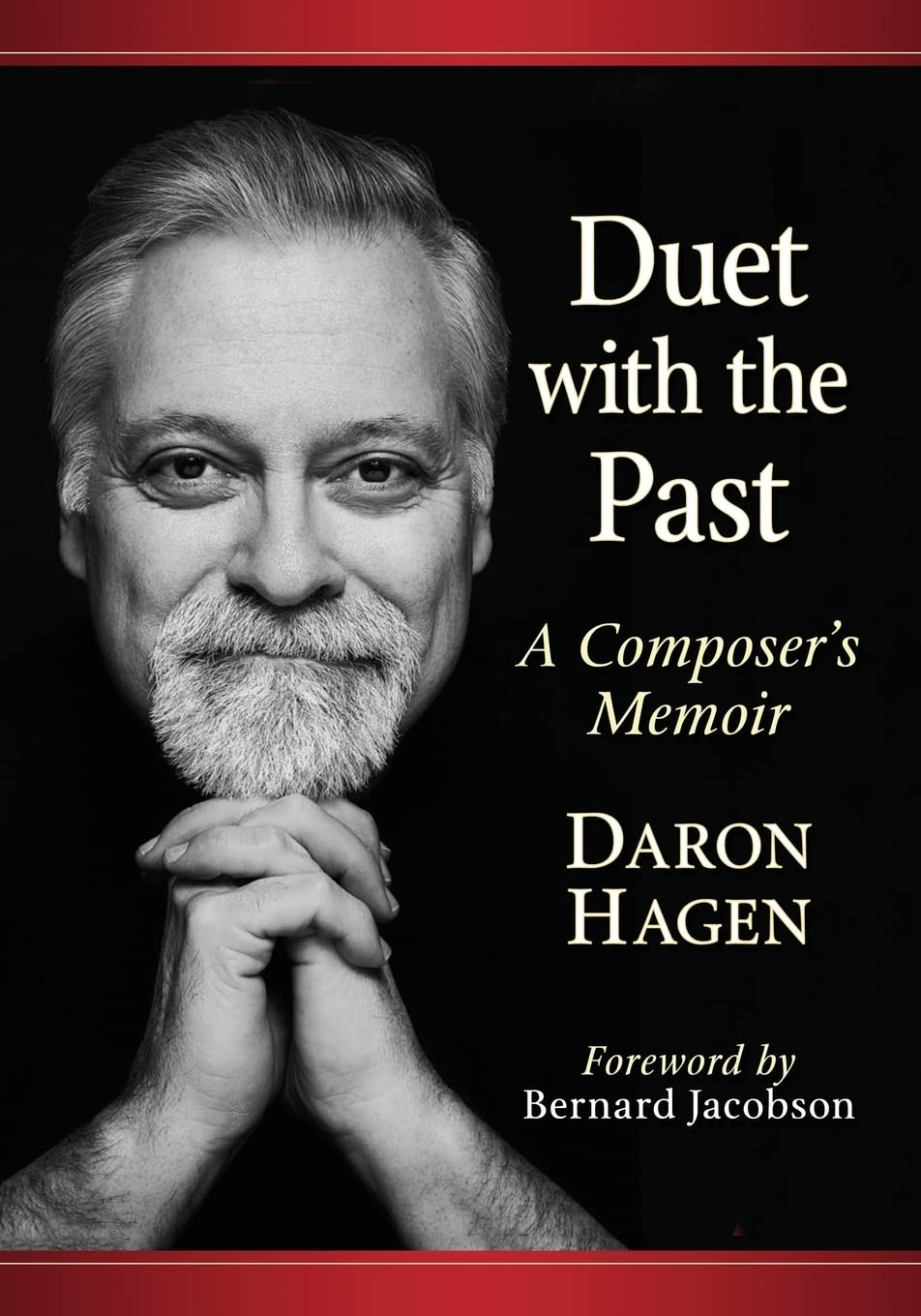
If Daron Hagen weren’t a composer, he would be one hell of a writer. He IS one hell of a writer. I already knew that, from the too few times I’ve visited his blog. But I finally got around to reading his memoir, “Duet with the Past,” last month, and I have to say, it is one of the best-written books, fiction or nonfiction, I’ve read in a while.
I would think it would be an absorbing read for anyone who would chance to open the front cover, but it is especially compelling for somebody with a deep interest in mid-century American art music. Not that Hagen is of that generation – he’s only a few years older than I am – but his experiences as a student, composer, and copyist brought him into contact with an astonishing array of legends and luminaries of the era, including Leonard Bernstein, Ned Rorem, David Diamond, Virgil Thomson, Gian Carlo Menotti, Lukas Foss, Eugene Ormandy (and Philadelphia’s associate conductor William Smith), Roger Sessions, Milton Babbitt, Jack Beeson, and Aaron Copland – as well as Joan Tower, David Del Tredici, Michael Torke, and Aaron Jay Kernis, among others.
The writers he’s known and collaborated with include Paul Muldoon and Gore Vidal. My friend and colleague, Kile Smith, gets a few mentions (Hagen once worked with him at the Fleisher Collection at the Free Library of Philadelphia), as does pianist Hugh Sung (who I finally just met for the first time a few weeks ago). The ghost of Marc Blitzstein, with whom Hagen in his youth is said to have borne some resemblance, also frequently rears his head.
All fascinating, of course, but Hagen’s story is even more riveting to me personally, as it seems he and I have lived parallel lives in a flabbergasting number of ways. Although I was never conscious of our paths having actually crossed, they must have. There are just too many shared interests and common hang-outs. You might say ours is a story of near-misses and there-but-for-the-grace-of-Gods.
Hagen arrived in Philadelphia only a few years before I did, to study at the Curtis Institute of Music. My college girlfriend worked at Curtis. He and I both like reading and books and are viscerally affected by the power of the written word. I worked in at least six bookstores in Philadelphia, one of them managed by Rorem’s niece. (Rorem was one of Hagen’s principal teachers.) One of the book shops I owned was within a block of Curtis. We’ve both amassed sizable libraries.
We both lived in the same neighborhood (as did, later, Jennifer Higdon), although perhaps at different times. But if you live in Center City Philadelphia, an expanse of less than 30 blocks and perhaps ten blocks up and down, you pretty much see everyone.
We were both regulars at the late, lamented neighborhood greasy spoon, Little Pete’s, on South 17th Street above Locust (right around the corner from Curtis), and Hagen totally nails the vibe, recollecting the smell of burnt coffee, the lime-green wrap-around counters, and the drunks nodding over their eggs in the wee hours of the morning. One of those drunks could very well have been me, on the way home from McGlinchey’s, prior to standing on a street corner with a friend and conversing volubly until the skies began to lighten. I read a substantial portion of “Les Miserables” there, and D.H. Lawrence’s “Women in Love,” and Edmund Wilson’s “Axel’s Castle,” the letters of Abelard and Heloise, and a charming book of essays, “Dreamthorp,” by Alexander Smith.
We also both clearly love classic movies. Hagen grew up in a suburb of Milwaukee, within driving distance of a faded movie palace turned into a repertory house, and he writes lovingly of his experiences there. If I were to do the same, it would involve two or three such theaters I haunted during my teens and 20s.
Our upbringing was also eerily similar, with artistically-inclined, nurturing mothers and fathers ill-equipped to manage their impulses. I have to say, I was much luckier than Hagen was with how my situation turned out, as my mother got my sister and me away before any lasting physical or psychological damage could occur. Nevertheless, Hagen and I are both prone to nostalgia (though it’s possible I may be the more sentimental of the two of us) and melancholy. We’ve both gone on some legendary benders and stared into the abyss.
So, yes, perhaps the reason the book connected so well with me is because I identified so personally with many of his experiences.
Unlike me, Hagen managed to harness all those disparate elements and will himself into an artist of merit. Talent is great, but you also need drive, and Hagen’s work ethic, in all weather, is to be admired. He’s managed to build up quite the catalogue, especially, but by no means exclusively, as a successful opera composer. I’ve had several of his pieces in my library for years, and played a few on the radio. I could swear, at some point, I may even have introduced a concert broadcast of his opera “Amelia.”
Since finishing the book, I’ve ordered his four commercially-available operas (“Shining Brow,” “Vera,” “Bandanna,” and “Orson Rehearsed”). I am sorry so many of his major works have yet to be recorded. I would love to hear those he describes as Korngoldian – even his overture to “Much Ado About Nothing,” written for the Philadelphia Orchestra, which earned him much scorn for being so frothy and allegedly lacking in substance. I assure you, Hagen has composed plenty of substance. Are composers not allowed to enjoy themselves once in a while? Tragically, the handwritten manuscript for a “Much Ado” opera he had been at work on was left in his room at the Hotel Warwick (across the street from Little Pete’s) as he fled Philly in humiliation, and the opera is now lost.
But no matter what adversity life tossed his way, Hagen just kept churning out music. I honestly don’t know how he’s done it, subletting his living spaces (and with them, apparently, his adorable, impressively long-lived cat, Clara, always there to nuzzle him on his battered return, who made it to 24 and enjoyed the first year of Hagen’s happy, stabilizing marriage) to take off to Europe or for residencies at artists’ colonies, burning through all his money, but somehow always landing on his feet with a plum commission and finally finding domestic happiness in Rhinebeck, New York, near Bard College (where I travel every summer for the Bard Music Festival), in a quaint Victorian home with his loving family. (I have eaten at the Tivoli restaurant he mentions in the book, where he and Joan Tower dine.)
He’s not afraid to share his missteps, but if nothing else his life story demonstrates that even when you bottom-out, if you just hang in there, things might work out all right in the end. Talent and hard work are important, but luck, or chance, if you will, will always be a deciding factor. Life after all is a game of Chutes and Ladders. Hagen’s similes are less trite than mine, but he would be the first to admit he’s waded through quicksand on occasion, sometimes because of bad choices, sometimes not, only to have been lifted on the wings of angels. (His wife is composer, vocalist, and visual artist Gilda Lyons.)
By coincidence, Hagen’s latest album, “The Art of Song” (recorded at Curtis with Lyons one of the singers), was just released by Naxos within the last couple of weeks. Words and poetry have always been central to Hagen’s inspiration (which likely explains, in part, why he himself is such a good writer), and opera, song, and large-scale cycles comprise a significant portion of his output. As stated in the promotional material, “Divided into four ‘life seasons,’ this richly emotional cycle embraces themes that range from the human cost of America’s politics since the Civil War; the rueful wisdom of aging, love and nostalgia; and on towards tragedy, faith and an acceptance of nature’s cycles.”
Hagen can be nostalgic and hardnosed, pensive and reckless, ugly and beautiful, vainglorious and modest. But who among us has not been?
He writes with all five senses. Proust had his madeleine; Hagen had… well, everything apparently. We’ve all had the experience of certain scents conjuring memories, but Hagen, it seems, never forgot a smell, whether it be that of a dusty curtain in an old movie house or that distinctive blend of aromas that characterize any city. You can tell he’s always been a faithful journaler, which is only one more thing to admire. (Regrettably, my own very sporadic attempts have never made it past a few entries.)
He also has a good mind for similes and metaphors and all those tools of master storytellers and literary artists that make their work that much more engaging and enriching.
Not that the subject matter is always delightful. Hagen can be brutally honest, and it’s not always pretty. But in his writing, as in his music, he is dedicated to serving truth. He does so with enviable recall, a powerful command of observation, often great sensitivity, and a poetic disposition.
In the interviews I’ve seen, he’s as thoughtful and well-spoken in life as he is on paper.
There are plenty of samples of his music posted online and a lot of recorded interviews. You’d be doing yourself a favor by getting to know Daron Hagen.
Teaser for “The Art of Song”
Daron Hagen: The Human Element
Composer’s website
His blog
https://www.daronhagen.com/blog
An elegy for Little Pete’s
Leave a Reply