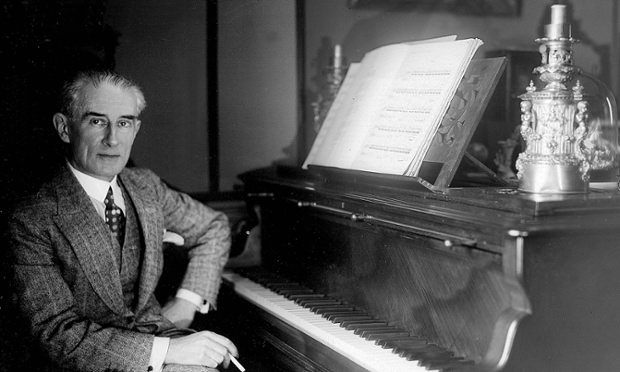
The most torturous piece of music ever conceived by one of the great composers… IS FOR LOVERS?
Maurice Ravel’s “Bolero” has always been popular. Except with me. I hate it, and I’ve never been afraid to say so. It’s easily the most maddening piece by a composer I love. Perfect background for housecleaning, perhaps – especially when drowned out by the vacuum – but to my knowledge, it was never associated with any kind of eroticism until Blake Edwards and Bo Derek gave it a shot in the arm with “10” (1979). The spike in record sales precipitated by its use in the hit movie generated an estimated one million dollars in royalties and made Ravel the best-selling classical music composer, 40 years after his death. Another 40 years later, and it’s been calculated that “Bolero” is performed somewhere in the world once every 15 minutes.
Clearly, “Bolero” is worth big bucks, and although it’s slipped into the public domain in many areas of the world – including for the moment in France – there have been all sorts of legal sleights of hand in order to attempt to extend its copyright. EU copyright holds that a work is protected for 70 years after the death of its creator. Ravel died in 1937. However, in France, an additional 8 years and 120 days are added for musical works that may have suffered from the effects of World War II. In the case of “Bolero,” once that option was exhausted, its copyright holder played the co-author card, alleging that since the work was originally co-conceived as a ballet, credit for its creation should be shared by its choreographer, Bronislava Nijinska, and its scenarist, Alexandre Benois. Benois died in 1960. The legal claims were eventually rejected and “Bolero” remained in the public domain.
Parenthetically, Ida Rubinstein, the dancer who actually set the project in motion, also died in 1960. It was she who had asked Ravel to orchestrate six piano pieces from Isaac Albéniz’s “Iberia.” Ravel had already begun work on the assignment when he was informed that the pieces had already been orchestrated, by conductor Enrique Fernández Arbós. Ironically, copyright law prevented any other orchestrations from being made.
Now guess what? As of today, Valentine’s Day, “Bolero” is back in court.
Ravel had no children. On his death, the rights to his music passed to his brother, Édouard. Édouard, also childless, made his hairdresser, Jeanne Taverne, his universal legatee. (I’m not making this up.) When Taverne died, the copyright passed to her husband, Alexandre. Next in line was Georgette Lerga, Taverne’s manicurist (!) and second wife. When Lerca died, she bequeathed her fortune to her daughter, Évelyne Pen de Castel, who now controls 90 percent of Ravel’s copyrights. (SACEM, a company in Monaco owns the remaining 10 percent.)
Here are the opening two paragraphs, in English translation, from an article in today’s Le Figaro, reporting on the latest wrinkle.
“On Wednesday, February 14, a historic trial for classical music enthusiasts begins at the Nanterre court. The beneficiaries of Maurice Ravel, who died in 1937, will fight tooth and nail against Sacem. At stake: the millions of euros in royalties generated by ‘Boléro,’ the composer’s flagship work. Ravel’s rights holders receive their rights through a myriad of overlapping companies, changing names and tax havens.
“Holder of moral rights and sole heir of Maurice Ravel, Évelyne Pen de Castel, caught in the Panama Papers, has a lot to lose. She controls 90% of Ravel’s copyright through the Caconda company. The composer’s publishing rights are held by the Nordice and Redfield companies. Who is behind it? Their lawyer won’t tell us. At the forefront of the fight, we also discover Jean-Manuel Mobillion, known as Jean Manuel de Scarano. With the fortune accumulated thanks to the disco group Santa Esmeralda (“Don’t Let Me Be Misunderstood”)…”
The rest of the article is paywalled. But you’ll find more here:
https://www.lexology.com/library/detail.aspx?g=d67278bd-3da1-4f66-88aa-2c6f4dbd3356
Beyond that, I don’t know what to tell you.
Ravel once described “Bolero” as a piece for orchestra without music.
He elaborated, “It constitutes an experiment in a very special and limited direction, and should not be suspected of aiming at achieving anything different from, or anything more than, it actually does achieve. Before its first performance, I issued a warning to the effect that what I had written was a piece lasting seventeen minutes and consisting wholly of ‘orchestral tissue without music’ – of one very long, gradual crescendo. There are no contrasts, and practically no invention except the plan and the manner of execution.”
The piece is like an inexorable automaton that finally blows a gasket.
At its first performance at the Paris Opera on November 20, 1928, over the shouts, stamps, and cheers of the audience, one woman was heard to shout, “Au fou! Au fou!” (“The madman! The madman!”). When Ravel was told, he is said to have replied, “That lady… she understood.”
If the court finds that “Bolero” is indeed a collaborative work, it could return to copyright through at least 2039!
In the United States, it remains protected until January 1, 2025, as it was first published here with a prescribed copyright notice in 1929.
Wring out your dead! Whether it be Maurice Ravel or St. Valentine, there’s gold in them thar hills.
Happy Valentine’s Day à la Maurice Ravel!
On a related note, it was on Valentine’s Day 40 years ago that Torvill and Dean were awarded an Olympic gold medal and became the highest-scoring figure skaters of all time for a single program – with a rating of twelve perfect 6.0s and six 5.9s – for their artistic interpretation of “Bolero.” (The couple went on to achieve an even higher score at the 1984 World Championships.)
For their routine, it was necessary to abridge Ravel’s original piece, which in the composer’s own recording lasts over 16 minutes. They couldn’t get it down to any shorter than 4 minutes and 28 seconds. So a loophole was exploited in which they engaged in 18 seconds of preludial kneeling and swaying to the music, before the clock officially started when their skates touched the ice for their “4 minute, 10 second” routine.
When other couples began to follow suit, either kneeling or lying on the ice, the rules were changed. I suppose otherwise what would be to keep someone from attempting a routine set to Satie’s “Vexations” (which in performance can span anywhere from 14 to 24 hours)?
Mon Dieu!
The Philadelphia Orchestra performs “Bolero”
Ravel conducts (some say it’s really Albert Wolff)
https://www.youtube.com/watch?v=8JKXbTHSTvk
Torvill and Dean’s Olympic “Bolero”
In Canada
The manuscript at the Morgan Library
Trailer for Blake Edwards’ “10”
PHOTOS: Ravel (top) with (left to right) Bo Derek, Torvill and Dean, and the skull of St. Valentine
Leave a Reply