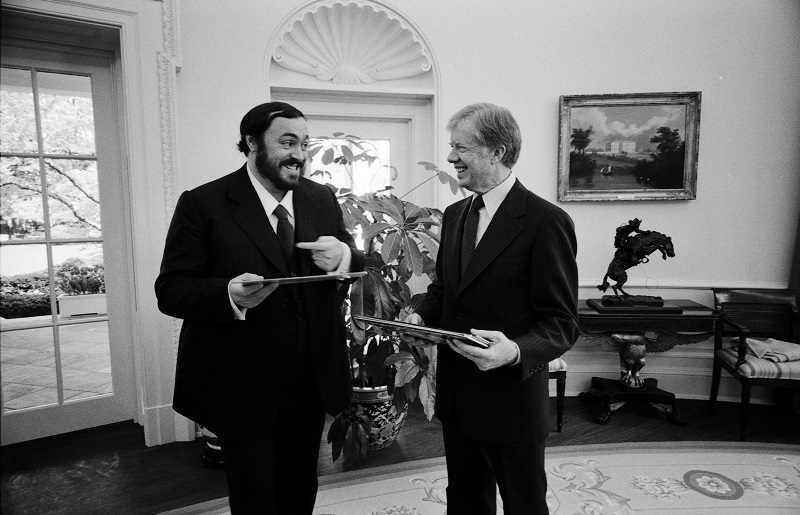
On this national day of mourning, one final appreciation of President Carter’s love of the musical arts. As I’d previously noted, Carter enjoyed a broad array of music from all genres. Reminiscences in the press in recent days remind us of the White House Jazz Festival, the president’s lifelong ties to gospel and country music, and his friendships with Bob Dylan and Willie Nelson. Many describe him as the Rock ‘n’ Roll President. But Carter seems to have held classical music especially dear, dating back to at least his days at the U.S. Naval Academy. (His roommate was a pianist, and the two pulled their resources to build a considerable collection.) That said, both he and Rosalynn had already been instilled with an appreciation of classical literature, art, and music, which the president attributed, with gratitude, to the efforts of Julia Coleman, a high school teacher in Plains, Georgia.
Of necessity, anybody who wants to get into the White House had best not come across as too high brow on the campaign trail, but once Carter was elected, it was no secret he spent long hours in the company of the longhairs. It’s said that classical music played on a turntable in the Oval Office up to ten hours a day. Beethoven, Tchaikovsky, Brahms, Ravel, Rachmaninoff, Copland, Schumann. He expressed a particular fondness for the recordings of Andrés Segovia. His taste in opera ranged from “Madama Butterfly” to “Tristan und Isolde.”
Vladimir Horowitz, Rudolf Serkin, Leontyne Price, and the Juilliard String Quartet all performed at the Carter White House. The president collaborated with PBS in the development of broadcasts of some of these recitals. The budget for the National Endowment of the Arts, created as an independent agency of the federal government by an act of Congress and signed into law by Lyndon B. Johnson in 1965, doubled under the Carter presidency.
I’m not saying that Carter loved classical music more than any other, but clearly the genre played an active and important role in his everyday existence.
In 1978, at the opening the East Wing of the National Gallery of Art, he remarked, “We have no ministry of culture in this country, and I hope we never will. We have no official art in this country, and I pray that we never will. No matter how democratic a government may be, no matter how responsive to the wishes of its people, it can never be government’s role to define exactly what is good, or true, or beautiful. Instead, government should limit itself to nourishing the ground in which art and the love of art can grow.”
Carter recognized the civilizing influence of art in a healthy society. He was a living example of the kind of hope, sanity, and appreciation that a belief in greater things can instill.
Rest in peace, Mr. President.
Leave a Reply