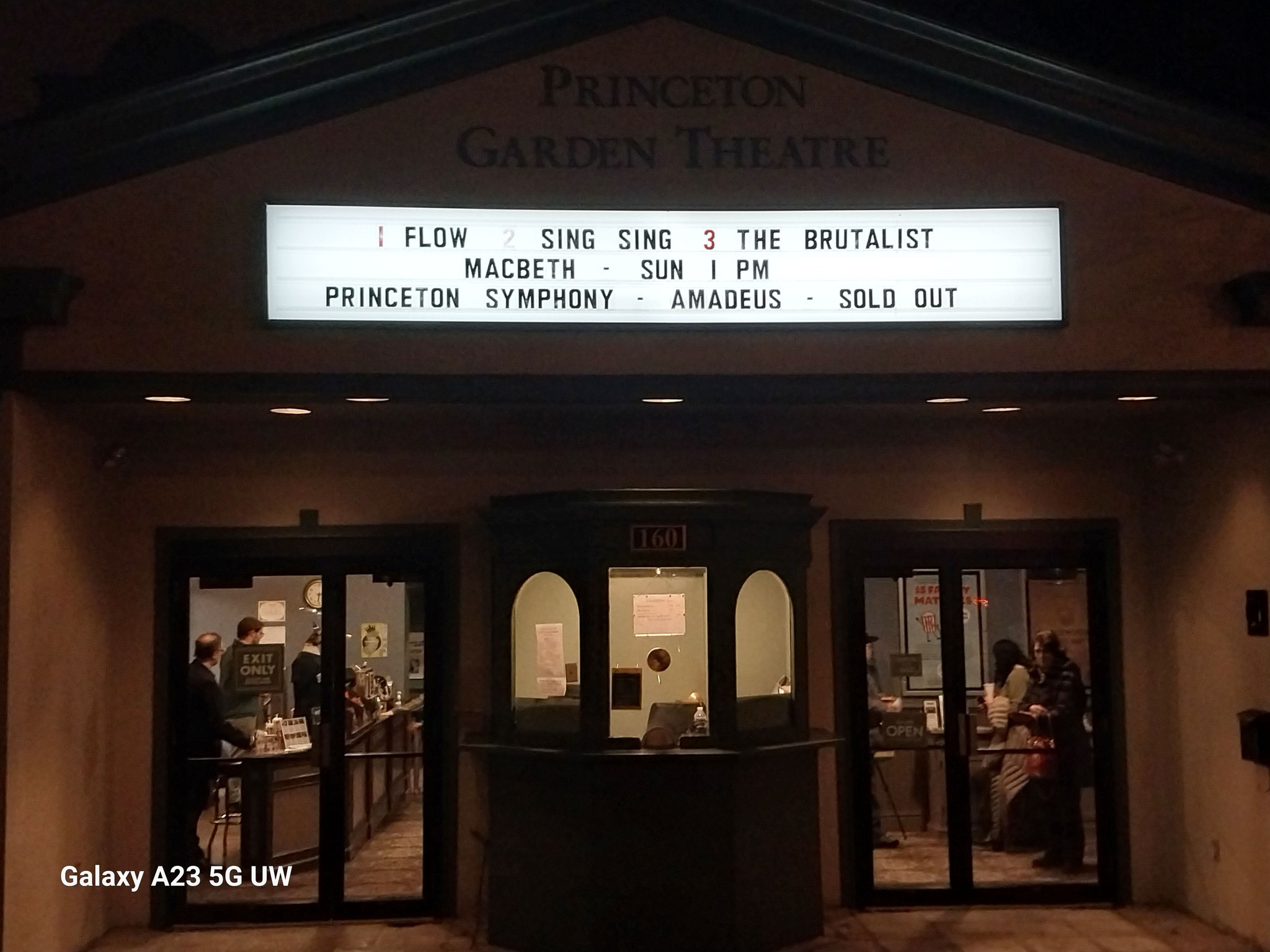
Add “Amadeus” to “The Godfather” and “Jaws” for films guaranteed to sell-out the Princeton Garden Theatre. Fortunately, I bought my ticket weeks ago, when I went to see “Nosferatu.” It didn’t hurt that the theatrical cut had been unavailable, apparently, since 2002, usurped by the inferior “director’s cut.” I think there are several posts I could spin out of this (my impressions of the film after all these years, the qualities of the film itself, how movies have changed over the years, and my dislike of director’s cuts, especially when they cause the originals to be pulled from circulation), but I’ll save those for another time.
For now, I will say the Garden Theatre ALWAYS does a superb job with its repertory showings and that there are great turn-outs even for what one might expect to be niche films (e.g. “The Gunfighter” with Gregory Peck, “Eyes without a Face”). When I went to see “Grand Illusion” some months back, that too must have been very close to sold-out. Forget “2001: A Space Odyssey” and “Seven Samurai.” The sound and projection for “Raiders of the Lost Ark” was the best I’d ever experienced.
I will say, “Amadeus,” which was presented in partnership with the Princeton Symphony Orchestra (violinists Rautao Mao and Iris Chen played a half-hour of Mozart prior to the screening), still holds up, and in fact, if such a thing is possible, I may have enjoyed it more yesterday than I ever have. It’s a movie that, for me personally, just gets richer with the passage of time. I found two things particularly sobering: (1) that a film of the stature of “Amadeus” seems to have required such an extensive restoration, drawing from several sets of elements; and (2) that seeing this 41 year-old movie in a theater today is the equivalent of my going to see a 1943 film in 1984. That’s how much time has passed.
But a lot of this is digression and preamble to my point: that while you might not have been able to get in to see “Amadeus,” you may still be able to snag a ticket for this weekend’s hot-selling all-Mozart program with the Princeton Symphony Orchestra.
Even for a hard-bitten classical music radio announcer who’s heard it all way too many times, the repertoire is enticing: the buoyant and energetic ballet music from the opera “Idomeneo,” the rich and dramatically expressive Piano Concerto No. 20 in D minor, and possibly my favorite of the last three, great symphonies – all of them composed over a period of just two months in the summer of 1788 – the masterfully inventive, joyous, and ultimately life-affirming Symphony No. 39.
The soloist in the Mozart concerto – the very same played over the end credits of “Amadeus,” as a matter of fact, and one of only two piano concertos Mozart composed in a minor key – will be Orli Shaham, whose Mozart credentials are unimpeachable. Hers has been a lifelong love affair with the composer. (Hearing the Piano Concerto No. 20 as child is what made her want to take up the piano.) She’s just finished her recorded survey of the complete Mozart piano sonatas for Canary Classics. With her husband, the conductor David Robertson, she’s also recorded the Concertos Nos. 17 & 24.
The conductor for this weekend’s concerts will be Gérard Korsten, who trained with another esteemed Mozartian, Sándor Végh. Korsten was concertmaster and then assistant music director of Végh’s Camerata Salzburg (based in Mozart’s hometown). He also served as concertmaster of the Chamber Orchestra of Europe, in which capacity he worked with such conductors as Claudio Abbado, Nikolaus Harnoncourt, and Heinz Holliger. He himself has conducted over 100 orchestras. From 2010 to 2014, he was principal conductor of the London Mozart Players. His repertoire in the opera house has encompassed all three Da Ponte operas, “The Magic Flute,” “The Impresario,” and yes, “Idomeneo.”
The program will be presented twice at Princeton University’s Richardson Auditorium – located right up the street from Princeton Garden Theatre – this Saturday at 8:00 and this Sunday at 4:00. For tickets and information, visit princetonsymphony.org.
Rock me, Amadeus!
Leave a Reply