Mozart’s masterful Symphony No. 39 is a marvel of classical invention. But not even HIS nimble imagination lit on the idea of including a snow plow.
Last night, on the first of two concerts devoted to a program of the composer’s music, presented by the Princeton Symphony Orchestra at Princeton University’s Richardson Auditorium, a rumbling, scraping basso continuo underscored the work’s last two movements, as a wintry mix was cleared from the parking lot outside the venue. This was especially evident in the silence between movements, though briefly the truck’s back-up alarm did make for a disorienting John Cage-like tug-of-war between everyday and Elysium.
Not everyone braved the weather last night, so a well-sold house was left with pockets of empty seats. A pity for those who couldn’t be there, as the music-making, on the concert’s first half, especially, was inspired and transporting, with plenty of warmth and glow to keep the sleet and slush at bay.
Guest conductor Gérard Korsten, forgoing the standard-issue baton in favor of directing with his bare hands, oversaw the orchestra with energy and commitment. Whether I should be crediting him, the musicians, or the music, I’m not sure – perhaps all three – but whatever or whoever was responsible, all the tumblers aligned for some of the most satisfying Mozart I’ve ever heard from this group, which seldom disappoints, but is frequently more successful in Romantic and 20th century repertoire. (A gross generalization, as a concert they did with a barefoot Daniel Rowland that interleaved Vivaldi’s “The Four Seasons” with Astor Piazzolla’s “The Four Seasons of Buenos Aires” in 2016 continues to resonate in my memory.)
The program opened with punchy and energetic ballet music from the opera “Idomeneo.” It came off so well, I was disappointed to find it was not the full 25-minute suite, but rather only two of the five numbers, with a combined running time of about 14 minutes. Too bad, because I really loved what I heard. The effect was like being awakened in the middle of a beautiful dream.
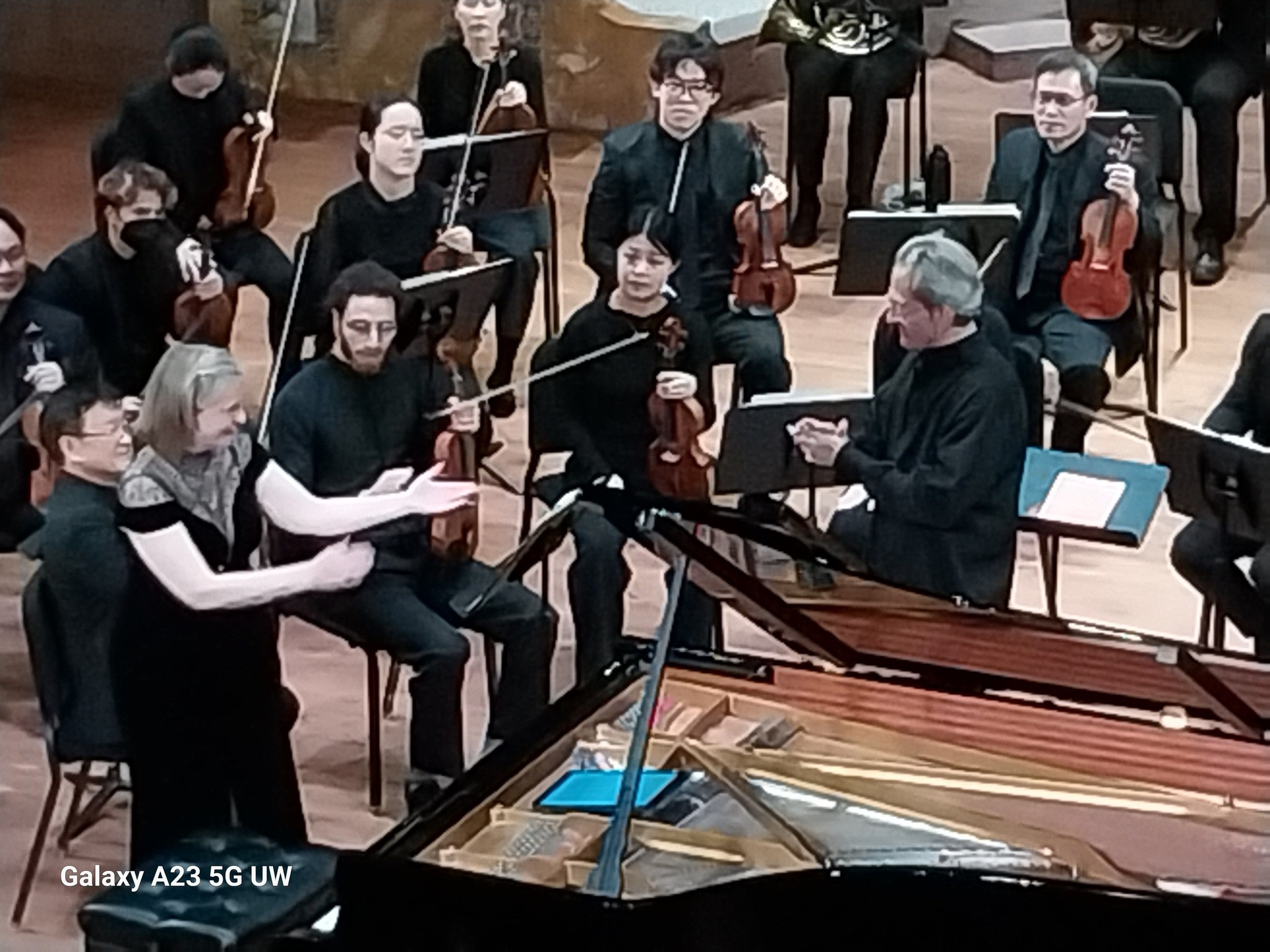
But my yearning was short-lived, thankfully, as the highlight of the evening was surely the Piano Concerto No. 20 in D minor – one of only two piano concertos Mozart composed in a minor key – which pretty much fulfilled its ideal with soloist Orli Shaham. Like a poetic alchemist, Shaham turned ivories into pearls, for a performance that balanced the work’s drama and depth, honoring the emotion in the score’s nascent Romanticism while never betraying its Classical poise. The pianist has had a long history with the piece – it was the work that made her want to take up the instrument as a child – but somehow she has managed to keep it fresh and immediate, her involvement evident in every phrase. She silently mouthed passages and swayed to the music and even leaned into the first violins at times, as if to symbolize her sense of oneness with the orchestra. Truly, it was a thing of beauty (with apologies to Keats).
One of the things I love about the Princeton Symphony Orchestra is how the wind players all actually listen to one another. Last night, principal clarinetist Pascal Archer, always full of animation, was characteristically the focal point of some very sensitive wind playing, musically linking arms with clarinetist Gi Lee and flutist Sooyun Kim; but all the winds – and I should include in this the brass (two horns and two trumpets) – were excellent.
While the performance of the symphony as whole did not, for me, attain the giddy heights or emotional depth of the concert’s first half, there’s no question it was well-played. Putting principal percussionist Jeremy Levine on period kettle drums may have been a nod to 18th century practice, but authenticity be damned, I missed the anchor of a strong downbeat as those strings rain their torrents of joy!
Kudos, though, to trumpeters Jerry Bryant (principal) and Thomas Cook, who throughout the evening were consistently fine, both in uniformity and execution – impeccable in their restraint, when necessary – in both “Idomeneo” and the last movement of the symphony. If I could play the trumpet, I would always be tempted to play so that the walls of Jericho would crumble.
As I know I’ve mentioned before, the prospect of an all-Mozart program seldom gets me excited, but the repertoire, soloist, and conductor for this one filled me with anticipation. It gave me pleasure to set aside my deep-seated cynicism, if only for an evening.
The program will be repeated, without freezing rain, today, Sunday, at 4 p.m. I suspect tickets really will be scarce. But, who knows, if last night is any indication, there could be a number of stay-at-homes. You can try your luck at princetonsymphony.org.
Leave a Reply