I know Russia isn’t exactly “in” right now. But on Rimsky-Korsakov’s birthday, I am reminded of how the last act of this most venerable of Russian nationalist composers was to give a great big middle finger to the Tsar.
With the completion of “The Invisible City of Kitezh” in 1905, Rimsky thought he was through with the operatic stage. He had composed 14 operas in all, and for “Kitezh” he brought the utmost in his artistry to bear. It would form the capstone in a kind of pantheon to a distinctly Russian national sound in music, the foundations of which were laid by Mikhail Glinka, beginning in the 1830s and ‘40s.
But political indignation stirred Rimsky to take up his pen for one final statement, a sardonic take-down of autocratic rule, Russian imperialism, and military incompetence during the Russo-Japanese War.
To say that the conflict, in which rival empires clashed for supremacy around the Yellow Sea, proved to be an enormous embarrassment for Russia would be an understatement. After a series of staggering defeats, Emperor Nicholas II remained headstrong in his determination to win. Even beyond the point of all hope for victory, he doubled-down to try to save face, rather than submit to a “humiliating peace.” He ignored an olive branch from Japan and rejected the idea of ending the war.
The inadequacy of the Russian military and Japan’s decisive victory stunned the world. It led to the decline of Russian prestige and influence abroad, and contributed to growing domestic unrest that culminated in the 1905 Russian Revolution.
It didn’t help that at home the Imperial Guard had fired on workers during an unarmed demonstration, a peaceful march to the Winter Palace. The actions of the Tsar’s soldiers resulted in the deaths of men, women, and children. Depending on who you believe, casualties were somewhere between 96 (according the official record) and 4,000. Ironically, the Tsar wasn’t even in residence at the time.
That was in January. The war finally ended in September with the Treaty of Portsmouth, mediated by Theodore Roosevelt.
Rimsky himself had earlier served as an officer in the Russian Imperial Navy and later as a civilian inspector of its bands. In 1905 he took to the ramparts, figuratively speaking, when he stood with student agitators at the St. Petersburg Conservatory. Rimsky was in his 60s at the time and a much-beloved presence. For his actions, he was dismissed from his professorship, approximately 100 students were expelled, and the conservatory was threatened with closure.
A second demonstration by students during a performance of one of Rimsky’s earlier operas, “Kashchey the Immortal,” led to a ban on his music. Widespread outrage rippled beyond Russia’s borders. 300 students staged a walkout at the conservatory until Rimsky was reinstated. Not long after, in 1906, Rimsky would resign to launch into work on his final opera, with a pen warmed up in hell.
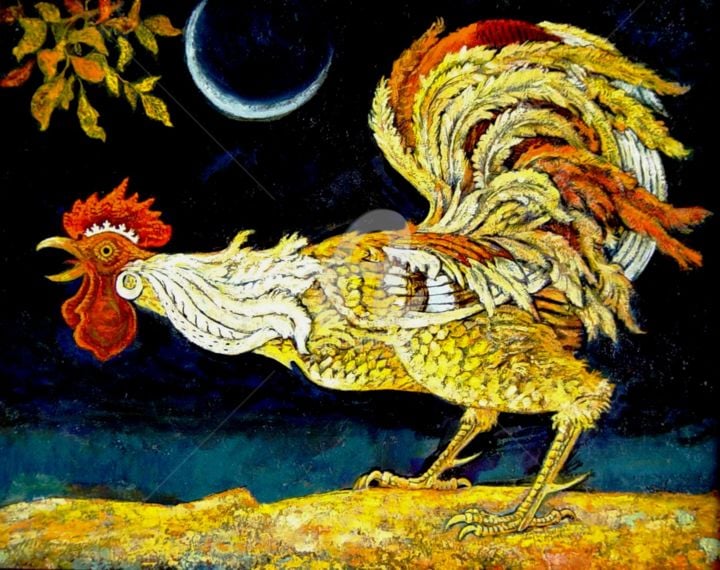
On its surface, “The Golden Cockerel,” after Pushkin, is a fairy tale. But like all the best fairy tales, it also serves as a thinly-veiled allegory. The Astrologer in the work’s prologue and epilogue tells us that the characters are all based on real persons and that the moral is valid and true. In between, we’re introduced to a paranoid ruler who reneges on his promises, commits criminal acts, makes war on a sovereign state, displays military ineptitude, and in the end has his jugular pecked out by a cockerel.
There’s no way the Russian censors were ever going to allow this work onstage. Rimsky, whose health was in decline, demanded that no changes be made, and suggested to a friend that he arrange for it to be performed in Paris. It got there eventually, staged as “Le coq d’or,” the title by which it has frequently been identified in the West ever since.
But the actual premiere took place in Moscow in 1909, the year after Rimsky’s death. And yes, the libretto was judiciously pruned and the staging carefully modified.
In his lifetime, Rimsky-Korsakov was one of the most prominent and respected musical figures in all of Russia. The St. Petersburg Conservatory, from which he was fired, now bears his name.
Ironies continue to pile upon ironies, as history ever looms, ready to repeat itself. In 2026, Rimsky’s barbed response to the events of 1905 seems uncannily prescient and sadly universal.
————
From a New York City Opera telecast, in English, with Beverly Sills in 1971. The Tsar (Norman Treigle) gets the big peck at 1:38:30.
There are plenty more legible productions on YouTube, but most are sung in Russian, and not many have subtitles.
Here’s a more vivid production, with no translations:
Perhaps the opera’s best-known number, “Hymn to the Sun”
Arthur Fielder conducts the orchestral suite:
Leave a Reply