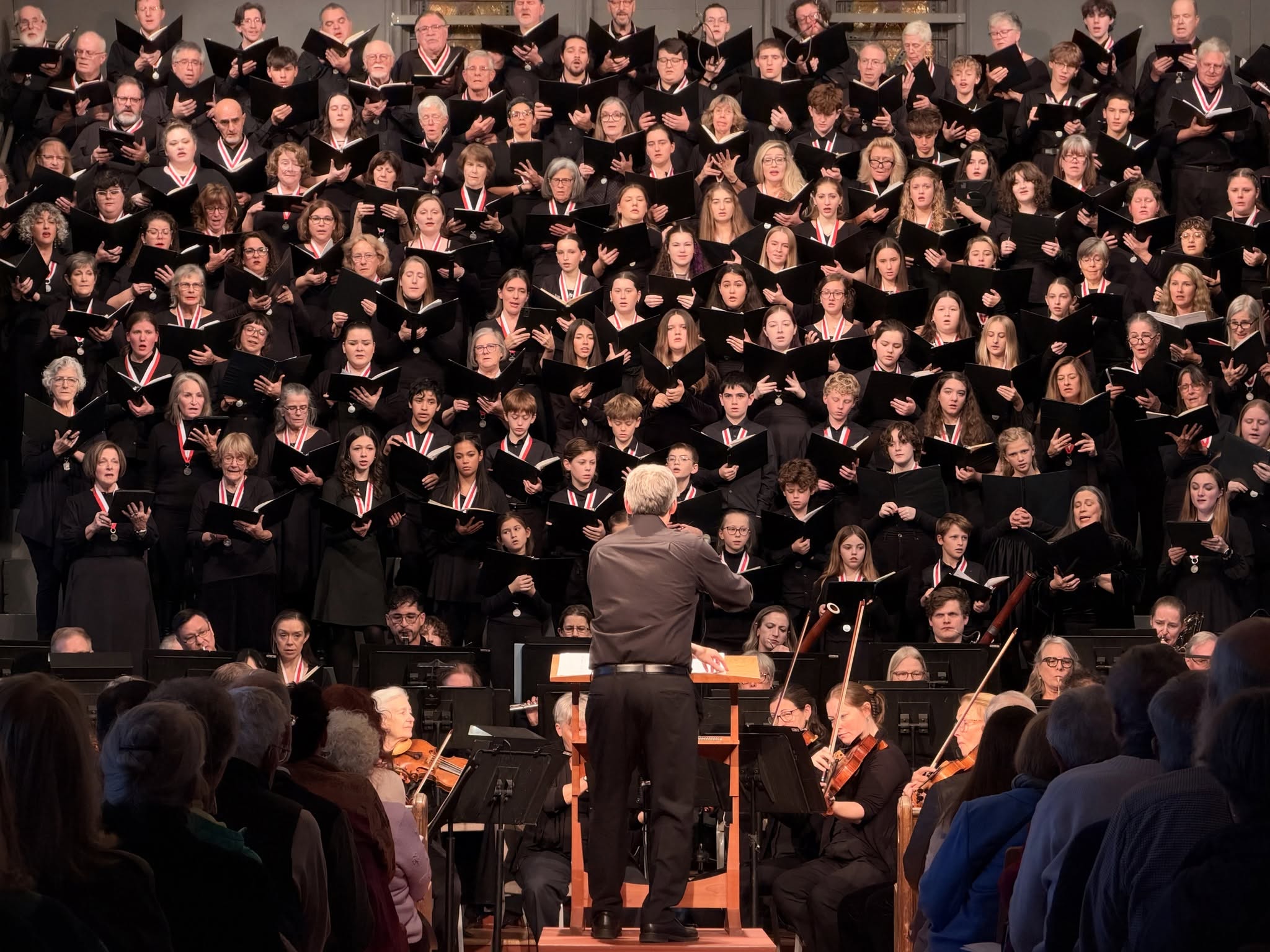
I’m not like one of those deranged tinsel fanatics who throws the switch on the lights the day after Halloween, but Christmas did arrive unseasonably early for me this year, as Sunday I made the trip to Rhode Island to take in a Chorus of Westerly performance of Ralph Vaughan Williams’ magnificent cantata “Hodie” (“This Day”).
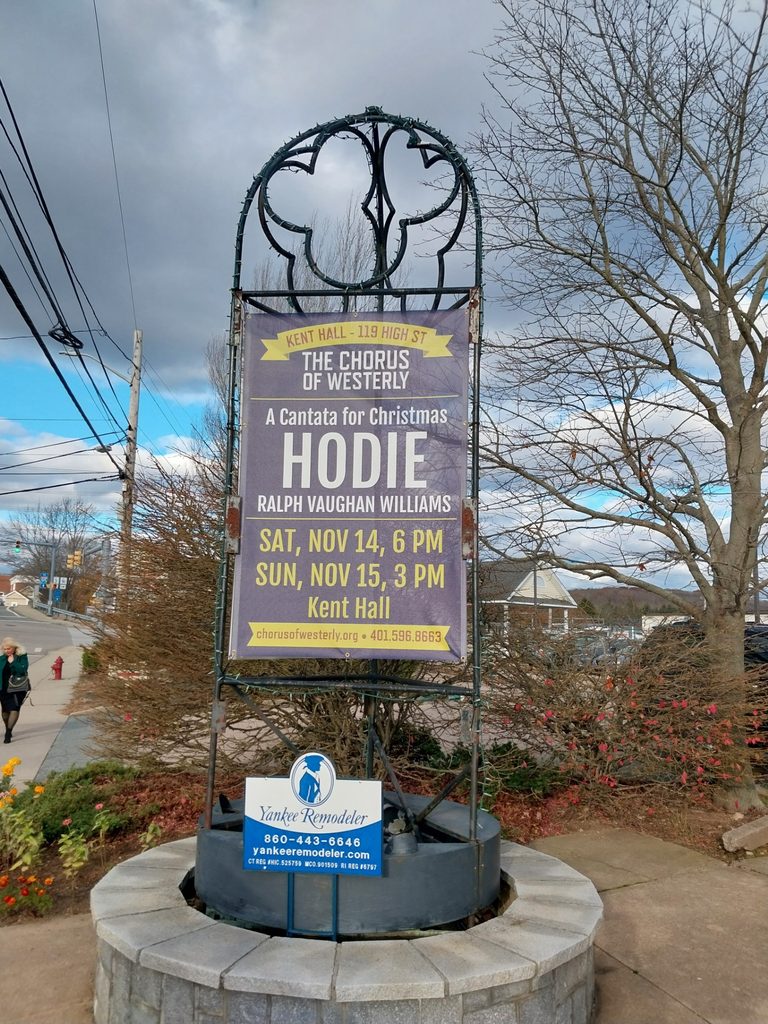
Yes, I really will drive three-and-a-half hours – and four hours on the return – to be able hear a major Vaughan Williams work performed live. Especially this one.
I understand the economics of it, that holiday pops concerts have become to music organizations what “The Nutcracker” has always been to American ballet companies, but my, do I miss the big, juicy Christmas works. It seems all we have left are Bach and Handel. Twelve months do fly by awfully quickly when I’m back in the pew listening to yet another performance of “Messiah,” or Lord help me, another Bach “Christmas Oratorio.” Still, I’ll take those over a miked Broadway siren adorned like a velveteen elf singing “All I Want for Christmas.” Humbug!
There’s an unwritten law that the musical selections on these programs should not exceed the length of Leroy Anderson’s “Sleigh Ride” (with the exception, perhaps, of Leroy Anderson’s “Christmas Festival,” in a version for superfluous high school choir, with awkward audience participation).
Not that those concerts don’t have their place. (I’m obligated to say that to keep from being visited by three spirits.)
And to be fair, there are still some choral concerts with some integrity that delve a little more deeply into the Christmas literature, which after all, extends back hundreds of years. But these are often more modest affairs. Nothing packs a hall like “Deck the Halls.”
So to be able to sit center-balcony before three vocal soloists, a wall of choristers, an organ, and a live orchestra (with three hardworking percussionists), for a span of 60 minutes, is very special indeed. Vaughan Williams’ “Hodie” is a most sumptuous Christmas banquet. And nothing about it bellows ho ho ho.
My hardline views on Christmas music have little to do with my personal religious convictions – and interestingly, for a man who loved Christmas so much himself, Vaughan Williams was famously characterized by his wife, Ursula, as a “cheerful agnostic” – but rather my perennial low-level despair that these glorious Christmas works by the great composers are in the very act of slipping away.
You can’t hear many of them on the radio anymore, since most of the surviving classical music stations won’t even program the Beethoven symphonies in their entirety, because they’re too long for the dumbed-down ADHD format. (At 12 minutes, Vaughan Williams’ “Fantasia on Christmas Carols” seems secure. For the moment.)
Where is Josef Rheinberger’s “The Star of Bethlehem?” Camille Saint-Saëns’ “Christmas Oratorio?” Franz Liszt’s “Christus?” Hector Berlioz’s “L’Enfance du Christ?” Benjamin Britten’s “Saint Nicolas?” Pablo Casals’ “El Pessebre?”
I mean, the Liszt is three hours long, but Marc-Antoine Charpentier’s “Messe du minuit pour Noël,” Ottorino Respighi’s “Lauda per la Natività del Signore,” and Arthur Honegger’s “Christmas Cantata” are about 25 minutes a piece.
We’re not hearing them in concert halls. Or in churches. Or on the radio. If they’re not handed down in the family or by musical organizations, how are people supposed to even know of their existence?
Alas, most listeners seem be content with peppermint bark and fruitcake. They’ve been groomed not to expect or desire anything more.
Don’t get me wrong, Mel Tormé has his place. But there is simply no substitute for the sweeping majesty, the ineffable mystery, the profound reverence, the numinous terror, and the ecstatic jubilance of a work like “Hodie.”
Why, oh why is it never done? I know of no other composer who captures the weirdness and the “sore afraid” aspects of the Nativity story so well. Few even try. The prologue, with its invitational fanfares, rhythmic vitality, and glittering orchestration, the flittering choral exchanges of “Nowell!”, the euphoric calls of “Gloria,” and the insistent “Alleluias,” rivals the opening of Vaughan Williams’ “A Sea Symphony,” and if the concluding “Ring Out, Ye Crystal Spheres” doesn’t put you in a joyous mood, I don’t know what will. The work is a flat-out masterpiece.
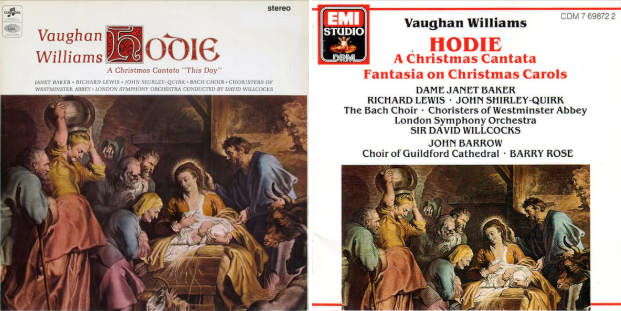
David Willcocks recording, on LP and CD
I’ve been aching to hear it live for years. There was a performance of it in New York a couple of seasons ago, but I missed it. I saw it advertised on a youth choir Facebook page and assumed it was going to be a watered-down adaptation for kids. But OF COURSE there’s a youth choir! What the post didn’t specify was that it would be part of a larger group. Ouch!
I could swear it was also performed here in Princeton, perhaps 15 or 20 years ago, but I can find no evidence of it on the internet. Was I confusing it was another “Hodie?” The title is short for “Hodie Christus natus est” (Latin for “This day Christ is born”), and the phrase, lifted from a passage of the Christmas Day Vespers service, has been set by other composers. Either way, I was held up at the radio station and couldn’t make it.
The New York blunder had me surfing the internet forlornly for a couple of years, seeking other East Coast performances. None were forthcoming – until one popped up on my Facebook feed last month, with the Chorus of Westerly, an offshoot of Christ (Episcopal) Church, in Westerly, Rhode Island. One Google Map search later, I purchased my ticket.
I knew nothing about the Chorus of Westerly, but the more research I did, the more excited I became. If you’re looking to hear an authentic “Hodie” performance by an amateur group in the United States, Westerly is uniquely positioned to be the New World standard-bearer.
Vaughan Williams composed his cantata in 1953 (at the age of 81!). It was given its first performance the next year at the Three Choirs Festival in Worcester (England). The chorus master on that occasion was David Willcocks, who went on to conduct what, for many, is the definitive recording of “Hodie” for what was then EMI.
Chorus of Westerly founder (in 1959) George Kent studied and trained with Willcocks, the director of the King’s College Chapel Choir, for several summers in Cambridge (England). A seedling of the great English choral tradition sprouted in Rhode Island when Kent performed “Hodie” for the first time in Westerly in 1960 – only six years after the work’s premiere.
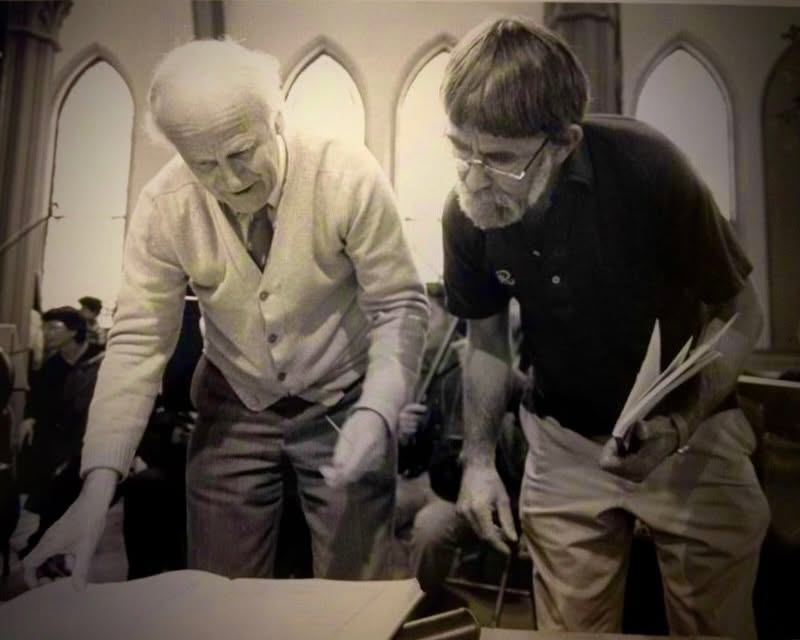
David Willcocks with George Kent (Photo from Chorus of Westerly Facebook page)
Kent initiated the chorus in his third year of what turned out to be a 69-year tenure as organist and choirmaster at the church. Under his direction, Westerly became a great friend to Vaughan Williams’ music, and its advocacy has continued down the decades, with no less than seven presentations of “Hodie,” and performances of numerous other RVW works, large and small. Can you think of any other organization in the U.S. that’s performed “Sancta Civitas,” “An Oxford Elegy,” “In Windsor Forest,” and “Five Tudor Portraits” – to say nothing of “Dona nobis pacem,” the “Fantasia on Christmas Carols,” the “Serenade to Music,” “Toward the Unknown Region,” etc.?
The chorus sings in a venue now named for Kent – George Kent Performance Hall (or Kent Hall for short). Constructed in the 1880s, the building formerly served as a Catholic church. After the Catholic parish moved to a new location in 1968, the choir began to use the space for rehearsal and performance. For 15 or 20 years, the site was managed by the Westerly Center for the Arts. In 1991, the Chorus of Westerly acquired it as its own. The hall was rededicated in Kent’s name in 2005.
On Sunday, the spectacle of the chorus in itself (consisting of community and Christ Church singers) was enough to knock me back on my heels. After making my way to my seat in the rather snug balcony, I was so preoccupied with trying to contort so that others could slip past with a minimum of awkwardness – under the circumstances impossible, though everyone was very gracious (someone behind me even helped me off with my jacket) – and then became so immersed in the unusually substantial and well-written 4 ½ page program note by Kathryn Aaron, that when I looked up, I was astonished to see a wall of singers facing me!
I’m not kidding. I’ve never seen anything like it. It might be best-described as a cascading chorus. The risers appear to be astonishingly vertiginous. I have no idea how the singers got into position or when they did so – the audience was still abuzz with conversation and no one applauded upon their entrance – but some of the mystery was revealed when at the end, a large door was thrown open at the top, allowing those nearby to make their exit, as those further away merely stepped down to the floor.
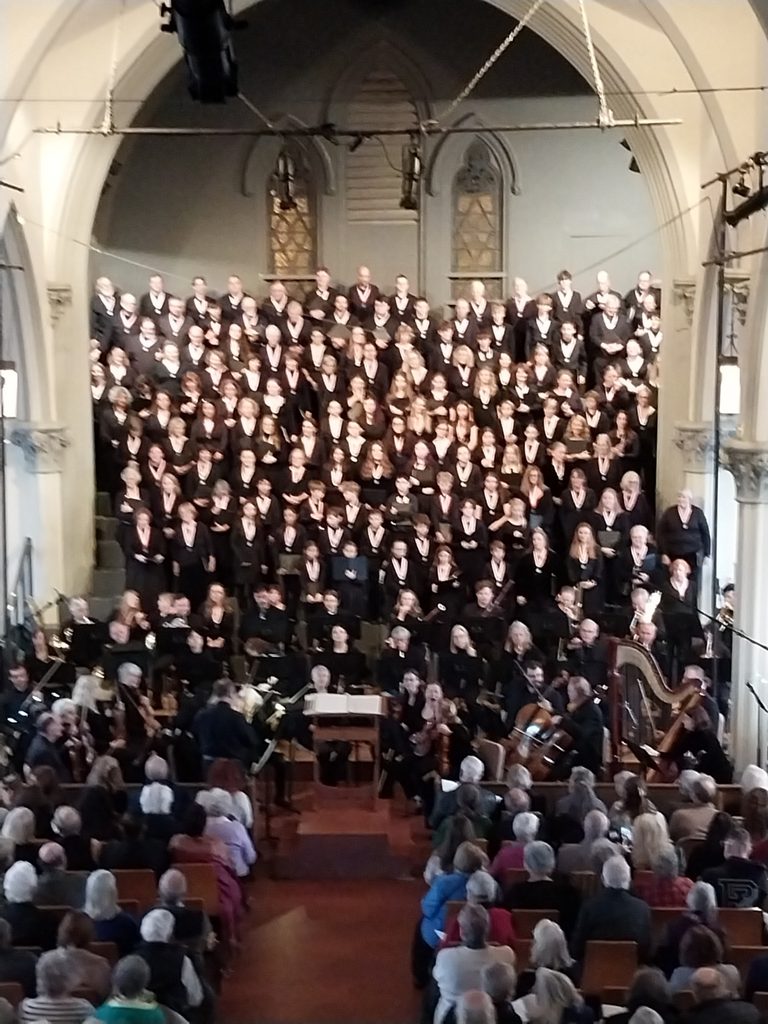
Was it my phone that blurred it, or did I swoon? Cascading Chorus of Westerly
Choristers in the last two rows could sit when not singing. The rest stood stock still for the duration of the concert. Only some of the kids – who were not segregated, but rather embedded in the heart of the choir, amidst the adults – fidgeted a little when they weren’t doing their thing (which fortunately was not often). At the bottom and behind the orchestra, a few singers, perhaps those with medical excuses, were able to remain seated throughout.
I didn’t get close enough to see what the risers were constructed out of, but they seemed to be designed as a permanent part of the auditorium, and they were extraordinarily sturdy, if not spacious. From my perspective in the balcony, prior to the singers’ entrance, gray paint caused them to blend into the back wall. In fact, when I entered and took a look out at the orchestra, I couldn’t imagine how they were going to be able to fit all the singers.
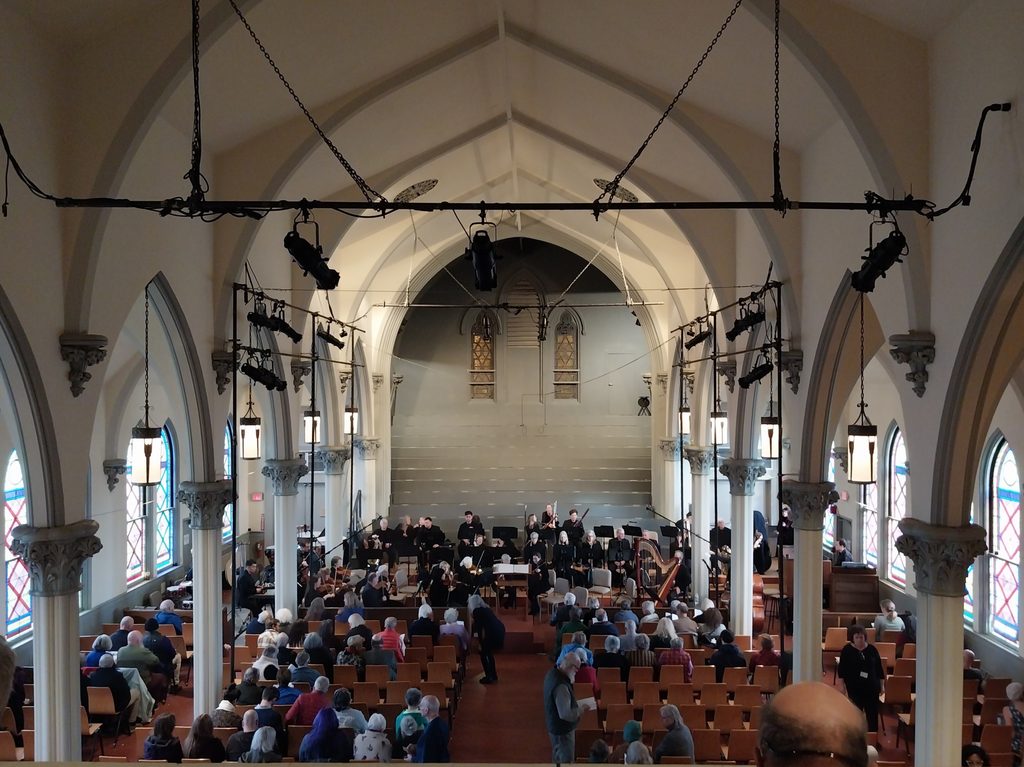
Barely–visible gray risers
Three percussionists were interleaved with columns of an arcade on the left, and an organist was over on the right.
Of the three vocal soloists, mezzo-soprano Clara Osowski suffused the room with a warm and ingratiating voice, which found a felicitous analogue in the late-afternoon sun glowing at the venue’s stained-glass windows.
Andrew Bearden Brown’s tenor had a pleasant timbre, but by comparison he might have been a little muted in the space by the work’s instrumental and choral forces. In his YouTube videos, he seems to be more in his element when accompanied by a piano in a more intimate setting. (Hats off to the exposed trumpeter who introduced Brown’s “Hymn: Bright Portals of the Sky.” It had to have been a high-pressure moment, and he nailed it.)
Baritone David McFarrin sang with a more pronounced vibrato than what I’m hearing in his videos, but he was invariably sensitive to the poetry and the spirit of the score. I wondered if his sartorial choice of a yellow tie was influenced by the fact that it fell to him to sing of the gift of gold in “The March of the Three Kings.”
As I find is often the case with such seemingly disparate soloists, when the three sang together, a kind of miraculous murmuration took place in which all of their voices were flawlessly matched.
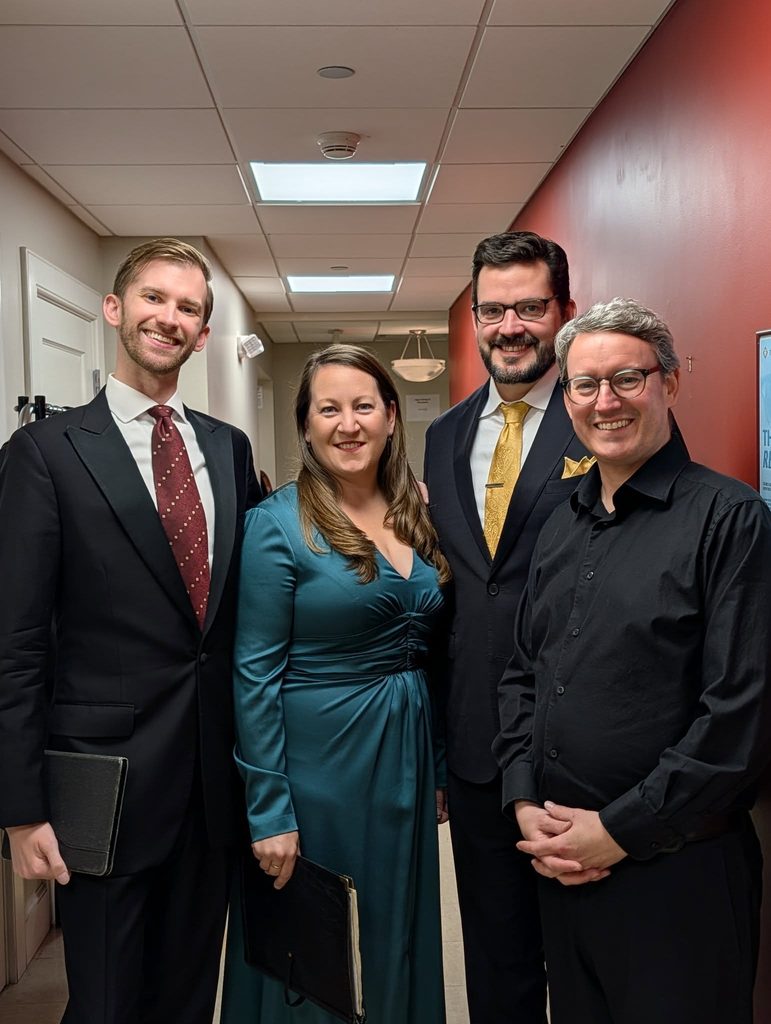
Left to right: Tenor Andrew Bearden Brown, mezzo-soprano Clara Osowski, baritone David McFarrin, music director Andrew Howell (Photo from Chorus of Westerly Facebook page)
Vaughan Williams’ texts were assembled from Scripture and writings and translations of William Ballet, Miles Coverdale, William Drummond, Thomas Hardy, George Herbert, and John Milton, and two poems by his recent bride (39 years the composer’s junior), Ursula.
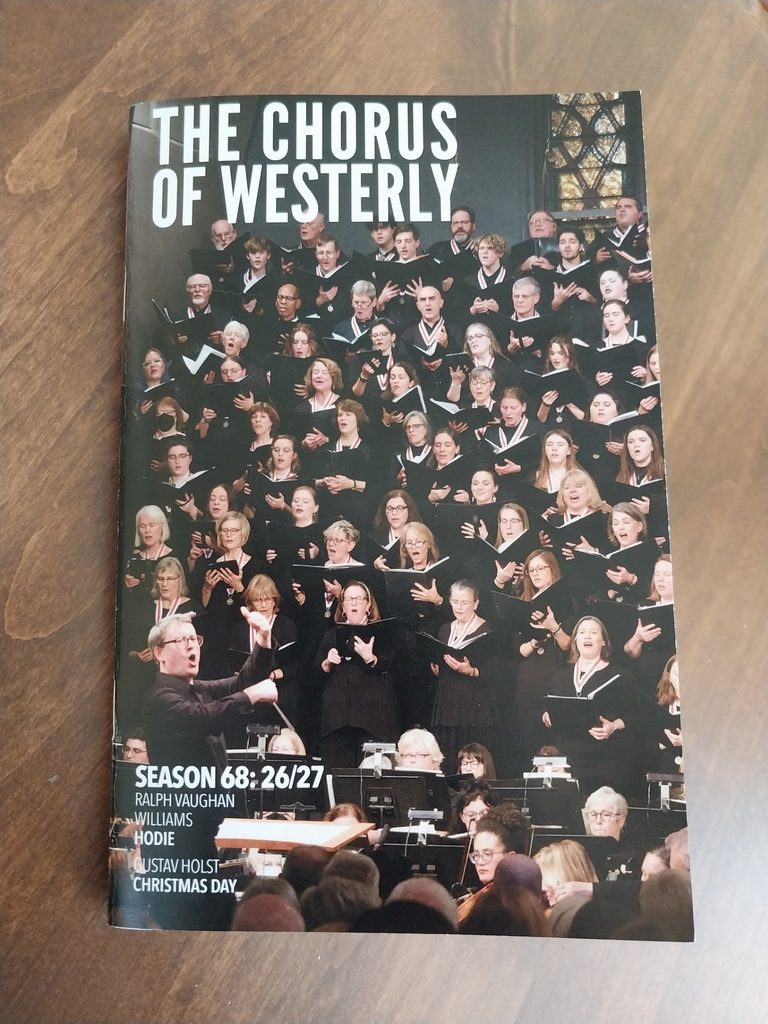
The texts were included in the program book. I was impressed even by this, a 60-page, glossy-covered creation, quite the production for a community chorus. In general, the trend for concerts in recent years has been toward slimmer booklets, even one-sheets for smaller groups. Even at the Philadelphia Orchestra, they no longer provide enough programs for a fuller house, hoping that more people will use their phones to search for the notes online. Bah! I understand it saves money and trees, and I suppose it really should be done – but bringing digital technology into an acoustic, humanistic environment does take something away from the experience. We need less phone activity in our halls, not more.
The concert, which was presented without intermission, began with a comparatively brief (at seven minutes) and agreeable work by Vaughan Williams’ dear friend Gustav Holst. “Christmas Day” nicely set the mood with a series of variations on “In dulci jubilo” (“Good Christian Men, Rejoice”), interwoven with other familiar carols.
Andrew Howell, only the organization’s second music director, taking over from Kent on his retirement in 2012, conducted. The chorus was obviously well-prepared, and Howell kept his disparate forces balanced, allowing every detail in the orchestration to be heard. He was good too in looking out for his vocal soloists. Then again, a lot of that was already thought through by the composer. And of course, Osowski had a natural advantage, as her voice was going to be heard, no matter what.
Every aspect of the Westerly experience seemed to be handled with an eye for detail, a respect for tradition, and a refreshing sense of permanence. I regret that I didn’t take a photo of a picture displayed in the lobby of Kent conducting. Kent died last year at the age of 88. He last played the organ and directed the Christ Church Choir only weeks before his passing. The classic black and white composition lent the image a comforting sense of timelessness. And continuity. Perhaps some of these Christmas works will endure after all.
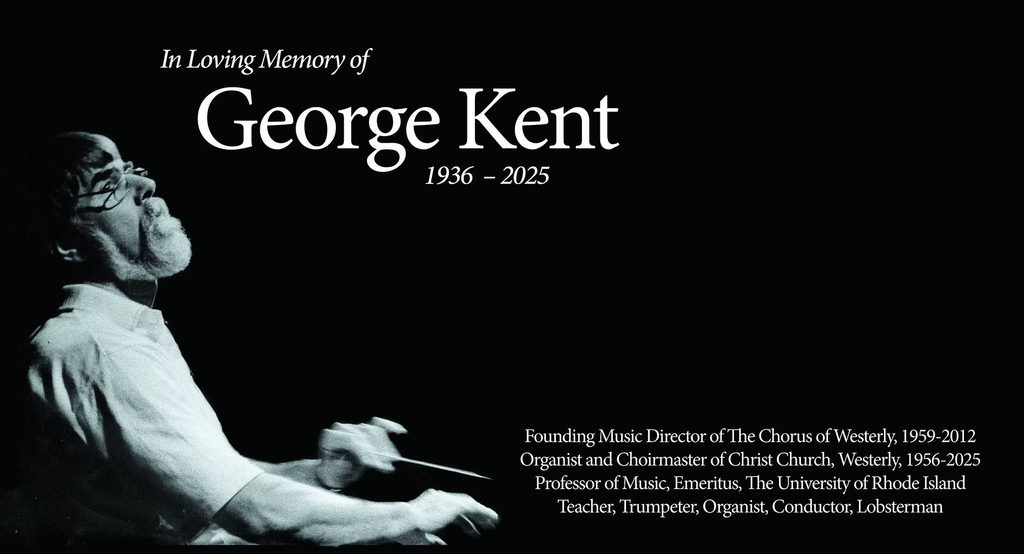
(From the Chorus of Westerly website)
It didn’t occur to me until after I’d left the venue that the concert may not have passed the tingle test, that moment when I feel emotionally overwhelmed by an exceptional performance, but then there I was, choking back a sob on my walk to the car. Awesome Vaughan Williams!
The 3:00 start time was ideal for a commute from Princeton. It allowed me to get on the road before 10:00, arrive early enough to grab lunch (at The Cooked Goose), with a slice of pie and a cup of coffee to go, to serve as an after-performance snack to give me the boost I needed to get home by 8:30. (I poured the coffee into a travel mug to keep some of the heat.) It was only later that it occurred to me, I could have heard the concert twice had I booked a B&B for Saturday night!
As it was, it was a beautiful day, with perfect driving weather, enhanced by arresting clouds and the last of the fall colors. In Rhode Island, the trees started to look more like Thanksgiving. The skies were seductively mercurial, with silvery mid-November sunshine, glinting on water, bathing historic cemeteries, and casting shadows from New England widows’ walks. By the time I approached the concert hall, clouds which had earlier resembled schools of flirtatious dolphins had been overtaken by ponderous leviathans.
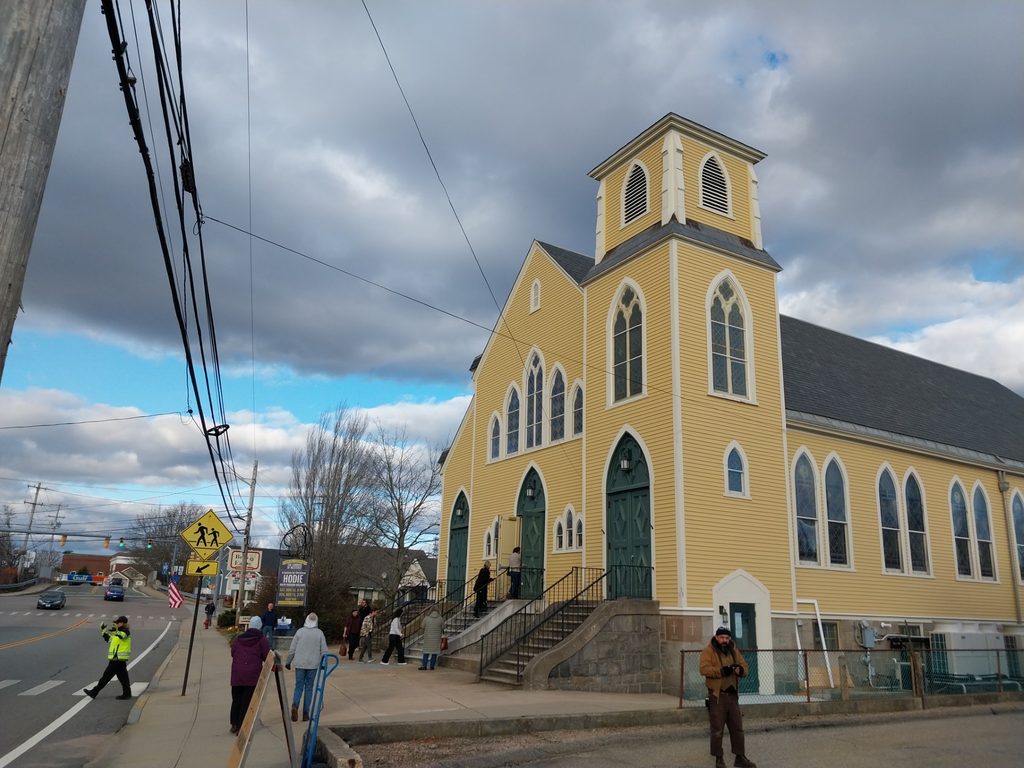
George Kent Performance Hall
The chorus keeps a full calendar, with six programs being presented this season, including two performances of Dvořák’s Requiem coming up in May.
Westerly will perform its Christmas Pops concerts (yes!) on December 19 & 20. This is a model for how choruses and orchestras could sustain the bigger Christmas works. Drop them in around Thanksgiving, and then break out the jingle bells and Santa hats in December.
I will be eyeing future Westerly seasons with the keenest interest. I can easily imagine becoming an annual pilgrim to Rhode Island in November.
To learn more, visit chorusofwesterly.org. While you’re over there, be sure to check out the organization’s history under the “About Us” tab!
Leave a Reply