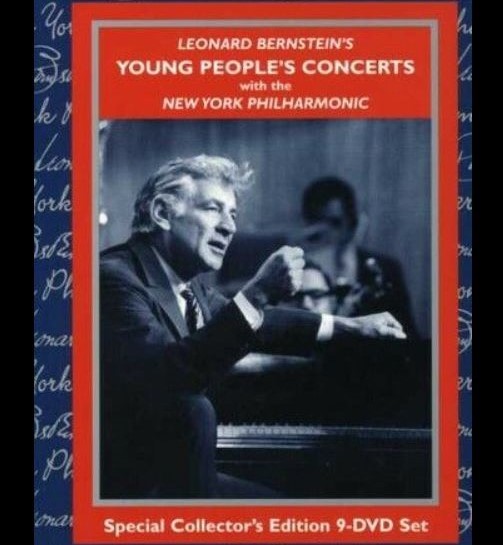
Last night, I pulled out my collection of Leonard Bernstein’s Young People’s Concerts with the New York Philharmonic to see if I owned a DVD of the broadcast that introduced a young André Watts in the Liszt Piano Concerto No. 1. I do not – though thankfully someone else posted it on YouTube. I decided instead to view “A Tribute to Sibelius,” presented in honor of the composer’s 100th anniversary.
I learned from Bernstein’s spoken introduction that President Johnson declared 1965 “Sibelius Year” in the United States. And yes, there was a time when Sibelius was that popular in America, though I would say it was a few decades earlier. In 1935, the composer’s 70th year, the New York Philharmonic surveyed 12,000 listeners of its Sunday afternoon radio broadcasts to learn their musical preferences. When asked who their favorite composer was, Sibelius was mentioned more than any other. Beethoven came in second. I always suspected I was born too late!
I also thought it was clever of Bernstein to compare Sibelius’ handling of his thematic material to a good detective story, in which clues are planted at the beginning, the true significance of which is only gradually revealed. He demonstrates this by following a three-note motif through its various permutations in the Second Symphony. “Those three innocent scale-notes turning up in a hundred different disguises…. [I]n the end they all link up, so that when the final light dawns, and all is made clear, you feel the thrill of having solved a great mystery, you yourself.” It’s an apt simile, even a brilliant one, in that it makes the listener feel like an active participant. But Bernstein was always an effective popularizer.
The young soloist in the Violin Concerto is the Romanian-born Sergiu Luca, who would later distinguish himself as an early music pioneer. Among Luca’s teachers was Ivan Galamian, who also taught Itzhak Perlman. At the age of 9, Luca made his debut with the Haifa Symphony Orchestra. (At the time, his family was living in Israel.) Like Watts, his U.S. debut was with the Philadelphia Orchestra, conducted by Eugene Ormandy – in Luca’s case, playing the Sibelius concerto – which brought him to the attention of Bernstein and led to his appearance on the New York Philharmonic telecast later that year.
Also of interest, from the end credits, I notice that the assistant to the director was none other than John Corigliano, Jr., son of the Philharmonic’s concert master, who went on to become a Pulitzer Prize and Academy Award winning composer himself. Corigliano won the Oscar for Best Original Score for his music for “The Red Violin.” He also scored “Altered States.”
Assistant to the producer was Mary Rodgers, daughter of Richard Rodgers and composer of “Once Upon a Mattress.” On the side, she also wrote “Freaky Friday.”
But arguably the part of the broadcast that brought me the most amusement was when Bernstein, conducting the Symphony No. 2, in the thrill of the moment, loses his grip on the baton when gearing up for the return of the big tune around 43 minutes in. I was all set to watch him ride it out with nothing but his bare hands, à la Stokowski, but a few seconds later, sure enough, he reaches under his music stand and produces as spare!
Hopefully nobody lost an eye.
Bernstein’s Young People’s Concerts were broadcast nationwide on CBS television and were eventually picked up around the world. The series, which ran from 1958 to 1973, received multiple Emmy, Peabody, and Edison Awards.
Crazy to look back at the orchestra now and realize there were no women, much less people of color. I remember reading a piece by Dave Barry once, decades ago, in which he humorously described white jazz clarinetists of yore as snapping their fingers in front of a bunch of guys dressed like dentists. The musicians of the New York Philharmonic from this era are kind of like that, only without the snapping fingers.
Predictably, some of the kids in the audience look a little distracted, though still well-behaved (and well-dressed), but a surprising number of them appear to be genuinely engaged. It’s sad that young people lack these kinds of opportunities anymore to be exposed to this kind of music. Classical music plays less of a part in American life now than it ever has since the rise of broadcast media.
There was a time in our history when people aspired to be better and believed that the way to do that was to acquire an education and expose themselves to the finer things. It was still like that when I was growing up, in the 1970s and early ‘80s. But that’s a long time ago now. From the perspective of the 21st century, we have passed our peak. This sort of television programming, especially from a network, endures only in memory or, if we’re lucky, in archival footage.
It seems like only yesterday that I was listening to the “Grand Canyon Suite” in music class and watching film strips of “Madama Butterfly” and “Amahl and the Night Visitors.” I feel sorry for anyone who has never been exposed to longer-form music, experienced its fantasy or been made to shudder at its ennobling beauty.
There’s so much more to music – and to life – than three-minute cuts manufactured in a recording studio. I don’t think I would have made it this far if I thought that’s all the world had to offer. Are these noble monuments to our shared humanity all really in danger of just fading away?
“A Tribute to Sibelius” (broadcast date: 2/19/65)
https://www.youtube.com/watch?v=Gx3lJpN6tMU
A transcript of the show, with a sample of Bernstein’s scrawl, in pencil, on a yellow legal pad
And in case you missed it when I shared the link earlier this week, a 16-year-old André Watts plays Liszt’s Piano Concerto No. 1 (broadcast date: 1/15/63)
Leave a Reply