So depressing is this email I received from the Philadelphia Orchestra yesterday. In the subject line, “A music-filled summer awaits!” Then I open it, and I see a photo of the Mann Music Center with more bodies strewn about the lawn than at the railroad station converted into a makeshift hospital in “Gone with the Wind.”
Scrolling down, there are capsules promoting the season-ending concert performances of “La bohème” at the Kimmel, the free neighborhood concerts, consisting mostly of excerpts from larger works (interesting repertoire admittedly – neglected Black composers – but why not show them the respect to play the music complete?), the summer festivals in Vail, Colorado, and Saratoga, New York, and a “summer residency” at the Mann.
What exactly does the summer residency entail? “…[C]lassical favorites by Gershwin and Tchaikovsky as well as hits by indie/roots band DISPATCH and Grammy Award-winner Beck. Plus… the first Philadelphia Orchestra live-score performances of two iconic films: ‘Batman’ and Disney’s ‘Aladdin.’”
Honey, bring me the smelling salts!
I know I posted about this last year, but this email is such a sad reminder. TWO orchestral concerts at the Mann – all summer – by the Philadelphia Orchestra. And they’re pitched right down the middle. I understand they want to appeal to as broad an audience as possible, but really? Is this what the orchestra now perceives as a music-filled summer?
But what are they going to do, say they know it isn’t much, but it’s what we’ve got, so enjoy it? Whoever wrote the press release probably wasn’t even born back when the orchestra really was offering a music-filled summer.
I hate to come across as the guy sitting in the back of his Rolls eating Grey Poupon out of the glove compartment, but time was when the orchestra used to play the Mann multiple nights a week (with the weekends reserved for popular bands). It looks like my description from last year (triggered by the death of André Watts) pretty much holds: “Now you’re lucky if they appear there three times in a summer, and then it’s usually to accompany a film or play the ‘1812 Overture.’”
Nobody had cell phones back in the day, either. But come to think of it, there always were some who treated the music as background to their inane picnic conversation. I guess people always were pretty much insufferable.
But in terms of the musical offerings, we never knew how good we had it. Or maybe we did, but we never thought it would go away.
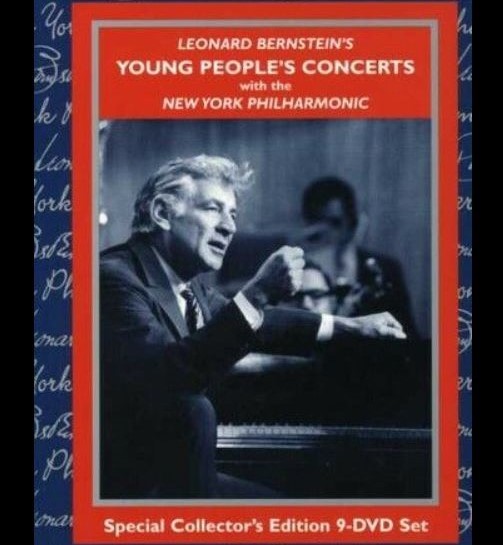
Last night, I pulled out my collection of Leonard Bernstein’s Young People’s Concerts with the New York Philharmonic to see if I owned a DVD of the broadcast that introduced a young André Watts in the Liszt Piano Concerto No. 1. I do not – though thankfully someone else posted it on YouTube. I decided instead to view “A Tribute to Sibelius,” presented in honor of the composer’s 100th anniversary.
I learned from Bernstein’s spoken introduction that President Johnson declared 1965 “Sibelius Year” in the United States. And yes, there was a time when Sibelius was that popular in America, though I would say it was a few decades earlier. In 1935, the composer’s 70th year, the New York Philharmonic surveyed 12,000 listeners of its Sunday afternoon radio broadcasts to learn their musical preferences. When asked who their favorite composer was, Sibelius was mentioned more than any other. Beethoven came in second. I always suspected I was born too late!
I also thought it was clever of Bernstein to compare Sibelius’ handling of his thematic material to a good detective story, in which clues are planted at the beginning, the true significance of which is only gradually revealed. He demonstrates this by following a three-note motif through its various permutations in the Second Symphony. “Those three innocent scale-notes turning up in a hundred different disguises…. [I]n the end they all link up, so that when the final light dawns, and all is made clear, you feel the thrill of having solved a great mystery, you yourself.” It’s an apt simile, even a brilliant one, in that it makes the listener feel like an active participant. But Bernstein was always an effective popularizer.
The young soloist in the Violin Concerto is the Romanian-born Sergiu Luca, who would later distinguish himself as an early music pioneer. Among Luca’s teachers was Ivan Galamian, who also taught Itzhak Perlman. At the age of 9, Luca made his debut with the Haifa Symphony Orchestra. (At the time, his family was living in Israel.) Like Watts, his U.S. debut was with the Philadelphia Orchestra, conducted by Eugene Ormandy – in Luca’s case, playing the Sibelius concerto – which brought him to the attention of Bernstein and led to his appearance on the New York Philharmonic telecast later that year.
Also of interest, from the end credits, I notice that the assistant to the director was none other than John Corigliano, Jr., son of the Philharmonic’s concert master, who went on to become a Pulitzer Prize and Academy Award winning composer himself. Corigliano won the Oscar for Best Original Score for his music for “The Red Violin.” He also scored “Altered States.”
Assistant to the producer was Mary Rodgers, daughter of Richard Rodgers and composer of “Once Upon a Mattress.” On the side, she also wrote “Freaky Friday.”
But arguably the part of the broadcast that brought me the most amusement was when Bernstein, conducting the Symphony No. 2, in the thrill of the moment, loses his grip on the baton when gearing up for the return of the big tune around 43 minutes in. I was all set to watch him ride it out with nothing but his bare hands, à la Stokowski, but a few seconds later, sure enough, he reaches under his music stand and produces as spare!
Hopefully nobody lost an eye.
Bernstein’s Young People’s Concerts were broadcast nationwide on CBS television and were eventually picked up around the world. The series, which ran from 1958 to 1973, received multiple Emmy, Peabody, and Edison Awards.
Crazy to look back at the orchestra now and realize there were no women, much less people of color. I remember reading a piece by Dave Barry once, decades ago, in which he humorously described white jazz clarinetists of yore as snapping their fingers in front of a bunch of guys dressed like dentists. The musicians of the New York Philharmonic from this era are kind of like that, only without the snapping fingers.
Predictably, some of the kids in the audience look a little distracted, though still well-behaved (and well-dressed), but a surprising number of them appear to be genuinely engaged. It’s sad that young people lack these kinds of opportunities anymore to be exposed to this kind of music. Classical music plays less of a part in American life now than it ever has since the rise of broadcast media.
There was a time in our history when people aspired to be better and believed that the way to do that was to acquire an education and expose themselves to the finer things. It was still like that when I was growing up, in the 1970s and early ‘80s. But that’s a long time ago now. From the perspective of the 21st century, we have passed our peak. This sort of television programming, especially from a network, endures only in memory or, if we’re lucky, in archival footage.
It seems like only yesterday that I was listening to the “Grand Canyon Suite” in music class and watching film strips of “Madama Butterfly” and “Amahl and the Night Visitors.” I feel sorry for anyone who has never been exposed to longer-form music, experienced its fantasy or been made to shudder at its ennobling beauty.
There’s so much more to music – and to life – than three-minute cuts manufactured in a recording studio. I don’t think I would have made it this far if I thought that’s all the world had to offer. Are these noble monuments to our shared humanity all really in danger of just fading away?
And in case you missed it when I shared the link earlier this week, a 16-year-old André Watts plays Liszt’s Piano Concerto No. 1 (broadcast date: 1/15/63)
I am very sorry to learn that André Watts has died. Watts was a familiar presence in Philadelphia for decades. Indeed, he was the soloist on the first Philadelphia Orchestra concert I ever saw, playing the Rachmaninoff Piano Concerto No. 2, at the Mann Center for the Performing Arts in Fairmount Park, on July 16, 1984, with Michael Tilson Thomas conducting.
An army brat born in Nuremberg, Germany, to a Hungarian mother (a pianist) and an African American father (a non-commissioned officer), Watts moved to Philadelphia with his family at the age of 8. Prior to that, he had studied violin in Europe. His mom gave him his first piano lessons.
Like most children, he disliked practicing. She captured his imagination by telling him about the young Franz Liszt and what he was able to achieve by applying himself and practicing faithfully.
Watts would continue to find inspiration in Liszt throughout his career. He was a great champion of the composer. In fact, it was as soloist in Liszt’s Piano Concerto No. 1 that he rocketed to fame after a performance with the New York Philharmonic conducted by Leonard Bernstein, televised as part of one the orchestra’s Young People’s Concerts, in January 1963. Watts was 16-years-old.
Later in the month, Glenn Gould fell ill, and Watts was invited back to play the Liszt concerto on an actual subscription concert. The performance generated such electricity that the hardboiled musicians of the Philharmonic joined the audience in a standing ovation. The performance was recorded and released on Columbia Masterworks, the thrill of the occasion preserved for posterity, as “The Exciting Debut of André Watts.”
Watts studied at the Philadelphia Musical Academy (now part of the University of the Arts), and then at the Peabody Institute in Baltimore under Leon Fleisher. In the meantime, his dance card was filling up fast. By 1969, his concerts were being booked three years in advance. He signed an exclusive recording contract with Columbia on his 21st birthday.
Alas, in more recent years, Watts suffered his share of health difficulties. In 2002, he underwent emergency surgery for a subdural hematoma. In 2004, a ruptured disc affected the use of his left hand. In 2019, he underwent surgery for further nerve damage.
An inveterate cigar smoker, he was diagnosed with (possibly unrelated?) prostate cancer in 2016. The cancer went into remission in 2017, but would return to claim him.
Despite his medical setbacks, Watts continued to perform. Personal illness did nothing to dampen his passion for playing in public, but the pandemic threw up some pretty steep barriers.
For certain, with half a century of performances and recordings behind him, and a National Medal of the Arts, among other honors, Watts had nothing more to prove. But he was determined to do what he loved for as long as he possibly could.
In an interview, he claimed that early on, what he really wanted to be was a writer. For Watts, communication with an audience – storytelling, if you will – was key.
He will be missed. R.I.P.
Introduced by Leonard Bernstein, then playing the stuffing out of Liszt
Visiting “Mr. Rogers’ Neighborhood”
Playing Mendelssohn with John Williams and the Boston Pops