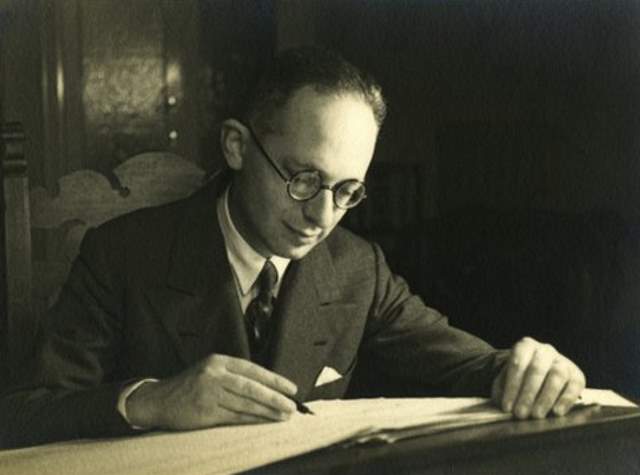
Things had already been heating up for Mario Castelnuovo-Tedesco for some time. His music was banned from radio and performances of his works were cancelled, well before the passage of Italian racial laws in 1938. Castelnuovo-Tedesco was a Jew living in Mussolini’s Italy. He finally emigrated in 1939, when Arturo Toscanini, who loathed fascism, sponsored the composer’s passage to the United States.
Castelnuovo-Tedesco’s music was embraced by Jascha Heifetz and Andrés Segovia, among others. His Violin Concerto No. 2, “The Prophets,” was given its first performance at Carnegie Hall, with Heifetz the soloist and Toscanini on the podium, in 1933. Its three movements are named for the Biblical figures Isaiah, Jeremiah, and Elijah.
I always make it a point to listen to this piece every year around Passover (which this year begins on Wednesday at sunset), but Castelnuovo-Tedesco is a composer whose music is unfailingly enjoyable in all seasons.
Furthermore, anyone who loves film music owes an incalculable debt to him. He wrote music for some 200 movies (including “And Then There Were None,” with Barry Fitzgerald, and “The Loves of Carmen,” with Rita Hayworth), and as a teacher, his students included André Previn, Nelson Riddle, Herman Stein, Henry Mancini, Jerry Goldsmith, and John Williams.
So thank you, and happy birthday, Mario C-T!
Violin Concerto No. 2 “The Prophets”
Segovia masterclass on the Guitar Concerto No. 1
Radio interview with Segovia and the composer
Toscanini conducts an adventurous program, including Castelnuovo-Tedesco’s “Overture to a Fairy Tale” (which, if I’m not mistaken, is the same as his “Midsummer Night’s Dream Overture”)
Leave a Reply