EIGHT DAYS OF SIBELIUS – DAY 2
Yesterday, I mentioned Robert Kajanus’ recording of Sibelius’ Symphony No. 3, a performance that fatefully brought me together with the composer’s grandson. Now, only six days in advance of Sibelius’ birthday, December 8, it happens to be the anniversary of the birth of Kajanus, his good friend and first devoted champion.
It was Kajanus who set down the first recording of Sibelius’ Third Symphony in 1932. It was he who commissioned the symphonic poem “En Saga.” “Pohjola’s Daughter” was also dedicated to him. In 1900, he toured with the Helsinki Orchestra (a group he founded), presenting programs that both he and Sibelius conducted. These concerts included performances of a number of Sibelius’ works heard for the first time outside of Finland.
Later, Kajanus made premiere recordings of Sibelius’ Symphonies Nos. 1, 2, 3 & 5, and the composer’s crowning symphonic poem, “Tapiola.” The plan had been to record all the symphonies. Unfortunately, Kajanus died, in 1933, before he could complete the cycle.
Kajanus himself was a composer. Here’s a recording of his Sinfonietta, dedicated to Sibelius:
By coincidence, today is also the birthday of Sir John Barbirolli, the conductor Ralph Vaughan Williams memorably dubbed “Glorious John.” Barbirolli was another inspired interpreter of the music of Sibelius, with his recording of the composer’s Symphony No. 2 with the Royal Philharmonic one of the best I have ever heard. In fact, I am posting links to both the Kajanus and Barbirolli recordings of Sibelius’ most frequently-performed symphony, below. They are very different interpretations, both superb in their own ways.
Kajanus, brisk, thrilling, and authoritative:
Barbirolli, passionate and big-hearted:
Happy birthday, Robert Kajanus and Sir John Barbirolli!
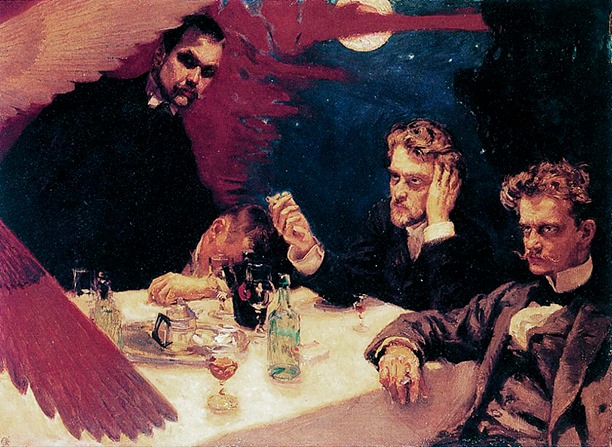
Of course, Sibelius was fond of his drink, a weakness apparently shared by his friends and associates of “the Symposion.” In Akseli Gallén-Kallela’s painting “Kajustaflan,” we find pictured (from left to right) the artist, composer Oskar Merikanto (blacked out), Kajanus, and Sibelius.
More about the Symposium, with the original version of Gallén’s painting – if possible, even more sordid – here:
http://www.sibelius.fi/english/elamankaari/sib_symbosion.htm
Leave a Reply