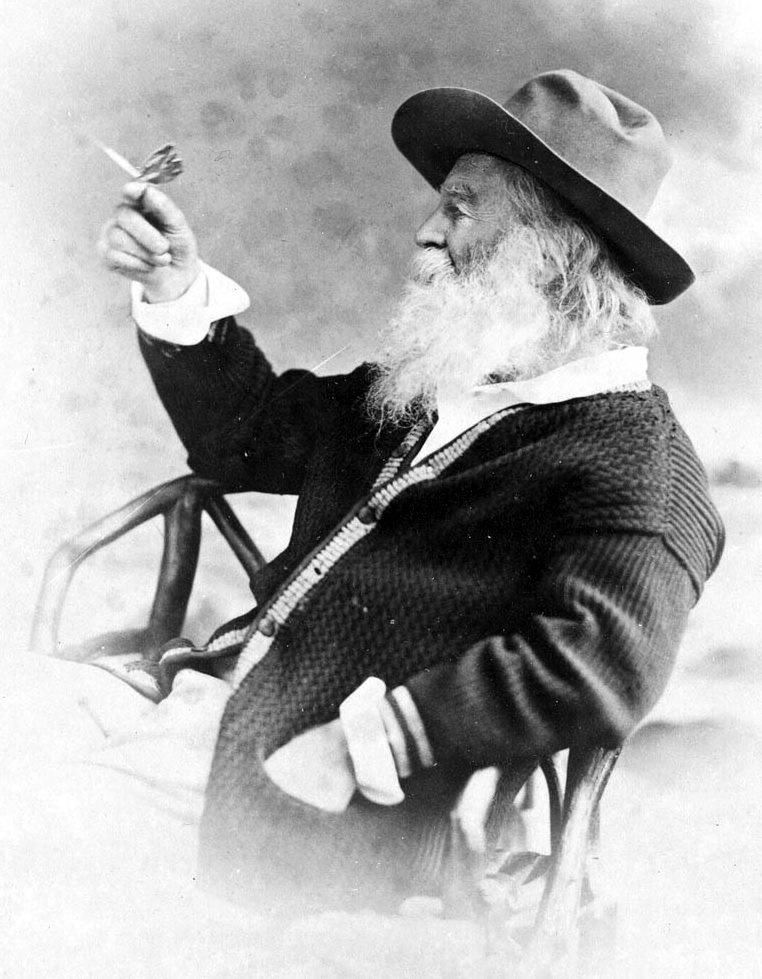
Whitman Week is underway!
May 31st marks the 200th anniversary of the birth of America’s “bard of democracy.” We’ve been celebrating this most influential of American poets, all month long, with music inspired by his verse.
Over the past several weeks, we’ve taken side trips to England and Germany. This Sunday night on “The Lost Chord,” we’ll conclude, as we began the series, with an all-American program.
Howard Hanson wrote several works inspired by Whitman. Hanson lived from 1896 to 1981. For some 40 years, he was the director of the Eastman School of Music. The recipient of the Pulitzer Prize in 1944 for his Symphony No. 4, he is really best remembered for his Second Symphony, from 1930. Subtitled the “Romantic,” the moniker pretty much sums up Hanson’s personal and artistic disposition.
We’ll experience his setting of “The Mystic Trumpeter,” from 1969. The speaker will be none other than James Earl Jones.
Lowell Liebermann, born in New York City in 1961, has met with considerable success in the writing tonal, immediately accessible music. His Flute Concerto, written for James Galway, has entered the repertoire, as has his Flute Sonata, and his suite for piano, “Gargoyles.”
Liebermann studied at Julliard with David Diamond and Vincent Persichetti. Over the course of his career, he has written symphonies, concertos, operas, and ballet, as well as chamber and instrumental music. He is currently on the faculty of the Mannes School.
Liebermann evidently has great affection for the music of Sergei Prokofiev, and a refreshing open-heartedness characterizes his output. In fact, like Hanson, he has been criticized in some circles for being so ingratiating, a throwback to less cynical times – to which I say, own it, brother!
Liebermann’s Symphony No. 2, for large chorus and orchestra, was composed for the centennial of the Dallas Symphony Orchestra and Chorus. It was given its first performance in the year 2000.
The work unfolds in one continuous, 40-minute span, yet manages to honor the conventions of a traditional, four-movement structure. Liebermann incorporates Whitman texts in a spirit of optimism and affirmation.
Whitman’s verse has inspired literally hundreds of musical responses. We’ll conclude our four-week survey of choral works, orchestral pieces, and songs – merely scratching the surface, with eleven works by ten composers – on “Joy, Shipmate, Joy,” this Sunday night at 10:00 EDT, on WWFM – The Classical Network and wwfm.org.
PLEASE NOTE: This is not the end of our Whitman celebrations on The Classical Network. On Saturday at 7:30 p.m., we’ll offer a live broadcast, from Washington’s National Cathedral, of Bernard Herrmann’s radio play “Whitman.” Baritone William Sharp will assume the title role, with the PostClassical Ensemble conducted by Angel Gil-Ordóñez. In addition, the program will include Herrmann’s Clarinet Quintet “Souvenirs de Voyage” and “Psycho: A Narrative for String Orchestra.”
We’ve also got something cooking for Friday afternoon, the actual anniversary of Whitman’s birth. Watch this space for further developments.
Leave a Reply