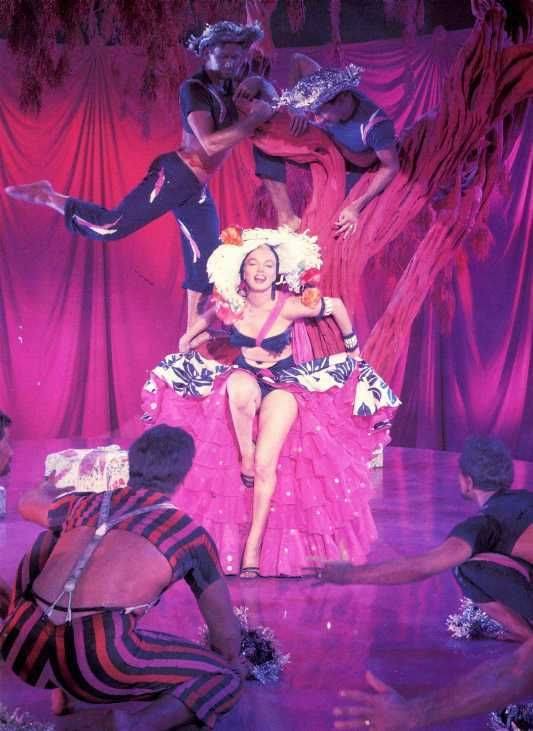
We’re having a heat waaaave… a tropical heat wave…
Only days after our first taste of snow, temperatures are poised to rise into the 60s.
This Thursday morning on WPRB, we’ll take our cue from Irving Berlin and ride the wave into the tropics. We’ll have music affiliated in some way or another with Cuba, Jamaica, Puerto Rico, Venezuela, and Brazil – broadly speaking, the Caribbean, the Amazon, and Latin America. Some of it will be in the form of picture postcards by European and (North) American composers; much it will be by artists who hail from equatorial climes.
Join me on my tropical estancia, tomorrow morning from 6 to 11 EST, on WPRB 103.3 FM and at wprb.com. We need more cow bell, on Classic Ross Amico.
So long, Old Man Winter – at least for the time being.
We’ll have an abundance of bananas and bongos this morning, as we travel south to equatorial climes, during what will seem in the Northeastern United States like a veritable heat wave. Too late for Indian Summer and too early for the Groundhog, it nevertheless provides us with some incentive to don our beachcombers and Bermuda shorts, musically speaking. We’ll enjoy a full morning of music evocative of the Caribbean, the Amazon, and Latin America. Some of the works will be by European and (North) American composers; most will be by those native to the regions.
For those of you listening from outside the Northeast, under very different weather conditions, consider yourself snow birds, bound for the tropics.
Join me as I crack coconuts with a machete this morning, from 6 to 11 EST, on WPRB 103.3 FM and at wprb.com. We’re having a heat waaave… a tropical heat wave…, on Classic Ross Amico.
As the weather has careened over the past several days from 20 degrees and snow to a projected 60 degrees tomorrow, so shall our musical selections this afternoon be varied and perhaps even a mite exhilarating.
We’ll observe the anniversary of the birth of composer Reinhold Glière with his flamboyant symphonic poem “The Zaporozhy Cossacks,” inspired by the raucous painting of Ilya Repin. Sir Alexander Gibson’s artistry will be recalled through one of his great Sibelius recordings. The Norwegian composer, Christian Sinding (he of “Rustles of Spring” fame) will be represented by his über-Romantic piano concerto. And Maurice Duruflé will set a more contemplative mood with his “Four Motets on Gregorian Themes.”
Is it winter? Spring? We have music suitable for all seasons this afternoon, from 4 to 7:00 EST, on WWFM – The Classical Network and at wwfm.org.
I think you’ll agree, there’s nothing slippery about this Slope.
Today’s edition of “The Classical Network in Concert” will feature performances guaranteed to stick to your ribs, as we travel to Saint John’s Episcopal Church in Park Slope, Brooklyn, for Concerts on the Slope. Concerts on the Slope was founded in 2012 to present top-notch chamber music concerts, featuring rising young artists from New York and around the world.
This afternoon’s broadcast will include a complete concert given on Oct. 23, 2016 – a program of clarinet trios by Jonathan Tunick, Ke-Chia Chen, and Beethoven – with clarinetist Eric Umble, cellist Benjamin Larsen, and pianist Jeong Hwa Park; and then, after a break, we’ll hear highlights from a concert given on Oct. 2, by Frank Morelli and his All-Star Bassoon Quartet. The program will include music by Gounod, Bach, Handel and Leonard Bernstein. You can find out more about the series at concertsontheslope.org.
Stick around after 2:00 EST for major works by Ralph Vaughan Williams and Bohuslav Martinu. I’ll be serving up the Slope for lunch at noon, and then spinning the platters until 4, on WWFM – The Classical Network and at wwfm.org.
Well, I missed it. I was off by one day. While I was busy lauding Ulysses Kay on the 100th anniversary of his birth, I failed to notice that January 8 was also the birthday of my friend, composer Robert Moran. And it was not just any birthday. It’s hard to believe that classical music’s merry prankster is now 80 years-old.
Bob has lived a lot in 80 years. Not only did he study twelve-tone music with Hans Erich Apostel in Vienna, he was accepted into a composition class of four at Mills College, where he was taught by Darius Milhaud and Luciano Berio. His classmates included Steve Reich, Phil Lesh and Tom Constanten. Lesh and Constanten went on to play for The Grateful Dead. And Reich? Who knows what happened to that guy.
Moran gained notoriety in the late 1960s and early ‘70s through a series of performance pieces that incorporated entire cities, including San Francisco, Bethlehem, Pa., and Graz, Austria. These involved tens of thousands of performers.
His many stage works include “Desert of Roses,” written for Houston Grand Opera, and, in 2011, “Alice” composed for the Scottish Ballet. Maurice Sendak introduced him to the Grimm fairy tale “The Juniper Tree,” which became an operatic collaboration with Philip Glass.
For the occasion of the tenth anniversary of the terrorist attacks on the World Trade Center, Moran was commissioned to write a work for the youth chorus of Trinity Wall Street, the so-called “Ground Zero” church in Lower Manhattan. “Trinity Requiem,” scored for children’s chorus, four cellos, harp and organ, offers a similar brand of solace to that conjured in the 19th century masterwork by Gabriel Fauré.
With Robert Moran, you never know what you’re going to get. In his more puckish moments, he might write for 39 autos, giant puppets or electric popcorn popper. But then there are times when his natural gift for lyricism will melt your heart.
Happy belated birthday, Bob. We’ll melt a few hearts this afternoon, between 4 and 7 EST, with at least one of his works, on WWFM – The Classical Network and at wwfm.org.
An aria from “Desert of Roses”:
Selections from “Trinity Requiem”:
“Obrigado” for Iowa Percussion:
Bob, looking groovy in merry prankster mode, introducing his “Lunchbag Opera” for the BBC:
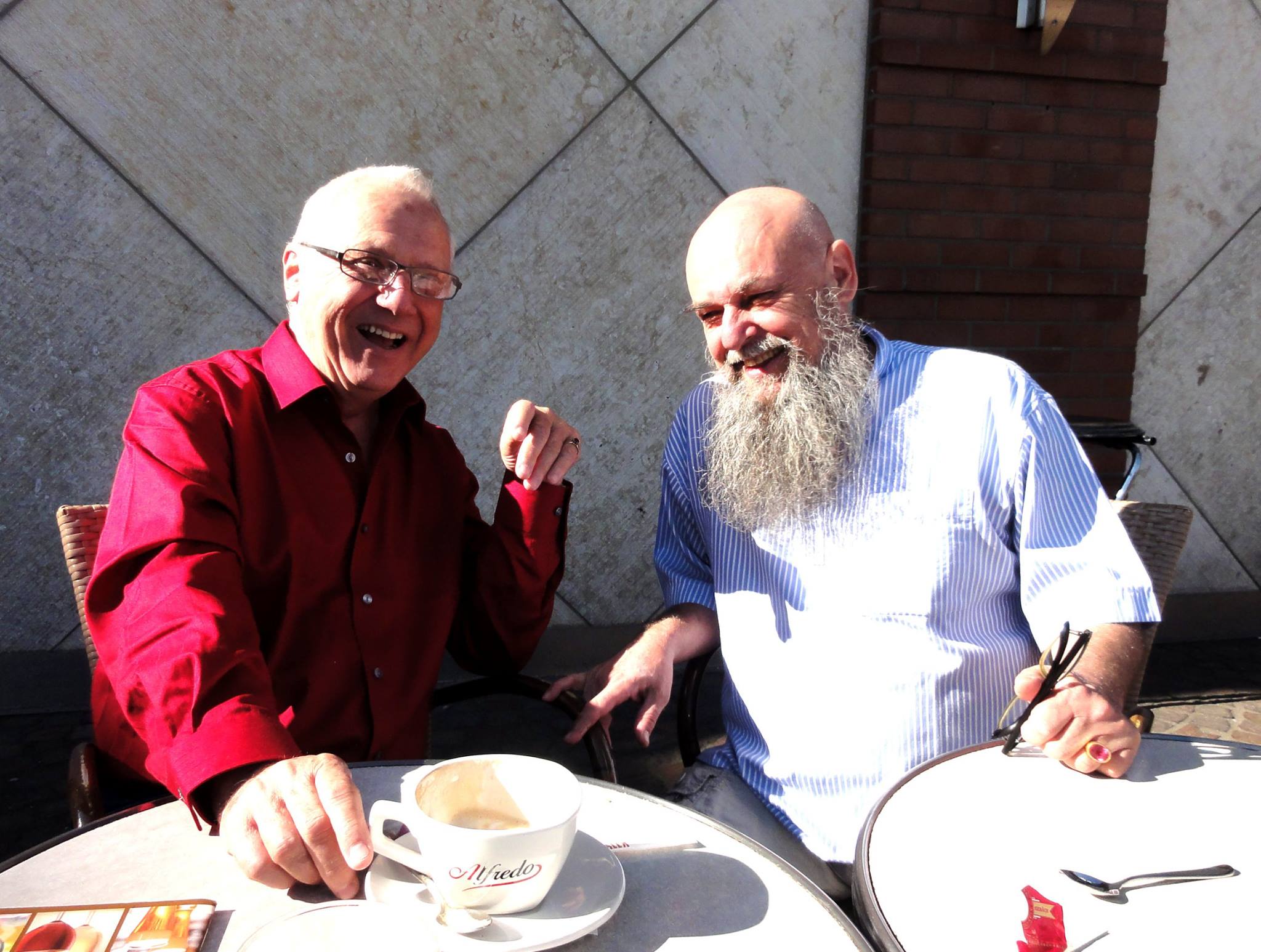
PHOTO: Bob (left) getting caffeinated with conductor, composer and performance artist Rupert Huber