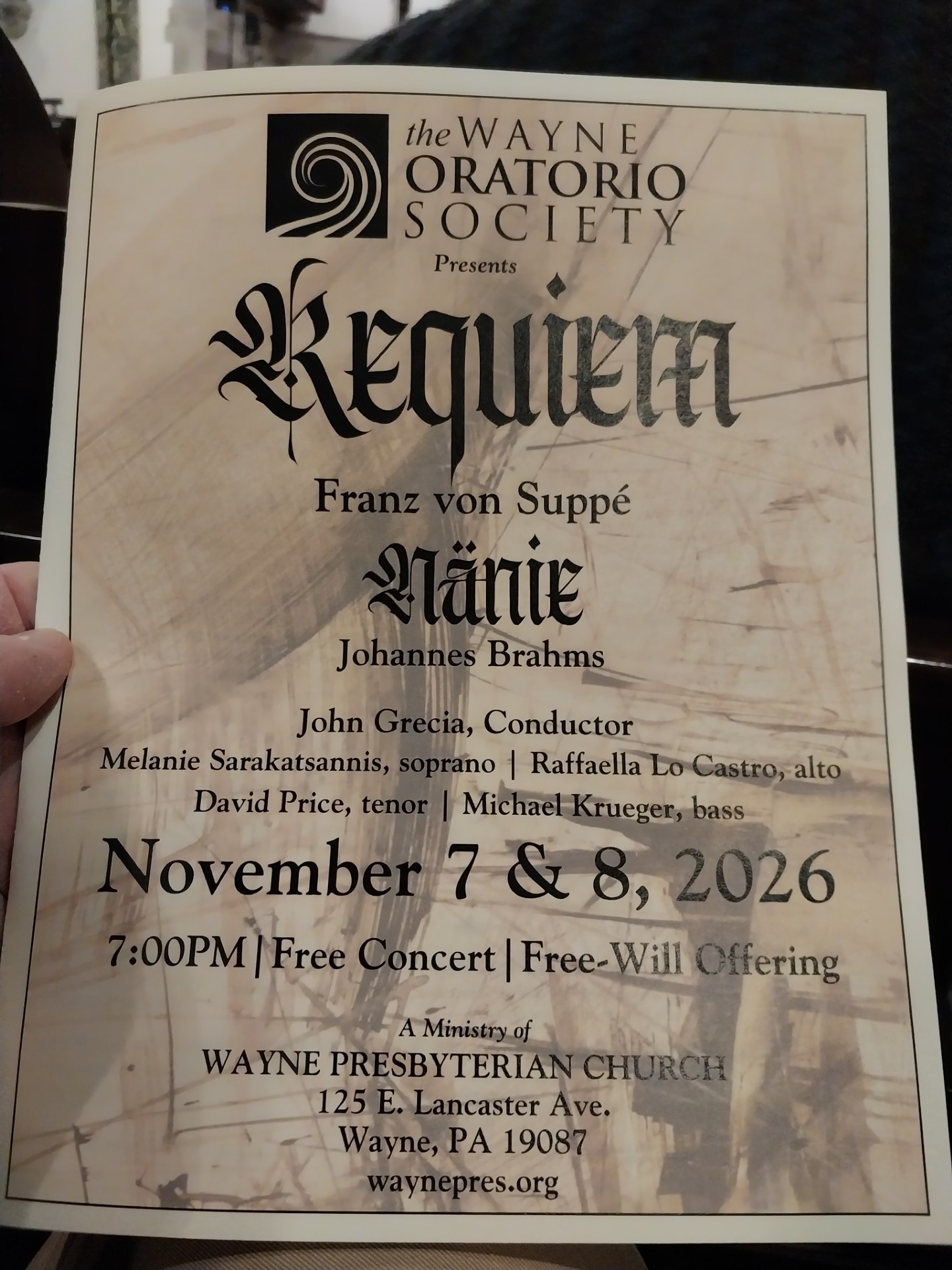
If you’re at all familiar with Mozart’s famous Requiem (an important plot point in “Amadeus”), you’ll be fascinated by Franz von Suppé’s essay in the form.
Yes, THAT Franz von Suppé, the composer whose indelibly tuneful, high-kicking overtures have remained in the public consciousness thanks to pops concerts, stereo LPs, classical drivetime radio, and vintage cartoons from Mickey Mouse and Popeye to Bugs Bunny and Tom and Jerry.
You mustn’t expect anything of that character in his Requiem, although I prepped for last night’s performance by the Wayne Oratorio Society – billed as the U.S. premiere – by indulging in no less than eight helpings of Suppé’s frothy schlagobers, courtesy of a 60-minute compact disc featuring Zubin Mehta and the Vienna Philharmonic, which buoyed my hour’s journey to charming Wayne, PA.
“Poet and Peasant.” “The Jolly Robbers.” “The Beautiful Galatea.” “Pique Dame.” “Light Cavalry.” “Morning, Noon and Night in Vienna.” Like Arthur Sullivan and John Philip Sousa, Suppe astonishes by drawing on a seemingly bottomless reserve of melodic invention, which he skillfully employs in endless variations on a formula. But he does it so well.
Mozart’s Requiem is hardly the closest comparison, but if you know the work, it’s an instructive one. There’s no mistaking Suppé’s model, as he flirts with it, while never quite lighting upon it (as in his setting of the Confutatis). While sharing Mozart’s key of D minor, Suppe’s Requiem is very much his own. His invention and theatrical sense ensure that composer takes it to some very interesting places, while yet honoring Mozart’s spirit. (Get a load of that Tuba Mirum!) It does perhaps become a little unintentionally amusing to note just how fond he is of fuguing and imitative vocal writing.
Suppé studied composition with Ignaz von Seyfried, a Mozart pupil, and he met Rossini, Verdi, and Donizetti (allegedly a distant relative), and attended performances of their operas while studying, ostensibly to be a lawyer, in Padua. He wrote two early operas himself that are said to bear Donizetti’s influence. These were not performed, and I do not know if they’re even still in existence.
It would not be farfetched to assume that they are not, or that they were lost. The Requiem itself, composed in 1855, disappeared for most of the 20th century. It was rediscovered and revived for performance only in 1984.
The impetus for its composition was the death of theatrical impresario and Suppé mentor Franz Pokorny in 1850. It was Pokorny and his son, Alois, who set up Suppé as a counterpart to Jacques Offenbach, the rights to whose popular operettas they could not afford. Suppe proved himself worthy of their trust, churning out about four dozen light operas, in addition to a staggering quantity of incidental music and other works for the stage.
So the dramatic impulse ran deep, and this is the side of Suppé he exploits in his sacred music (he also composed masses and an oratorio, “Extremum Judicium,” about the Last Judgment), abstaining from the schlag that delights and pacifies us in the overtures.
The Wayne Oratorio Society is enormous, perhaps 150 community singers, but they sing with restraint and taste, as conductor John Grecia shepherds them through their dynamic gradations, and ensures that no detail in the orchestra goes unheard. But they’re allowed to let go in their big moments.
The four vocal soloists for the evening (soprano Melanie Sarakatsannis, mezzo Raffaella Lo Castro, tenor David Price, and bass Michael Krueger) were well-matched when they sang as a quartet, as they do several times throughout the piece. In their solos, the women were standouts. Sadly, Lo Castro’s riveting performance of the Lacrimosa was marred by a cell phone in the audience, but she maintained her concentration throughout.
Also on the program was one of Johannes Brahms’ loveliest choral works, “Nanie” (a funeral song named for the Roman goddess), after a melancholy text of Friedrich Schiller. Schiller’s poem draws on mythological motifs to illustrate the impermanence of even beauty and perfection, but concludes “a lament on the lips of loved ones is glorious.” Brahms composed it as an elegy for his friend, the painter Anselm Feuerbach, who died in 1880.
There was an unexpected bonus in the form of a preamble as Grecia went to the piano and joined a violinist (presumably concertmaster Set Rodriguez) and a cellist (I’m sorry, I don’t know which) from the orchestra for a performance of the slow movement from Brahms’ Piano Trio No. 1, which nicely set the mood.
Keep in mind, these are largely amateur musicians, a community choir singing with a pick-up orchestra of professional players. I have no idea how much rehearsal time there was, especially with the choir together with orchestra, so of course it was not flawless, but there was nothing to spoil my enjoyment, and everyone sang and played with enthusiasm and commitment. The performance was at a level at which one could experience and become totally immersed in the music.
The choir sings several major works per season, with “Messiah” (Dec. & 6) and a double-bill of “Carmina Burana” and Leonard Bernstein’s “Chichester Psalms” (April 17 & 18) coming up, but for me, it’s the unusual repertoire that draws me like a fly to molasses. A couple of years ago, I attended a transcendent performance there of Vaughan Williams’ “A Sea Symphony,” and last year I was very sorry to have to miss John Knowles Paine’s Mass in D minor. If you make the trip, I think you will find it rewarding.
There’s one more chance to hear Suppé’s Requiem, tonight at 7:00. Wayne Presbyterian Church is located at 125 E. Lancaster Ave., in Wayne, PA. Admission is free, but don’t be a deadbeat. Leave them a nice donation. They do good work, and a portion of the proceeds to concerts at Wayne Presbyterian supports the Cornerstone Christian Academy Orchestra Program in Southwest Philadelphia.
Get there early to partake of the neighborhood’s boutiques, restaurants, coffee shops (I had a robust cup at Gryphon Café), and a diverting, well-curated bookstore (Main Point Books), a stone’s throw from the venue, which alas, I see closes today at 4 p.m. (They were open until 8:00 on Saturday.)
For more information, visit waynepres.org. Bravo, Wayne Oratorio Society!
Tag Cloud
Aaron Copland (94) Beethoven (95) Composer (114) Film Music (153) Film Score (143) Film Scores (255) Halloween (107) John Williams (198) KWAX (233) Leonard Bernstein (105) Marlboro Music Festival (125) Movie Music (168) Mozart (92) Opera (222) Philadelphia Orchestra (91) Picture Perfect (174) Princeton Symphony Orchestra (110) Radio (90) Ross Amico (244) Roy's Tie-Dye Sci-Fi Corner (290) The Classical Network (101) The Lost Chord (269) Vaughan Williams (107) WPRB (397) WWFM (881)
Leave a Reply