Can we have some serious love for Diane Wittry and the Allentown Symphony Orchestra?
I am ashamed to say, having grown up in the Lehigh Valley, that somehow I never attended a concert of the ASO until just a few years ago. Except of course, as I realize retroactively, a performance of “The Nutcracker” (like probably everyone else in the area) in the late 1970s.
But in the past decade or more, I’ve become gradually aware of some interesting things going on there, at the orchestra’s home in Miller Symphony Hall, in Allentown, PA.
The programming, in particular, has been very well balanced, with a lot of intriguing music, whether new or semi–forgotten, being performed alongside the comfy classics. Grażyna Bacewicz. Louise Farrenc. Jessie Montgomery. Aulis Sallinen. William Grant Still. Zhou Tian. Since 2023, Clarice Assad has been composer–in–residence.
Of course, working all hours at the radio for a quarter century helped keep me away, always busy and in penury. But now that I am at a stage where I’m more independent, it’s really mostly conflicts in my personal schedule, whether or not I’d heard a certain piece of music played recently in Philadelphia, New York, or Princeton, or if I’m simply worn out from having done too much and need some time at home that have kept me from attending more often.
But I have been able to go to a few of their concerts over the past several seasons, and all of them have been quite good. None finer than the Sunday matinee I attended yesterday (a repeat of a program given on Saturday night), with a friend who, yes, also remembered being at Miller in the ‘70s to see “The Nutcracker.”
Wittry has been Allentown’s music director since 1995. While she will officially remain in that capacity through the end of the 2027-28 season, she will conduct her final concert with the orchestra next fall. When she steps down, her 33–year tenure will have been the longest in the organization’s history. She will have inched past Donald Vorhees, who founded the ASO in 1951 and led the group for 32 years, until 1983. In between, William Smith, assistant conductor of the Philadelphia Orchestra, held the reins until his death in 1993.
I always enjoy visiting Miller Hall, which in its intimacy reminds me of my old haunt at the Philadelphia Orchestra’s original home of the Academy of Music, before its move to the cavernous, state-of-the-art Kimmel Center 25 years ago.
There’s a lot to be said for these vintage halls, in which, even in the balcony, it feels as if you can practically reach out and touch the performers. It’s a much more immediate experience for anyone in the auditorium, and more conducive, I think, to connecting a listener to the quintessentially human practice of making, sharing, and enjoying music than is often the case in the stadium-size arenas of today.
This weekend’s concerts opened with Strauss’ buoyant swashbuckler “Don Juan.” What a joy to encounter this piece again, in such close proximity, and to be able to marvel anew at the composer’s youthful energy and imagination. Wittry reminded us in her prefatory remarks that Strauss was only 24 when he wrote it. The percussion, the double basses, the woodwinds – quite frankly every section, every instrument of the orchestra – are utilized so very well. I wish there were more (or any?) composers who knew how to use an orchestra like this today.
The musical language, of course, served as a blueprint for the classic Hollywood sound to come. Strauss knew Erich Wolfgang Korngold as a wunderkind and even shared a box with him at the premiere of the 16-year-old’s Sinfonietta. His response, as he related it, was one of awe and fear at the realization of such talent in one so young. Korngold would become one of the progenitors of the Hollywood film score at Warner Bros. in the 1930s and ‘40s, where he lent musical uplift to historical adventures starring Errol Flynn. Clearly, he would have had a colorful antecedent in Strauss’ “Don Juan” of 1888. (Korngold was born in 1897.)
Wittry’s undemonstrative conducting as the music glinted and swaggered, in relation to the Don’s exuberance, passion, and desperation, struck me as being much in line with Strauss’ own philosophy. On the podium, the composer always favored economic gestures. In his 10 Golden Rules for young conductors, he humorously observed, “Don’t perspire while conducting – only the audience should get warm.” However overheated Wittry may have been in reality, she kept her composure on the podium, and the orchestra turned in a richly satisfying performance.
I regret that I so badly underrated American composer Stephen Paulus while he was alive. (Paulus died following complications from a stroke in 2014, at the age of only 65 years.) I knew him mostly as a choral composer. For some reason, the works that I heard didn’t really land with me at the time. I didn’t dislike them; I just couldn’t really connect with them.
But in recent years, I have had to wholly reevaluate him, as I have since encountered a few of his pieces that command not only my respect, but also my genuine affection. His “Prayers and Remembrances” for chorus and orchestra, written for the tenth anniversary of 9/11, is one of the most beautiful and poignant musical memorials written in response to the tragedy.
Paulus also wrote quite a bit of orchestral music. I was able to go back and listen to his Violin Concerto and his Symphony for Strings this afternoon, and I was a lot more receptive than I was upon first acquaintance over 30 years ago. But in general, I am more receptive to just about anything on a November afternoon.
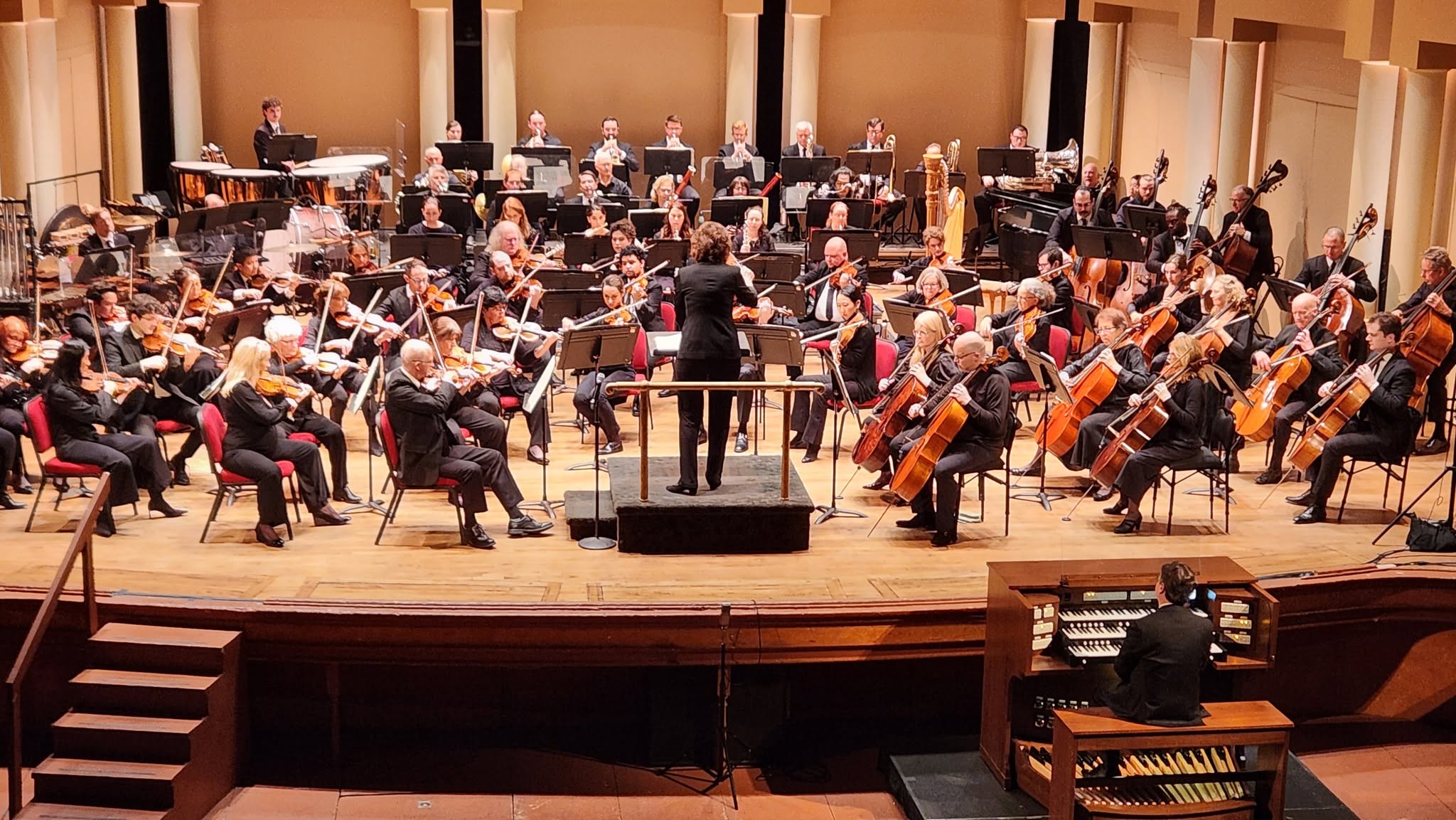
His Grand Concerto for Organ (actually his third organ concerto), at the heart of yesterday’s program, was a delightful discovery. A lot of concertos for organ get mired in thick textures, presumably so that the acoustic instruments aren’t wholly blotted out by this bellowed behemoth. Not so, Paulus’ concerto, ingeniously orchestrated so that the organ interacts cleanly with the other instruments on stage, frequently in genuine dialogue. It is really quite something to witness, and a joy to hear.
Paulus’ musical language is tonal and “modern” in the most welcome sense. This is music anyone could wander into and enjoy. While in no way pandering to the listener, again there are times when it’s almost like film music, though not in a facile or superficial manner that such a characterization might imply. There was nothing kitschy or pandering about it. It’s just really cleverly, admirably done. And with so much percussion on stage, I never anticipated how bright the piece would sound.
Furthermore, it was astonishingly well-balanced. I can’t for the life of me figure out how Wittry and the soloist, Juilliard’s Paul Jacobs – currently one of the world’s foremost organists – figured it out, as the instrument was positioned on the floor of the auditorium, against the foot of the stage, and well out of the conductor’s sightline.
Furthermore, it was electronic organ lent by Allen Organ Company, founded in Allentown, but world renowned. (Wittry reminded the audience that it was an Allen organ that reopened Notre Dame as a temporary replacement for the cathedral’s destroyed choir organ, which is still undergoing restoration.) If you’re curious, according to the orchestra’s website, the model was an Allen III–44 classical organ.
Interplay between soloist and orchestra was perfectly executed, and the timbres and dynamics of the organ were so well judged, I never once missed the pipes. There was a poignant moment at the end of the second movement in which the composer recalls his father through a quotation of “Come, Come, Ye Saints,” a favorite of the senior Paulus (who was also an organist). The final movement (of three), a toccata, incorporated the folk melody “The Water is Wide.”
The work was a crowd pleaser, warmly received by the Miller Hall audience. Already, with Saint-Saëns’ Symphony No. 3 scheduled for the second half of the program, this was an embarrassment of riches for fans of the King of Instruments. Nevertheless, Jacobs returned for an encore: if I’m not mistaken, the Sinfonia from Bach’s Cantata BWV 29, which in transcription really sounded like Wendy Carlos. So far, so good, and still plenty of organ to come!
Somewhat in contradiction to my earlier statements suggesting the drawbacks of venues such as the Kimmel Center, the Allen organ on yesterday’s program, while surprisingly adequate for the demands of the Paulus piece, could not compete with the terrifying power of the Kimmel’s Fred J. Cooper Memorial Organ, the largest mechanical-action pipe organ in a concert hall in the U.S., in the Saint-Saëns.
Again, the orchestra played well, if without the velvety sheen of the Philadelphians (which I last heard in this piece two seasons ago), and Wittry’s brisk tempi in the more expansive passages kept the work from wallowing in sentimentality. It occurred to me that such an interpretation would not be entirely inappropriate, as the comparative aloofness of her no-nonsense approach kept it very French. But the exciting finale of the piece never achieved the visceral thrill and sublime terror of hearing it with a magnificent pipe organ.
I was a little perplexed, frankly, since the organ blended so well with the orchestra in the Paulus piece. Can someone have adjusted the volume? Can Paulus be a more lucid orchestrator? I doubt anyone can be more transparent than Saint-Saëns. But in a symphony which is, after all, subtitled the “Organ,” and in which, in reality, the organist sits with his hands at his sides for half of it, you want to have the top of your head blown off by the work’s overwhelming coda.
It felt a little bit like what Wittry related in her introductory remarks about the conditions of the symphony’s first performance, with Saint-Saëns having catered the piece to the sound of a specific organ, on which he himself had had the opportunity to perform, only to show up at rehearsals to find it had been replaced by an inferior instrument.
Still, this was practically a five-star concert. Trust me, the audience loved it. If you are in a position to hear this group, especially performing any of the big orchestral works under Wittry’s direction, get out there and do so while you still have the chance!
For more information about upcoming events (including two performances of “The Nutcracker” with Repertory Dance Theatre on December 5), visit millersymphonyhall.org/symphony/concerts.
Sunday Satisfaction with the Allentown Symphony Orchestra
by
One response
Allentown Symphony Orchestra Camille Saint-Saëns Diane Wittry Erich Wolfgang Korngold organ Paul Jacobs Richard Strauss Stephen Paulus
Comments
One response to “Sunday Satisfaction with the Allentown Symphony Orchestra”
-
We got tickets for several upcoming performances..We are excited!!
Tag Cloud
Aaron Copland (94) Beethoven (95) Composer (114) Film Music (153) Film Score (143) Film Scores (255) Halloween (107) John Williams (198) KWAX (233) Leonard Bernstein (105) Marlboro Music Festival (125) Movie Music (168) Mozart (92) Opera (222) Philadelphia Orchestra (91) Picture Perfect (174) Princeton Symphony Orchestra (110) Radio (90) Ross Amico (244) Roy's Tie-Dye Sci-Fi Corner (290) The Classical Network (101) The Lost Chord (269) Vaughan Williams (107) WPRB (397) WWFM (881)
Leave a Reply