I hope you’ll join me for today’s Noon Time Concert, when I’ll be introducing works performed by Bucks County’s Lenape Chamber Ensemble. On the program will be music by Franz Schubert, Joaquin Turina and Antonin Dvorak. Lenape Chamber Ensemble is made up of crackerjack musicians from Philadelphia and New York City.
The group’s next set of concerts, which will feature works by Haydn, Schubert and Jean Francaix, will take place on October 7 at Upper Tinicum Lutheran Church in Upper Black Eddy, Pa., and October 9 at Delaware Valley University in Doylestown, Pa. For more information, look online at lenapechamberensemble.org.
Then stick around: later this afternoon, among my featured selections, we’ll enjoy a symphony by Sir Arnold Bax, on WWFM – The Classical Network and at wwfm.org.
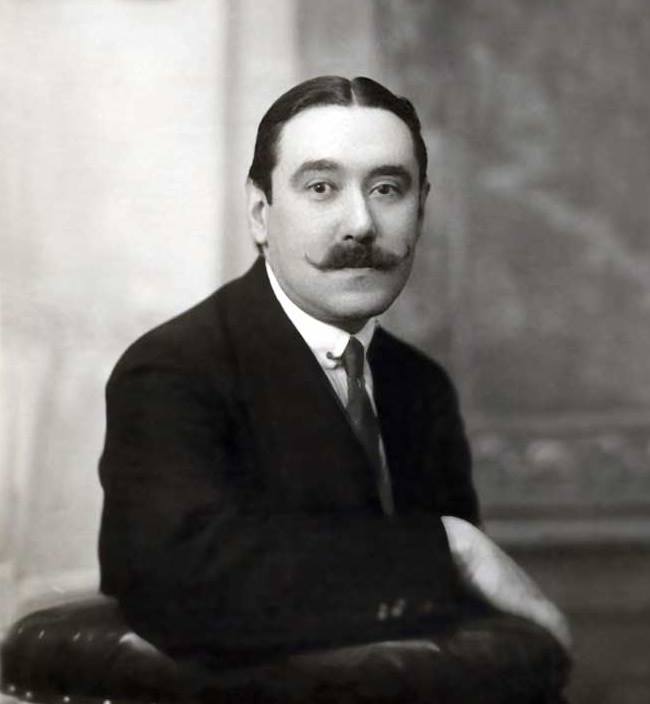
PHOTO: Turina, sporting the most dapper mustache in the room
He began his career as a song plugger on New York’s Tin Pan Alley. He was “discovered” by Al Jolson, who gave him his biggest hit. He composed a string of successful stage musicals with lyrics by his brother, Ira.
Though he had classical training, he was turned away by both Nadia Boulanger and Maurice Ravel, on the grounds that they didn’t want to spoil his natural voice. He played tennis with Arnold Schoenberg, who also refused him lessons. He kept an autographed photo of Alban Berg in his apartment, next to one of Jack Dempsey.
His musical, “Of Thee I Sing,” was the first to win a Pulitzer Prize. His opera, “Porgy and Bess,” was a failure at its premiere. His songs graced elegant screen comedies of the 1930s. In the concert hall, he was America’s most authentic voice.
George Gershwin died of a brain tumor in 1937, at the age of 38. Reportedly, his last words were “Fred Astaire.”
I invite you to join me this afternoon, as I salute this versatile composer on his birthday anniversary. Gershwin’s music will be among our featured highlights, between 4 and 7 p.m. EDT, on WWFM – The Classical Network and at wwfm.org.
You know Aram Khachaturian, right? The guy who wrote that frenetic tune that makes you want to spin plates on the tops of sticks? The one that is used to usher in the elephants at the circus?
This Sunday night on “The Lost Chord,” we’ll be listening to Leopold Stokowski’s rarely-heard recording of Khachaturian’s Symphony No. 2, sometimes called “The Bell.”
Khachaturian wrote the work in 1943, the height of World War II, while he was holed up at a Composers Union retreat with Shostakovich, Prokofiev, Miaskovsky and Gliere. He said of the piece, “The Second Symphony is a requiem of wrath, a requiem of protest against war and violence.”
The symphony’s nickname alludes to a kind of alarm that opens and closes the work. Overall, the tone is one of resolve in the face of tragedy.
Stokowski’s recording, long unavailable, was originally issued on United Artists Records in the late 1950s. It reappeared briefly on compact disc, on the EMI label, in 1994, and again in 2009, as part of a 10-disc box set of entrancing Stokowski performances.
The master tapes have not weathered the years well, alas, so there are moments of distortion, but the power of the piece transcends any technical limitations. There is certainly nothing wanting in the performance.
To round out the hour, we’ll hear the Russian-born pianist, Nadia Reisenberg, in a selection from her 1947 Carnegie Hall recital, Khachaturian’s most famous piano work, the “Toccata.” Reisenberg studied at Philadelphia’s Curtis Institute of Music under Josef Hoffman.
Join me for these Khachaturian rarities, “Khach as Catch Can,” tonight at 10 EDT, on WWFM – The Classical Network and at wwfm.org.
Here’s the composer, highly-decorated, conducting his “Concerto-Rhapsody,” with Mstislav Rostropovich:
Music for spinning plates, Liberace style:
A rare document of Khachaturian singing about the glories of Armenian wine!
So why are the film scores to blockbuster superhero films so undistinguished? You know something’s got to be wrong when Patrick Doyle, one of the screen’s great melodists (he wrote the music for “Henry V,” “Much Ado About Nothing,” and “Sense and Sensibility”), succumbs to a bludgeoning drum beat for “Thor.” One thing’s for certain, we are a long, long way from John Williams’ “Superman” (1978), which proved, even in its most intimate scenes, how indelible and uplifting a superhero score could be.
To be fair, there isn’t a lot of room in contemporary superhero films for the music to breathe, the scores often swallowed up by hyperkinetic editing and ear-splitting sound effects. For a composer’s contribution to be heard, he needs to be pounding the biggest drum – even if it’s an electronic drum – in the room.
If there is melody, it is either cranked out of a noodle press, someone running their fingers mindlessly across a keyboard with no concept of how a true melody is structured, or limited to a recurring motif (as in “The Avengers”), as if the composer is embarrassed to let his score “sing.” Alan Silvestri, composer for “The Avengers,” wrote the music for “Back to the Future,” for crying out loud! His scores since at least “Van Helsing” (2004) have been horrifying assaults. He was given the chance to write a good old-fashioned march for “Captain America,” but the film itself was a self-conscious throwback, directed by Lucas and Spielberg associate Joe Johnston.
So who decided audiences were fed up with grand, post-romantic, orchestral scores? What film composer has sold more albums than John Williams? What composer is more represented in a list of top-grossing films of all time? Who doesn’t love “Star Wars” and “Raiders of the Lost Ark” and “E.T.” and “Jurassic Park” and “Harry Potter?” I’m not saying every score has to be like those, but the majority of scores these days sound as if they are churned out on a synthesizer – which may very well be the case. Sure, the composer, as the last in the post-production assembly line, has to deliver very quickly, but Jerry Goldsmith churned out plenty of memorable music at white heat.
The sad fact of the matter is that the bean-counters have figured out that music no longer has to make much of an impression for a film to make a billion dollars worldwide. Also, if a composer no longer requires extensive training, then anyone can sit down and noodle something out on their computer – which is why so many rock musicians are now on the rise as film composers. Think back on the incredibly rich scores by Erich Wolfgang Korngold or Miklós Rózsa or Bernard Herrmann or Andre Previn, and measure their contributions against just about anything being written today. These guys were honest-to-goodness geniuses at their craft.
Hans Zimmer, who, by his own admission doesn’t have the chops to write on Williams’ level, as far as orchestral scores are concerned, helped sow the seeds of destruction by demonstrating that synthesizers and electronic sampling by a team of composers would be perfectly acceptable to most audiences. When producers have the choice between hiring out to Zimmer’s studio or leasing the London Symphony Orchestra, who are they going to go with? It could take a composer, working with a trusted orchestrator, a good month or more to come up with a polished score. Using electronics, music can be cranked out like sausages, and today’s audiences are only too ready to gobble them down.
Okay, that’s my rant. Here’s a related piece on how cannibalized temp tracks have helped keep Marvel movies at a level of musical mediocrity.
2016 has been a bold year for remakes. Above and beyond a new “Ghostbusters,” which had so-called fanboys tied up in knots, Hollywood has brazenly taken on two beloved classics in “Ben-Hur” and “The Magnificent Seven.” Generally speaking, the originals excelled on all levels, which is why they are still fondly remembered, but the music for both has been especially indelible. In fact, I would argue “The Magnificent Seven” is as beloved as it is mostly because of Elmer Bernstein’s immortal score.
This week on “Picture Perfect,” you’ll have a chance to sample music from the remakes, alongside selections from their classic predecessors.
I’ve been listening to James Horner’s score for the new version of “The Magnificent Seven,” and while the result is not exactly top-shelf Horner – the composer was killed in a plane crash last year, not long after making some sketches after having merely read the script (an associate of his, Simon Franglen, who worked with the composer on “Titanic” and “Avatar,” was hired to flesh out the material) – it nonetheless serves as a painful reminder of exactly what’s been lost from the art of film-scoring.
Horner’s trademark use of the shakuhachi is invoked, as are “Mask of Zorro”-style handclaps and the inclusion of the all-pervasive Horner “Danger Motif” (which echoes the opening of Rachmaninoff’s Symphony No. 1 and is in just about every genre score Horner composed since at least “Star Trek II” in 1982). But what is most pertinent, and most refreshing, are the snippets of bona fide melody – and some of that melody is actually stirring and uplifting. After all, Horner hit his stride in the early ‘80s, when music still had something meaningful to add to movies, beyond simply acting as a moody drone or pumped-up bass-line.
Say what you will about Horner – he was a flawed artist who lifted freely from his own and others’ work – but he was always polished, professional and dramatically effective. I would go so far as to say he may very well have been the most naturally talented film composer of his generation. He was fatally limited by a lack of originality, but he always knew his way around an orchestra.
Furthermore, he had the ability to uplift. It’s a quality not at all common in film music today, or in movies at all for that matter. Movies may retain the ability to thrill, but the thrills, I find, such as they are, are mostly adrenaline-driven. When was the last time you experienced awe at the movies, or left the theater feeling elevated or elated? More commonly, it’s the sensation of having been wrung-out, triumph experienced vicariously only insofar as having survived the latest computer-generated assault. Where is the joy in that? Where is the hope?
Horner’s score in no way displaces Elmer Bernstein’s immortal music for the original “The Magnificent Seven.” Then again, how could it? But at least he doesn’t embarrass himself. The best I can say about Marco Beltrami, on the other hand, is that he is smart enough to know there is no way a new “Ben-Hur” is going to be able to top its predecessor. So instead, he tries for something completely different.
Tune in at 6:00 EDT and hear for yourself. We’ll enjoy a little “7” and “7” with two sides of “Ben-Hur,” on WWFM – The Classical Network and at wwfm.org.
Unfamiliar with Horner’s “Danger Motif?” These clips should give you an idea:
You can also it hear it here, in the first movement of Rachmaninoff’s First Symphony: