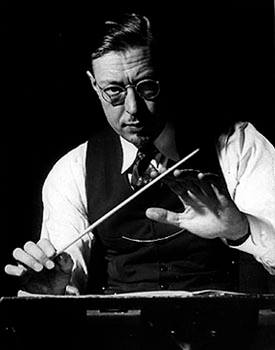
Howard Hanson, you incurable Romantic. I wish I had time to write about you today, your birthday, but I don’t. For four decades, you were the director of the Eastman School of Music; you were the recipient of a Pulitzer Prize in 1944 for your Symphony No. 4; and you were the champion of dozens of American composers as conductor of the Eastman-Rochester Orchestra.
Criminally, only a fraction of your recordings have made it to compact disc. Here’s one of them that didn’t, of you conducting your Symphony No. 4:
WWFM has begun its Fall Membership Campaign, on a harvest theme. I hope you will support the station, and that when you do, you will put in the good word for me and my shows. Also, please make sure that the phone volunteers take the information!
I will be there live on Wednesday, from 4 to 6 p.m. ET, followed by a rebroadcast of last night’s “The Lost Chord,” from 6 to 7. During the two-hour preamble, I will be playing past “Lost Chord” favorites and offering as a special thank you gift autographed copies of Robert Moran’s new album, “Game of the Antichrist.” (Of course, you can always opt for the tote bag or the station mug.)
This will be the first time I have been on the air, in a live capacity, since June. Thankfully, the station is still carrying “The Lost Chord” and “Picture Perfect,” made possible through member contributions from listeners just like you.
Whenever I interview composer Robert Moran, I’m reminded of Andre Gregory’s description of “the beehive” in “My Dinner with Andre.” Only more ribald.
Anyone who has followed Bob’s career is familiar with his merry prankster ethos. He’s written works for harpsichord and electric frying pan, and any number of performance art pieces, including one which involves people walking around a financial district in giant paper bags. Here it is – like just about everything else, it seems – on YouTube:
“For 39 minutes, 100,000 persons were tripping together.” Groovy.
Bob’s new album, “Game of the Antichrist” is being released this week – just in time for Hallowe’en – on the innova Recordings label. It is the featured work tonight on “The Lost Chord” (more information about that below).
Robert Moran was born in Denver, Colorado, in 1937. He studied composition with Hans Erich Apostel in Vienna, then earned his Masters Degree at Mills College under Darius Milhaud and Luciano Berio.
He himself has taught at a number of institutions, including the San Francisco Conservatory of Music and Portland State University. He’s been composer-in-residence to the city of West Berlin; at the Buffalo, NY, Center for the Performing Arts; and Northwestern University.
Early in his career, he gained notoriety for his compositions on a grand scale, incorporating entire cities (San Francisco; Bethlehem, PA; Graz, Austria; Hartford, CT) – their automobiles, airplanes, skyscrapers, radio and television stations, marching bands, dancers, theatrical groups and tens of thousands of performers.
He collaborated on the opera, “The Juniper Tree,” with Phillip Glass, and has composed many other works for the stage, including “Desert of Roses,” after Beauty and the Beast, for Houston Grand Opera, and “Alice,” after “Alice’s Adventures in Wonderland,” for the Scottish Ballet.
Lest I give you the impression that Bob is all flash and no substance, I assure you he can turn around and write absolutely gorgeous music. Portions of “Desert of Roses” are so beautiful my heart could break. He also composed a lovely piece for youth chorus to commemorate the tenth anniversary of 9/11, the “Trinity Requiem,” on a commission from Trinity Wall Street, the co-called “Ground Zero” church in lower Manhattan. You can sample that on YouTube, as well.
This deserves to be repertory.
Bob’s works have been performed by the San Francisco Symphony, the Baltimore Symphony, the National Symphony, The Greater Trenton Symphony, Mendelssohn Club of Philadelphia, and Pennsylvania Ballet.
“Game of the Antichrist” is a choral/theatrical adaptation of a 12th century mystery play. It’s scored for vocal soloists, chorus, children’s chorus, winds (including recorders), brass, Alphorn, bar piano, synthesizer, harp, organ and percussion. If memory serves, I think there’s even a glass harmonica in there. Oh yeah, and puppets. Giant puppets.
Since the 1980s, Moran has made his home in Philadelphia. We had an opportunity to chat there, at his townhouse, last week, where he filled me in on some of the background to his new piece. Although I’ve edited the conversation to keep it within FCC standards (I hope), Bob still has his moments. You can listen in to his expurgated insights, as Bob is my guest tonight on “The Lost Chord.”
The program is slated to air at 10 ET. Because of the recent schedule change, the show will now repeat during the dinner hour, 6 ET, on Wednesday, smack dab in the middle of our autumn pledge drive! If that doesn’t cost me my job, nothing will. So please be generous with your support on Wednesday. To further scandalize the phone volunteers, you can even say you are pledging in honor of “the Antichrist.”
I’ve been invited to do a live preamble on Wednesday, from 4 to 6, to talk up the show and play some of my “Lost Chord” favorites from years past. Bob has generously signed and contributed ten copies of “Antichrist,” which I’ll be offering as thank you gifts exclusively during those two hours.
You can listen and make your contributions here: http://www.wwfm.org; or call Wednesday, between 4 and 6, at 1-888-232-1212. Thank you for your support!
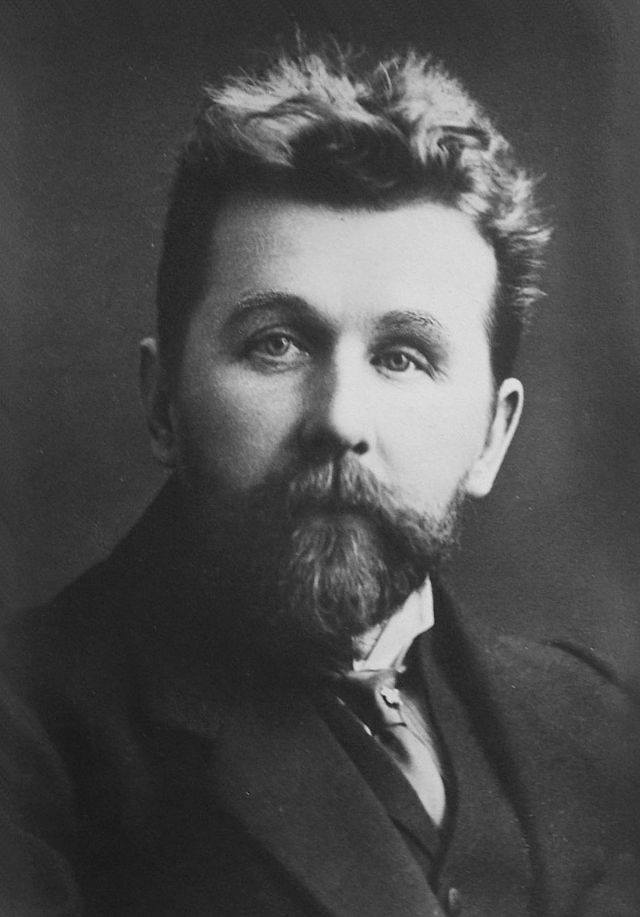
Get this: there’s actually a pupil of Nikolai Rimsky-Korsakov buried outside Six Flags Great Adventure.
That’s right, Alexander Gretchaninov, who began composing in pre-revolutionary Russia, opted to decompose in New Jersey.
Gretchaninov, born on this date in 1864, wrote five symphonies, four string quartets, two piano trios, sonatas for violin, cello, clarinet and balalaika, several operas and numerous other works.
He claimed not even to have seen a piano until the age of 14, when he entered the Moscow Conservatory. He did so without the approval or even the knowledge of his father, a businessman who wholly expected his son to take over the family firm.
Gretchaninov studied there with Sergei Taneyev (who had studied with Tchaikovsky) and Anton Arensky. After a quarrel with Arensky, he moved to St. Petersburg to study with Arensky’s teacher, Rimsky-Korsakov.
By that point, Gretchaninov’s parents had basically disowned him. Rimsky, who recognized the teenager’s extraordinary talent, devoted extra time to his instruction and even assumed the role of a surrogate father, helping to support him financially. The two formed an intimate bond which lasted until Rimsky’s death in 1908.
Gretchaninov returned to Moscow and wrote quite a bit of music for the theater and the Russian Orthodox Church. He achieved such acclaim that in 1910 the Tsar awarded him an annual pension.
After the Revolution, Gretchaninov hung on for about eight years. Eventually he decided he’d had enough and left for France in 1925. In 1939, at the age of 75, he settled in the United States. He finally became an American citizen.
He died in New York in 1956, at the age of 91. His remains are buried outside the church at Rova Farms, a Russian enclave in Jackson Township, Ocean County. One hopes he was buried deep enough that the lions don’t get him.
Happy Birthday, Alexander Gretchaninov!
Here’s sampler of Gretchaninov’s liturgical music:
Is it possible that I am still asleep and dreaming? For the first time since the restructuring of the paper, one of my stories has actually hit the front page, a seemingly regular occurrence under the old system.
But conductor Daniel Spalding and I both presented cases for the importance of heightened exposure for the New Jersey Capital Philharmonic Orchestra, as it is about to commence its first complete season. The orchestra, rising from the ashes of the Greater Trenton Symphony, will perform at the Trenton War Memorial Saturday night at 8.
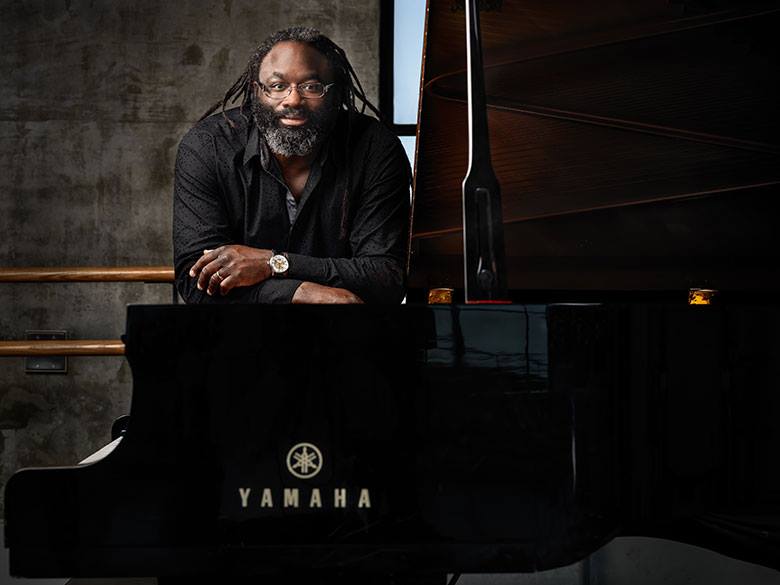
The program will include works by Beethoven, Shostakovich and American composer Ron Nelson. Awadagin Pratt will be the soloist in Beethoven’s Piano Concerto No. 4.
The Times of Trenton did the right thing and actually sent a photographer to one of the orchestra’s rehearsals.
Please consider attending the concert, if you can. The area can never have too many orchestras, if people will only go, and the greater the support, the better the NJCP is bound to get. It’s your call whether or not you think the city of Trenton should have its own orchestra.
Personally, I’m looking forward to George Antheil’s “Capital of the World,” which the NJCP will perform on May 9. Antheil, the self-proclaimed “Bad Boy of Music,” was born in Trenton in 1900. He turned Paris on its ear with his “Ballet Mécanique,” which incited one of the great musical riots in 1926. Spalding made an acclaimed recording of the work with his other group, the Philadelphia Virtuosi Chamber Orchestra, at the War Memorial, which was issued on the Naxos label. He’s also recorded Antheil for New World Records.
The Greater Trenton Symphony, founded in 1921, was New Jersey’s oldest professional symphonic ensemble. The orchestra performed its last concert – the first since 2010 – on New Year’s Eve, 2012. You can read more about what happened next in my article in today’s Trenton Times.
PHOTO: Awadagin Pratt, who will be the soloist tomorrow night in Beethoven’s Piano Concerto No. 4, wowed the judges of the Naumburg International Piano Competition with his performance of the piece in 1992