I don’t know how good your French is, but it’s obvious René Leibowitz wasn’t as much of a Sibelius fan as I am. Tell us what you really think, René! For the record, Leibowitz, a Schoenberg disciple, also dismissed Béla Bartók for pandering to popular taste with works like his Concerto for Orchestra. I haven’t read Leibowitz’s monograph, but I have to hand it to him, it’s got one of the great titles. Sibelius was still alive, by the way. He died in 1957 at the age of 91. But it’s Sibelius who had the last laugh. Royalties earned from his compositions continue to be among the highest of all classical music composers currently within copyright.
The years, they do fly by. It astonishes me how quickly important anniversaries make their laps. I don’t know if it’s because I’ve been doing this for nine years or because I’m now in my late 50s and time really does speed up when you’re older. Not OLD, mind you – for as nice as it would be to pass the days in a rocking chair on the front porch, I’m not collecting my Social Security benefits quite yet – but older.
Furthermore, I have to say, increasingly I am a little intimidated to go back and look at my past posts. For Krampus, for St. Nicholas, and now for Pearl Harbor Day, I sincerely don’t know how I could improve on what I wrote last year, or even the year before. It is daunting to be in competition with oneself!
Especially so, since I’ve been under the weather this week, and it’s difficult to do anything, so I hope you will excuse me for deferring to the more able-bodied Classic Ross Amico of yore for this day that has lived in infamy, as I do take it seriously, even as I puzzle over what has happened to my country in recent decades.
Now is not the time to go too much into it, since the entire point is for me not to overextend myself in my weakened state, but it’s sad that we do not honor the countless Americans who sacrificed so much, both in the service and at home, by walking the walk. “Thank you for your service” is all well and good, but how about earning it by being civil to our neighbors, not treating domestic affairs like they’re a wrestling match, not glorifying violence, bullying, and vengeance, upholding fair-play, extending a helping hand, and doing our best to leave a positive imprint on our communities? We, as citizens of the United States, carry the seeds of our own salvation or destruction. Do we really want to be the ones to accomplish what the Axis could not?
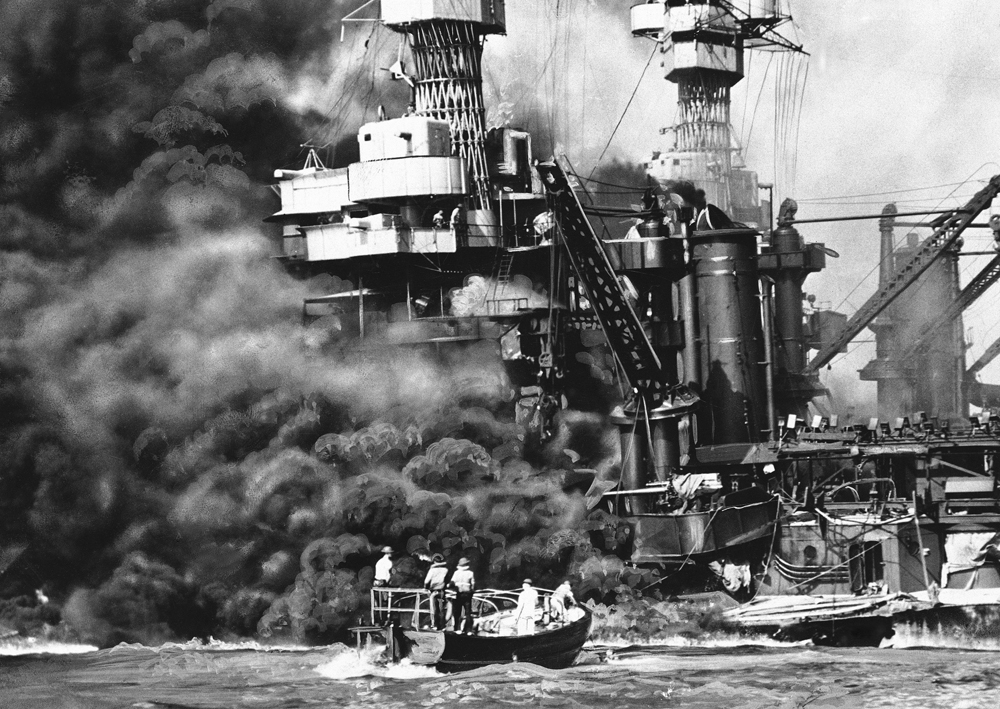
On December 7, 1941, a surprise strike by the Imperial Japanese Navy on the U.S. naval base at Pearl Harbor resulted in 2,403 American deaths, 1,178 wounded, and the United States’ entry into World War II. Sailors, soldiers, airmen, marines, and civilians were among the casualties.
Here is last year’s remembrance of composer John Duffy, who served in the U.S. Navy and had family at Pearl Harbor:
And, from two years ago, my reflections on American Christmas in 1941:
Hopefully, next year I will have the strength, the focus, the fire, and the time to pound out another mini-masterpiece. For today, I’m still getting over a flu and I’ve got a deadline looming.
Dona nobis pacem. Peace on earth, goodwill toward men.
Stop me if you heard this before. After crisscrossing the same ground for the past nine years, especially around the holidays, I sometimes feel as if we’re an old married couple, patiently enduring the same stories. All the same, I can’t bypass St. Nicholas on his day. Also, I’ve been under the weather, and I’m up against a deadline, so I hope you’ll excuse the cut and paste.
Here we go, then…
St. Nicholas Day follows on the cloven hoof of Krampus Night.
In theory, the whole Nicholas-Krampus dynamic serves as a kind of “good cop/bad cop” scenario, with the naughty, threatened with the punishment of Krampus (the Christmas devil), driven to virtue, reinforced by the rewards of Nicholas (the patron saint of children).
But that’s a gross oversimplification, as it turns out Nicholas could be a pretty rough customer. He’d have to be, to be looking after not only children, but sailors, merchants, archers, prostitutes, women seeking husbands, repentant thieves, wrongly condemned criminals, travelers, pawnbrokers, and students. I’d be grouchy too.
Nicholas did not suffer fools lightly. His modesty could be so extreme as to sometimes verge on the sociopathic, and he could be downright cantankerous when thanked.
So what’s your favorite Nicholas story?
Is it when he tosses the bags of gold down a poor man’s chimney, surreptitiously providing a dowry for the man’s daughters and rescuing them from a life of prostitution, and then sharply rebuffs the man for his thanks?
Or is it when he chastises the sailors for their salty language, and when they mock him for his prudishness, prays for stormy seas until they drop to the deck in terror and repent?
Or is it when he reconstitutes and resurrects the three pickled boys, dismembered by a treacherous butcher to be passed off to his customers as ham?
Or is it when he sends Arius, father of Arianism, sprawling for his heresy that Jesus Christ is subordinate to the entity of God?
The Nicholas of history and legend was a far cry from your Coca-Cola Santa.
There’s no way I’m sitting on this guy’s lap. Happy St. Nicholas Day!
“Legends of St. Nicholas,” performed by Anonymous 4
“The Play of St. Nicholas,” 12th century (in four parts)
Somewhere, I imagine, there’s a wizened, Middle European crone rolling her rheumy eyes whenever I post about Krampus. I remember Krampus WHEN…! Much as I now shake my head at all those whippersnappers who’ve since appropriated the Alpine demon. I was appropriating Krampus before it was cool, introducing a glass devil’s head ornament to the family Christmas tree some 30 years ago. Now Krampus has become a veritable industry, with dolls, mugs, sweaters, and at least one major motion picture. This year I stumbled across a Krampus BADvent calendar and I had to kick myself (with cloven hoof), since the “treats” behind each door were basically ripped from the subject matter of all my dark Christmas posts over the past nine years, about Black Peter, Mari Lywd, the Yule Lads, and Befana the Christmas witch. The Man ruined rock ‘n’ roll, and now he’s coming for Krampus!
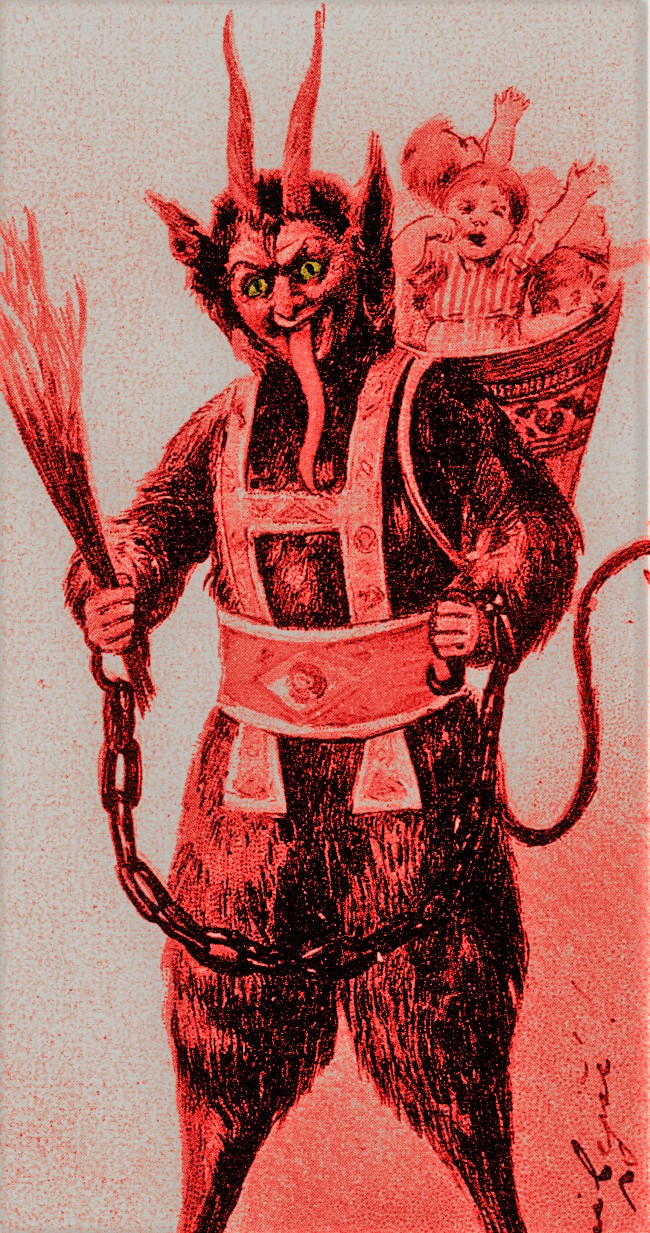
In case you’re not up on your Krampus lore, on December 5, the eve of Saint Nicholas’ Day, it is customary for an egregiously-horned, whiplash-tongued demon to emerge from his mountain lair, festooned in chains and cow bells, to accompany the Patron Saint of Children on his rounds. To all the good boys and girls, Saint Nick bestows small gifts; the bad are handed over to Krampus.
Garden-variety naughtiness earns the sting of a switch; but the especially ill-behaved are clapped in irons, taken for a short ride in a wicker basket, and then drowned in a stream or immolated by hellfire. With mounting anxiety a thousand times worse than the anticipation of a bad report card, a wee sinner pulls the sweat-soaked blankets over his head and begins to pray vociferously for a stocking full of coal.
It used to be that there were one or two books of vintage postcards, and those out of print and difficult to get a hold of. Now Krampus has become something of a shadow industry. Hardly surprising, as bad behavior has become pretty much mainstream.
There’s even a sizeable feature in today’s Washington Post. I want my subversive Christmas demon back!
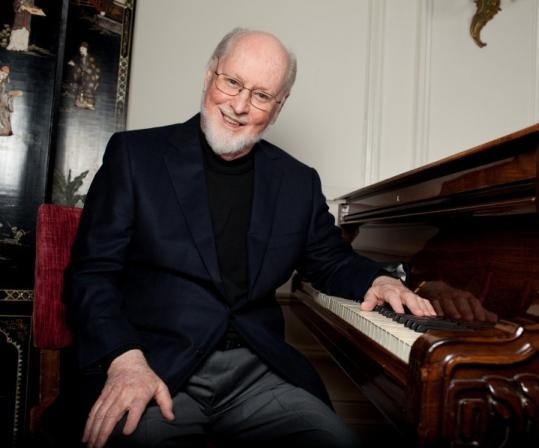
I posted earlier about film composer Alex North (“A Streetcar Named Desire,” “Death of a Salesman,” “Spartacus,” “Cleopatra,” “Who’s Afraid of Virginia Woolf?”) on his birthday. Now here’s a two-part interview about North with John Williams!