Category: Daily Dispatch

  • Samuel Ramey Turns 81: Remembering Opera’s Devil

    Samuel Ramey Turns 81: Remembering Opera’s Devil

    Bass-baritone Samuel Ramey is 81 today. I try not to let a birthday pass without giving the Devil his due.

    Also, now I can show off this nifty collectible from my cabinet of curiosities: a photo inscribed by Ramey to actor Christopher Lee.

    Lee, who possessed quite the resonant bass-baritone himself, harbored a latent desire to become a professional opera singer. As a young man, he was overheard singing in a tavern in Stockholm and praised by none other than Jussi Björling, who offered to undertake his training. But it was at a time in Lee’s life before he could afford to live in Sweden.

    Of course, both men – Ramey and Lee – were renowned for playing heavies.

    Here’s Ramey as Verdi’s “Attila.” Listen to that audience, at around 3:20 and again at 7:04. The adoration is such that he finally launches into an encore.

    Of course, his signature role will always be Boito’s Mefistofele.

    Act I, “Son lo spirito che nega” (“I am the spirt that denies”)

    Act II, “Ecco il mondo”(“Behold the world”)

    Singing Cimarosa with Thomas Hampson

    Ramey as Don Giovanni at the Met

    And as “L” Toreador on “Sesame Street”

    Happy birthday, Red Daddy!*


    *Coined by Ramey’s son, not me:

    https://www.npr.org/2009/05/14/103854868/samuel-ramey-bad-guy-bass-of-opera

  • Corner Pianos An April Fool’s Relic?

    Corner Pianos An April Fool’s Relic?

    An early April Fool’s joke?

    I was bouncing around the internet the other week and came across this peculiar beast, known as a corner piano. I’m not finding a lot of reliable information about it.

    Some of the magic was tempered when I saw someone on Reddit had commented that the instrument is merely decorative, a relic from a time when pianos were fashionable, and was manufactured for people who wanted a piano but didn’t really have the space.

    Be advised that whatever it is that’s being marketed as a corner piano by dealers these days is most likely not the same, but rather a grand piano designed to fit in the corner of a room! If space is really an issue, surely you could find the extra few feet to accommodate an actual upright that allows you easy access to middle C?

    Here’s a link to a blog that says quite a lot about corner pianos. However, despite the inclusion of a photograph of this unusual specimen, it’s unclear from the descriptions and history that the writer is actually treating the same subject.

    Also, I cannot find any videos of a corner piano actually being played. Perhaps one of you knowledgeable folk can shed some light on this cryptozoological instrument?

    You are advised to regard anything you read at this link with a degree of caution!

    https://pianosheetmusiceasy.com/corner-piano/

  • The Quiet Man Book vs Movie A Surprising Tale

    The Quiet Man Book vs Movie A Surprising Tale

    This is another one of those books I’ve had in my library for 30 years. I finally took it down to read it as part of my St. Patrick’s Day celebrations. Last year, I had it out, thinking I’d read just the title story, but then time got away from me (again), and I figured I’d save it for 2023, hoping to read the entire collection. And I’m glad I did. Because if you read just “The Quiet Man,” you’re not getting the full story.

    First of all, the 1952 John Ford classic, starring John Wayne and Maureen O’Hara, is one of my favorite movies. If you’re put off by Wayne, thinking this going to be like one of his westerns (many of which I’ve also grown to love), give it a shot. I think you’ll really enjoy it. It’s full of whimsy, with a colorful supporting cast of memorable character actors. I’m sure there are some Irish who are worn out on the stereotypes, and maybe millennials, if they ever watch anything made before 1980, who would be appalled at the treatment of O’Hara’s Mary Kate; but if you meet it on its own terms, I find it very hard to believe it won’t charm your emerald socks off. I try to watch it every St. Patrick’s Day over several pints of Guinness. (One of these days I’ll have to write about “The Quiet Man” Drinking Game, if I haven’t done so already.)

    But this is not a review of the movie, and if you’ve read this far, you are probably of an age that it would already be familiar to you in any case, so I’ll get to the matter at hand.

    Maurice Walsh’s “The Quiet Man and Other Stories” – retitled, because of the success of the film, from “Green Rushes” – has very little in common with Ford’s adaptation. In fact, any reader who picks it up expecting the porter-fueled hilarity of that leprechaun incarnate Barry Fitzgerald is in for a shock. Because Walsh’s original tales, set during and after the Black-and-Tan War, all deal with the IRA, men and women (and the oblique manner in which they sometimes communicate), and the pleasures of fishing. It’s small wonder that Hemingway was an admirer. These stories are nothing at all like the film version, but I’d be lying if I said they weren’t fascinating. And very well written, in the manner of the day. (Walsh was one of Ireland’s bestselling authors of the 1930s.) The prose is evocative without entirely tipping its hand, so that there’s plenty to be gleaned from reading between the lines.

    Basically, the screenwriters took the premise of the title short story and a couple of lines of dialogue (surely no more than two or three), and then just went with their own thing. It is amusing and disorienting to discover that many of the characters look and behave quite differently than they do in the film. Michaleen Oge Flynn is Mickeen Oge Flynn in the stories and, beyond his fondness for a pipe and his involvement with the IRA (quite subtle in the film), by no stretch of the imagination is he anything like Barry Fitzgerald.

    There is no Sean Thornton. In the book, he’s Paddy Bawn Enright – named after one of Walsh’s real-life field hands – and his dark, squat-but-powerful, heavy-browed character does not in any way resemble John Wayne. Closer is Art O’Connor, an Irish-American who comes to Ireland, he says, for the fishing. Mary Kate Danaher, the Maureen O’Hara character, is Ellen Roe Danaher in the book. She’s given a lot more to do in the movie. In fact, the only character I can think of that is pretty much the same on the page as he is on the screen is Red Will Danaher, the hard-headed, closed-fisted slab of beef played by Victor McLaglen.

    The primary reason I am thankful for not having simply read the title story, apart from the rest, is that the tales all interlock. The book is more like a novel, in which we learn more about the characters and events with each successive story. Moreover, the stories in themselves are like novellas, subdivided into chapters. There is nothing twee about them. The tone more realistic than fey (although there is a ghost); the stories are serious, but not without flashes of wit. Come to think of it, they all turn out to be love stories, in their understated way. And the rhythms are unmistakably Irish.

    The prologue sends ripples across the rest of the book. By the end, I was compelled to go back and reread the beginning, as it wound up having more of a bearing on the conclusion than I previously anticipated. Also, the significance of the original title, “Green Rushes,” is only apparent from the final pages.

    In 1954, flush with the success of “The Quiet Man,” Republic Pictures optioned another Walsh story to be made into a film, “Trouble in the Glen.” It reassembled the producers, screenwriters, composer (Victor Young), and some of the crew involved with the previous picture, which was nominated for seven Academy Awards and won two (including a Best Director Oscar for Ford), hoping to recapture some of that Celtic whimsy, though this time transplanted to Scotland. Victor McLaglen returns, but Forrest Tucker steps in for John Wayne, and Orson Welles, who previously adapted and starred in “Macbeth,” plays a Scottish laird.

    Alas, Ford was notably absent, and the film was not a success. In fact, Walsh was so depressed by the result that he vowed never to have any more of his books made into films.

    I recall, many years ago, my friendly neighborhood video shop had a copy of “Trouble in the Glen” on VHS, but I never got around to renting it. The box had a picture of Tucker beating the tar out of McLaglen, in true “Quiet Man” fashion. For some reason, the film doesn’t appear to be available for streaming anywhere online, but you can watch a couple of clips at the link below. In particular, the opening credits hew closely to those for “The Quiet Man,” right down to Victor Young’s score.

    https://www.silversirens.co.uk/productions/trouble-in-the-glen-1954/

    Interestingly, I learn even as I write this that a stage musical, “Castle Gillian,” is supposedly in development, based on another one of Walsh’s books. A musical of “The Quiet Man,” called “Donnybrook,” was produced in 1960, but flopped.

    At any rate, if it sounds appealing, and you can find a copy, you might consider giving Walsh’s “The Quiet Man and Other Stories” (or “Green Rushes”) a whirl. I picked mine up off a remainder table at Borders bookstore back in the early ‘90s. My library is full of books purchased over the past 40 years that I have not read and I am very glad not to have traded them off or sold them outright! But what’s the purpose of a library, if not to stock it with future dreams and hidden treasures?

  • Rachmaninoff 150th Birthday Broadcast

    Rachmaninoff 150th Birthday Broadcast

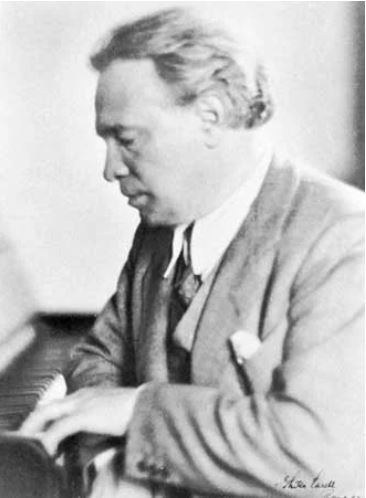
    This Sunday night on “The Lost Chord,” get a piece of the Rach!

    With the impending sesquicentenary of the birth of Sergei Rachmaninoff on April 1, enjoy an hour of historic performances.

    We’ll hear Rachmaninoff play his own “Symphonic Dances” in a recently rediscovered, fly-on-the-wall recording, captured surreptitiously at the home of Eugene Ormandy in 1940. Then Ormandy will introduce – and conduct – the Philadelphia Orchestra, in a special memorial performance of Rach’s “Isle of the Dead,” given only days after the composer’s death, in 1943.

    We’ll round out the hour with a literal party piece – as Rachmaninoff tosses off the Ukrainian folk song, “Bublichki,” or “Bagels,” in 1942.

    The recordings are from a 3-CD boxed set issued by Marston Records, the record label of industry legend Ward Marston. Now based in West Chester, PA (he was born in Philadelphia in 1952), Marston is one of classical music’s most revered audio engineers. Incredibly, he has been blind since birth.

    Marston’s work in restoration and conservation of historic audio has been both miraculous and rapturously received. His acclaimed remasterings have appeared on the Andante, Biddulph, Naxos, Pearl, RCA, and Romophone labels. For more information and a complete catalogue of Marston Records releases, visit marstonrecords.com.

    Then join me for an hour of Sergei Rachmaninoff in vintage recordings. That’s “Rach of Ages,” for the 150th birthday of Sergei Rachmaninoff, this Sunday night at 10:00 EDT, on WWFM – The Classical Network and wwfm.org.

  • John Williams’ “Of Grit and Glory” Premiere

    John Williams’ “Of Grit and Glory” Premiere

    In January, I posted a link to an inspiring new piece of television music by John Williams. “Of Grit and Glory” was composed for ESPN’s College Football Playoff National Championship broadcast. It’s use in the introductory montage was undeniably effective, but for those who longed to be able to hear it without the distraction of talking heads and roaring crowds, I am happy to report that someone has posted a video of the work’s world premiere concert performance with the Chicago Symphony Orchestra and the composer conducting. This is especially good news, as ESPN has taken down the original video.

    The performance may lack some of the pizzazz of that of the pick-up band that recorded it for ESPN, but that’s the difference between a live concert with a lot of music and limited rehearsal time and an intensive, well-miked recording session, in which the focus is on getting a four-minute piece just right.

    Here’s the complete Chicago program, with photos from the concert. For a Williams fan, it looks especially alluring, with a chance to hear some new works and some old favorites, and one or two rarities along the way.

    https://www.jwfan.com/?p=14921&fbclid=IwAR3UHXVTjvIeUDDBymxqfP61dxggu9BLB8InvQnw9t1uIfasJona7xv7_kU

    Hopefully the theme will appear on a commercial release in the near future. In the meantime, better save the audio quick, before the video disappears!

    Along with “Helena’s Theme” for the forthcoming Indiana Jones movie, it’s nice to have confirmation that the old wizard still has a few tricks up his sleeve.

Tag Cloud

Aaron Copland (93) Beethoven (95) Composer (114) Film Music (124) Film Score (143) Film Scores (255) Halloween (94) John Williams (188) KWAX (229) Leonard Bernstein (101) Marlboro Music Festival (125) Movie Music (139) Opera (202) Philadelphia Orchestra (89) Picture Perfect (174) Princeton Symphony Orchestra (106) Radio (87) Ralph Vaughan Williams (85) Ross Amico (244) Roy's Tie-Dye Sci-Fi Corner (290) The Classical Network (101) The Lost Chord (268) Vaughan Williams (103) WPRB (396) WWFM (881)

DON’T MISS A BEAT

Receive a weekly digest every Sunday at noon by signing up here


RECENT POSTS