For me, it’s never Easter until I listen to Vaughan Williams’ “Five Mystical Songs” with John Shirley-Quirk. Especially the first one, titled – appropriately enough – “Easter.”
Category: Daily Dispatch
-
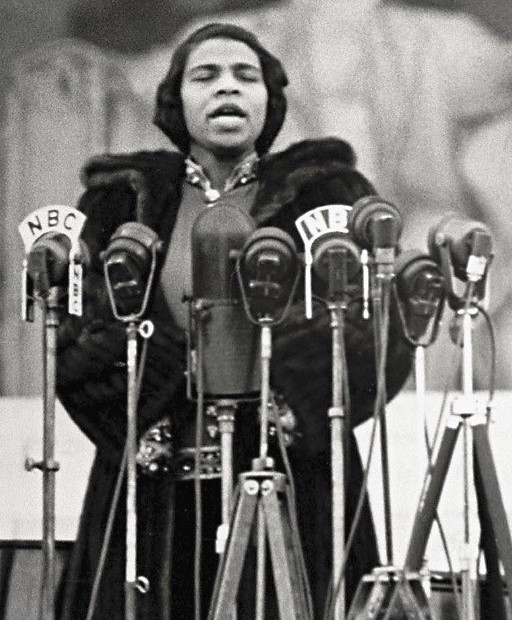
Marian Anderson’s Easter Triumph Florence Price’s Legacy
On Easter Sunday, on this date in 1939, in the ultimate demonstration of turning lemons into lemonade, Marian Anderson, barred from performing at Constitution Hall by the Daughters of the American Revolution, because of her race, sang instead from the steps of the Lincoln Memorial, to a diverse crowd of 75,000 people on the mall and a national radio audience estimated in the millions.
The program concluded with the spiritual “My Soul is Anchored in the Lord,” in an arrangement by Florence Price (1887-1953). By coincidence, today also happens to be Price’s birthday. Price, born in Little Rock, Arkansas, became the first African-American woman to be recognized as a symphonic composer, when her Symphony in E minor was performed by the Chicago Symphony in 1933. Needless to say, in an era when White American males struggled to find acceptance on Eurocentric classical music programs, Price, as a Black American woman, faced even greater challenges.
The playing field has shifted in recent years, and interest in Price’s music has been on the rise. It’s hard to believe, for a composer of her accomplishments, that dozens of her manuscripts were rescued from her dilapidated summer home, on the outskirts of St. Anne, Illinois, only as recently as 2009.
It’s an exciting time to be alive. Who knows what other musical riches are out there, undervalued in their time, awaiting rediscovery?
Anderson sings “My Soul’s Been Anchored in the Lord”
Price’s Symphony No. 1 in E minor
Lincoln Memorial Concert
-

Penderecki’s Utrenja Holy Saturday’s Haunting Masterpiece
While there are plenty of Vespers settings by classic composers to maintain a solemn and reflective atmosphere appropriate to the delayed gratification of Easter Sunday, few works for Holy Saturday are as engaging – or as challenging – as Krzysztof Penderecki’s “Utrenja.”
Penderecki, who emerged from the 1960s as an icon of the avant-garde, here performs a delicate balancing act. The heavy weather of tone clusters and quicksilver cacophony disperses for hurricane’s eye interludes of hypnotic tonality. The overall impression is eerie as can be, but also affectingly mysterious. It’s a ritual both time-honored and timeless.
The text is based on the Orthodox liturgy for Holy Saturday, for the lamentation for Christ’s death, and the Easter Sunday morning service commemorating the Resurrection.
The two parts were first performed separately. “The Entombment,” composed in 1970, was dedicated to Eugene Ormandy, who recorded it with the Philadelphia Orchestra and the Temple University Choir; “The Resurrection,” was composed in 1971. Both parts were commissioned by West German Radio.
Audience response to the joint premiere in 1971 was tumultuous, likely as much for extramusical considerations as for the music itself. The performance took place only days after the putdown by Polish armed forces of the Gdansk shipyard riots, sparked by precipitous inflation, that resulted in 44 people killed and over 1000 injured. Polish art and politics have frequently been familiar bedfellows.
Penderecki’s “Utrenja” has long since joined his “Polish Requiem” and “St. Luke Passion” as a milestone of modern Polish music. Not music for every day, perhaps, but if you’re feeling a little adventurous, put it on and just go with it. Afterward, you can always listen to Rachmaninoff’s “Vespers,” if you want.
Petrifying Penderecki:
Reassuring Rachmaninoff:
IMAGE: “Mourning from Chomranice,” by an artist identified as the Master of Mourning, c. 1440
-

Saints on Screen: The Music of Faith in Film
This week on “Picture Perfect,” the saints go marching in.
We’ll begin with a suite from “The Song of Bernadette” (1943), one of Jennifer Jones’ finest hours. Jones was honored with an Academy Award for her performance (the film was nominated in 12 categories). Franz Werfel’s novel tells the story of Bernadette Soubirous, a Lourdes peasant prone to visions of the Blessed Virgin Mary.
Igor Stravinsky made several attempts to break into Hollywood, but he could never keep up with the grinding schedule. He took a crack at scoring the “Apparition of the Virgin” scene, but then thought better of it. The project went to Alfred Newman, who won his third Oscar (of nine). Stravinsky’s music would be recycled in the second movement of his “Symphony in Three Movements.”
The story of Joan of Arc has been translated to film many times. In the case of “Saint Joan” (1957), Otto Preminger adapted the play by George Bernard Shaw. Newcomer Jean Seberg was cast in the title role. Her inexperience brought her in for a sound critical drubbing. Even an old hand like screenwriter Graham Greene was not immune to critical barbs for the liberties he took in reworking Shaw’s play. Despite all that, the score, by Russian-born English composer Mischa Spoliansky, is lovely.
By contrast, the film of “A Man for All Seasons” (1966), after the play of Robert Bolt, was lavishly praised, especially Paul Scofield’s performance as Sir Thomas More (for which he received an Academy Award for Best Actor). The film won six Academy Awards in all, including that for Best Picture. The period-inflected score is by Georges Delerue.
I suppose it’s impossible to get through Easter without some Biblical bombast, so why not go all out with “Quo Vadis” (1951)? Henryk Sienkiewicz’s international bestseller incorporates into its narrative Saints Peter and Paul, but the really interesting characters are the cynical Petronius (Leo Genn), who knows how to throw a party, and the quite mad Nero (Peter Ustinov), who plays the lyre even as Rome burns.
Miklós Rózsa’s score has been much-lauded for its attempt at historical authenticity (the incorporation of contemporaneous Greek, Hebrew, and Sicilian melodies), though its popularity has been eclipsed, somewhat, by that of his work on “Ben-Hur” and “King of Kings.” “Quo Vadis” is really the film in which Rózsa lays out the blueprint for a decade or more of big screen piety. Bernard Herrmann called it “the score of a lifetime.”
I hope you’ll join me in taking some time off for good behavior. That’s “Lives of the Saints,” on “Picture Perfect,” music for the movies, this Saturday evening at 6:00 EDT, on WWFM – The Classical Network and wwfm.org.
PHOTO: Jennifer Jones and the Lourdes’ prayer
-

Joseph Ryelandt Composer of Faith
It seems only appropriate that Joseph Ryelandt’s birthday anniversary would fall around Holy Week – this year on Good Friday, as a matter of fact – as he was an artist whose devout beliefs were central to every aspect of his existence and creativity.
Born in Bruges in 1870, Ryelandt was raised to value culture, tradition, and faith. He was unhindered by financial concerns for the first half of his very long life. World War I, however, badly affected his finances. The father of eight children himself, he took up teaching out of necessity at the age of 54. He did so with some hesitation, but was relieved to find it truly rewarding. He was appointed director of the Bruges Conservatory in 1924.
While his academic and creative work evidently brought him enormous satisfaction, life at home was saddened by the gradual decline of his wife’s health. She died in 1939. Ryelandt composed very little during the Second World War. A few chamber works followed, and then he abandoned composition altogether. He devoted his retirement to literature – writing poetry and reading the world’s classics. He died, following a brief illness, in 1965, at the age of 95.
Of all of his works, he considered his five oratorios the most important, though he composed much else, including six symphonies (the first of which he destroyed). None of the symphonies were performed until 1960. It was then that the Symphony No. 4 received its belated premiere, on a concert in celebration of the composer’s 90th birthday.
Ryelandt’s Fourth Symphony was composed in 1912-1913, on the very eve of World War I. Like nearly everything he wrote, the symphony is an outgrowth of his personal faith. The text of the triumphant chorus that concludes the work is from the Credo, as heard in the traditional Catholic Mass. Earlier in the piece, a choir of tenors sings a text from Thomas à Kempis’ “The Imitation of Christ.”
Whether or not you find it appropriate for Good Friday, which after all is a somber observance, I leave it to you. The piece does conclude in a blaze of glory.
Happy birthday, Joseph Ryelandt, and a blessed Good Friday to those who observe it.
Tag Cloud
Aaron Copland (94) Beethoven (95) Composer (114) Film Music (151) Film Score (143) Film Scores (255) Halloween (103) John Williams (198) KWAX (233) Leonard Bernstein (105) Marlboro Music Festival (125) Movie Music (166) Mozart (91) Opera (216) Philadelphia Orchestra (91) Picture Perfect (174) Princeton Symphony Orchestra (110) Radio (90) Ross Amico (244) Roy's Tie-Dye Sci-Fi Corner (290) The Classical Network (101) The Lost Chord (269) Vaughan Williams (107) WPRB (397) WWFM (881)