It seems only appropriate that Joseph Ryelandt’s birthday anniversary would fall around Holy Week – this year on Good Friday, as a matter of fact – as he was an artist whose devout beliefs were central to every aspect of his existence and creativity.
Born in Bruges in 1870, Ryelandt was raised to value culture, tradition, and faith. He was unhindered by financial concerns for the first half of his very long life. World War I, however, badly affected his finances. The father of eight children himself, he took up teaching out of necessity at the age of 54. He did so with some hesitation, but was relieved to find it truly rewarding. He was appointed director of the Bruges Conservatory in 1924.
While his academic and creative work evidently brought him enormous satisfaction, life at home was saddened by the gradual decline of his wife’s health. She died in 1939. Ryelandt composed very little during the Second World War. A few chamber works followed, and then he abandoned composition altogether. He devoted his retirement to literature – writing poetry and reading the world’s classics. He died, following a brief illness, in 1965, at the age of 95.
Of all of his works, he considered his five oratorios the most important, though he composed much else, including six symphonies (the first of which he destroyed). None of the symphonies were performed until 1960. It was then that the Symphony No. 4 received its belated premiere, on a concert in celebration of the composer’s 90th birthday.
Ryelandt’s Fourth Symphony was composed in 1912-1913, on the very eve of World War I. Like nearly everything he wrote, the symphony is an outgrowth of his personal faith. The text of the triumphant chorus that concludes the work is from the Credo, as heard in the traditional Catholic Mass. Earlier in the piece, a choir of tenors sings a text from Thomas à Kempis’ “The Imitation of Christ.”
Whether or not you find it appropriate for Good Friday, which after all is a somber observance, I leave it to you. The piece does conclude in a blaze of glory.
Happy birthday, Joseph Ryelandt, and a blessed Good Friday to those who observe it.
Don’t let the happy faces fool you. Roy and I return tonight to celebrate three years of Roy’s Tie-Dye Sci-Fi Corner, with a discussion of “Spock’s Brain.” One the looniest episodes of the original “Star Trek” television series, once seen it’s not easily forgotten. The Laurel and Hardy of sci-fi reunite for another gold-plated bull session. Make the trek to the comments section, when we livestream on Facebook, YouTube, etc., at a special day and time, this Thursday evening at 7:00 EDT!
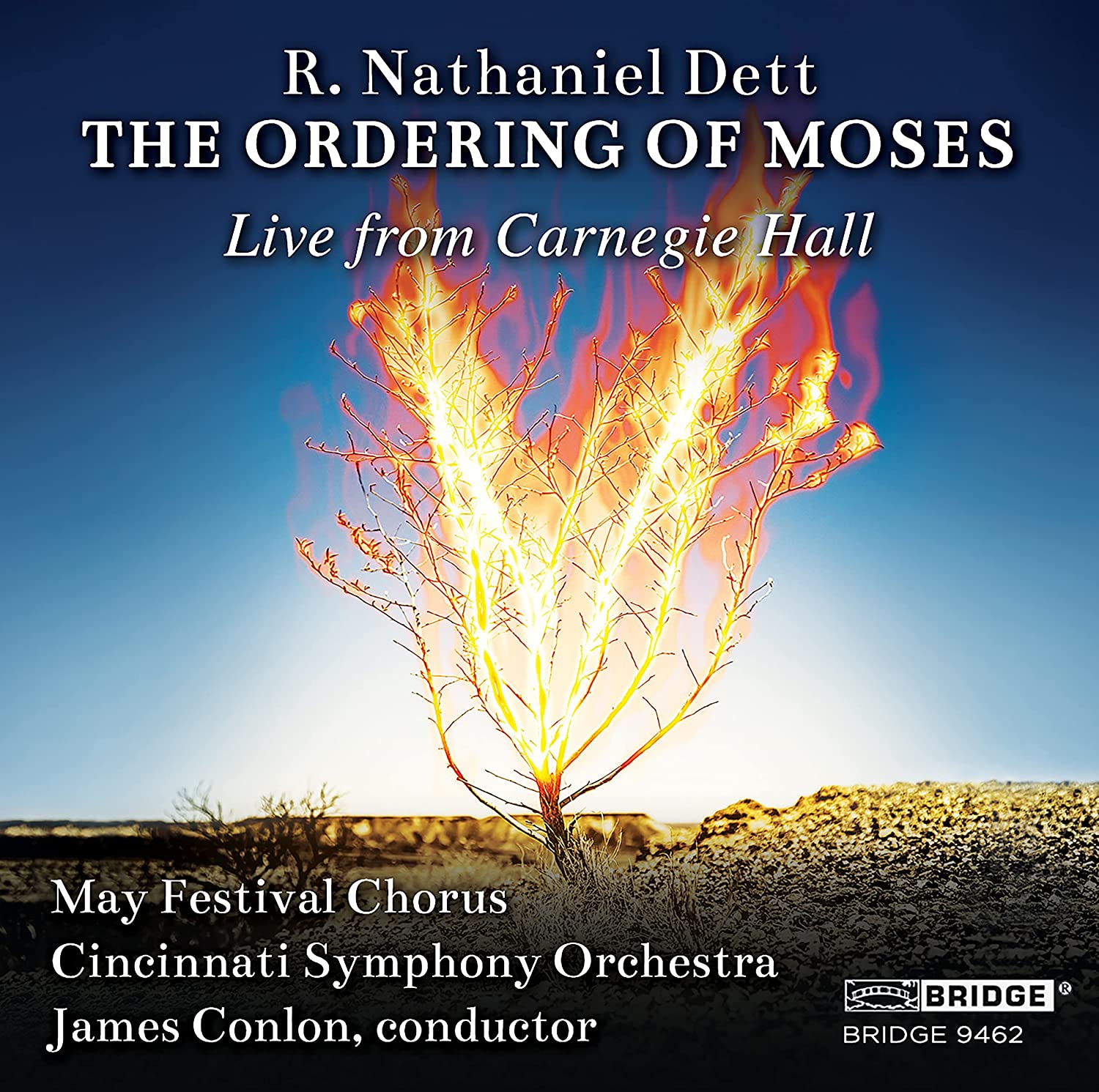
There have been innumerable musical treatments of Moses and the Exodus story, reaching back to at least the Renaissance. On this first day of Passover, it’s time to give “The Ordering of Moses” its due.
R. Nathaniel Dett was born in what is now Niagara Falls, Ontario, the grandson of a refugee who fled slavery on the Underground Railroad. He became an important figure in American music of his time, but it’s not until comparatively recently that we’ve had many opportunities to hear much beyond “Juba,” the last movement of one of his piano suites, “In the Bottoms,” championed by Percy Grainger and others.
Though he is remembered primarily, if at all, for his exquisite keyboard works, Dett also composed a handful of pieces for more ambitious forces, none of them more so than “The Ordering of Moses.” Scored for vocal soloists, chorus, and orchestra, the work was presented as his graduation thesis at the Eastman School of Music in 1932. It received its first public performance by the Cincinnati Symphony Orchestra, at the Cincinnati May Festival, on a concert broadcast over NBC radio, in 1937. Three quarters of the way through, the work was interrupted, allegedly because of a scheduling conflict.
In 1956, the piece was revived and recorded, also at the Cincinnati May Festival, with Leontyne Price and William Warfield.
More recently, in 2014, James Conlon conducted it in Cincinnati. A follow-up performance at Carnegie Hall was documented by Bridge Records, Inc., a superb account that finally brought the music some of the notice it deserves. Astonished critics asked the obvious question: how is it possible that such a powerful work could have languished for so long?
Did NBC indeed run into a scheduling conflict during that first concert broadcast, or did those in charge cave to listener complaints? After all, this was one of the first works of classical music by a Black composer ever to have been given that kind of exposure, broadcast as it was over a national radio network.
Whatever the truth, now is the time not to deny the past but also to look to the future. In this third decade of the 21st century, can “The Ordering of Moses” finally be appreciated on its own merits?
This performance, from 1968, was captured in Mobile, AL, conducted by William Levi Dawson.
Dawson was born in Anniston, AL. He himself proved to be a remarkable composer. With the current, belated wave of music by composers of color on our concert programs, Dawson’s “Negro Folk Symphony,” after decades of neglect, is popping up everywhere. You won’t hear any complaints from me. This symphony is the real deal.
The work was given its premiere by Leopold Stokowski and the Philadelphia Orchestra in 1934. Dawson revisited the piece after a visit to West Africa in 1952. It is in this form that Stokowski recorded it. I own three recordings of it so far (Neeme Järvi’s being my preference), but I never dreamed I would ever have the opportunity hear it live!
Likely due to lack of demand for his orchestral music, Dawson carved out a career as a choral music composer. In particular, he became a prominent arranger of spirituals.
A shame that he didn’t meet with more success in the concert hall. With a little encouragement, perhaps there would have been a Symphony No. 2.
William Levi Dawson’s superlative “Negro Folk Symphony”
One of the world’s foremost authorities on Dett happens to live and work in our area. Clipper Erickson, on the faculty of Temple University and Westminster Conservatory, was the first to record Dett’s complete piano works, for Navona Records. Clipper walks the walk, and has done so for decades, often including Dett’s music in his rich and varied recitals.
Clipper Erickson, piano, plays the “Barcarolle” from the suite “In the Bottoms.”
“In the Bottoms” concludes with Dett’s most famous music, “Juba.”
Here’s “The Ordering of Moses,” in more up-to-date sound, in the performance released on Bridge Records. The movements are posted separately, so you’ll have to let them play through, skipping any ads along the way.
Passover is a time to celebrate freedom. It reminds us of hope and elation at the prospect of a brighter future. It is for the benefit of all to learn from the wrongs of the past and endeavor to do better.
On a bad day, Ernst Toch’s music can be a bit like trying to chew through a dry brisket. But he wrote in a wide variety of styles, employing a broad range of musical expression, so if you search long enough, chances are that you’ll find the Toch for you.
Clearly he was “on” for the “Cantata of the Bitter Herbs,” a deeply personal piece, written in an accessible, even engaging idiom. While the primary inspiration is the Haggadah, the core of which is a telling of the Exodus story, read during the Seder on the first night of Passover, Toch strove for a more universal significance, no doubt influenced by the millions suffering from injustice and oppression under fascism in Europe.
The genesis of the work was in a chance meeting in 1937 between the composer and Rabbi Jacob Sonderling of Fairfax Temple, a Reform congregation in Los Angeles, who did much to enrich Jewish music by providing commissions for European exiles like Arnold Schoenberg, Erich Wolfgang Korngold, and Erich Zeisl. Sonderling contributed to the text of Toch’s cantata, which was first performed as part of a service at Fairfax Temple in 1941. The official concert premiere took place at Los Angeles City College.
Interesting that Dana Andrews was the speaker. In this recording, from the Milken Archive of American Jewish Music, the narration is spoken by Theodore Bikel. It’s a multi-movement work, so be sure to let it play through (skipping ads as necessary).
His Pulitzer Prize winning Symphony No. 3, which I always thought could use a little more horseradish:
But Toch could have fun, too. He composed a “Pinocchio” overture, a fantasy on “Peter Pan,” and this – perhaps his most frequently encountered work – a “Geographical Fugue,” which prefigures minimalism.
Passover begins at sunset. Chag Sameach!
PHOTO: At the Los Angeles City College premiere of “Cantata of the Bitter Herbs,” with the composer and Dana Andrews, center left
In a post earlier today about Howard Pollack’s new Samuel Barber biography, I mentioned a meeting between Barber and Trenton’s own George Antheil. The meeting took place in Vienna in 1934. Barber was surprised by Antheil’s congeniality and touched by his genuine interest in his music. In fact, in a letter to his parents, Barber specified that he felt they had parted the best of friends. Unfortunately, the two were not to have very much contact in the future.
Interesting, then, that I should stumble across this audio for a concert with the Hollywood Bowl Orchestra from 1950. The first half of the program is devoted to Barber’s “School for Scandal Overture” and Antheil’s Symphony No. 5! (Clearly, Antheil was on a Prokofiev kick at the time of its writing.)
The second half features Gershwin’s Concerto in F, with an assortment of encores, performed by Gershwin friend and acolyte, Oscar Levant. Last and least is a suite from Jerome Kern’s “Showboat.” Artur Rodzinski, notorious for packing heat on the podium, is the conductor.
A gem of a find and a remarkable coincidence that Barber and Antheil would wind up shoulder-to-shoulder on the same concert!