Though steeped in the comparatively conservative milieu of the English musical renaissance at the turn of last century, John Foulds possessed a physical, intellectual, spiritual, and creative wanderlust.
Foulds moved to India in 1935. There, he collected native folk tunes. He became director of European music for All-India Radio in Delhi, created an orchestra from scratch, and labored tirelessly to fulfill his vision of a synthesis between Eastern and Western music. He also composed works for traditional Indian instruments. His efforts on behalf of the radio were so successful that he was asked to open a satellite branch in Calcutta. Unfortunately, he contracted cholera and died within a week of his arrival, at the age of 58.
Because of the remote location and the fact that a number of the pieces of his maturity have been lost, or the manuscripts extensively compromised, Foulds’ slight reputation has rested for the most part on his “light music” (especially “Keltic Lament”). But Foulds was definitely ahead of his time, as the gradual rediscovery of his works has revealed, with the composer’s fascination with quarter-tones and, occasionally, a tendency toward an almost proto-minimalism.
So diverse were Foulds’ output and enthusiasms that it is difficult, if not impossible, to encapsulate the scope of his achievements within a single hour. Nevertheless, this Sunday night on “The Lost Chord,” we will endeavor to do our best, by sharing his light concert overture “April – England,” “Three Mantras” from the abandoned Sanskrit opera, “Avatara,” and selections from “A World Requiem.”
It’s a Foulds paradise! Join me for “April Foulds,” this Sunday night at 10:00 EDT, on WWFM – The Classical Network and wwfm.org.
PHOTO: Foulds (right), sitting in on an Indian jam session
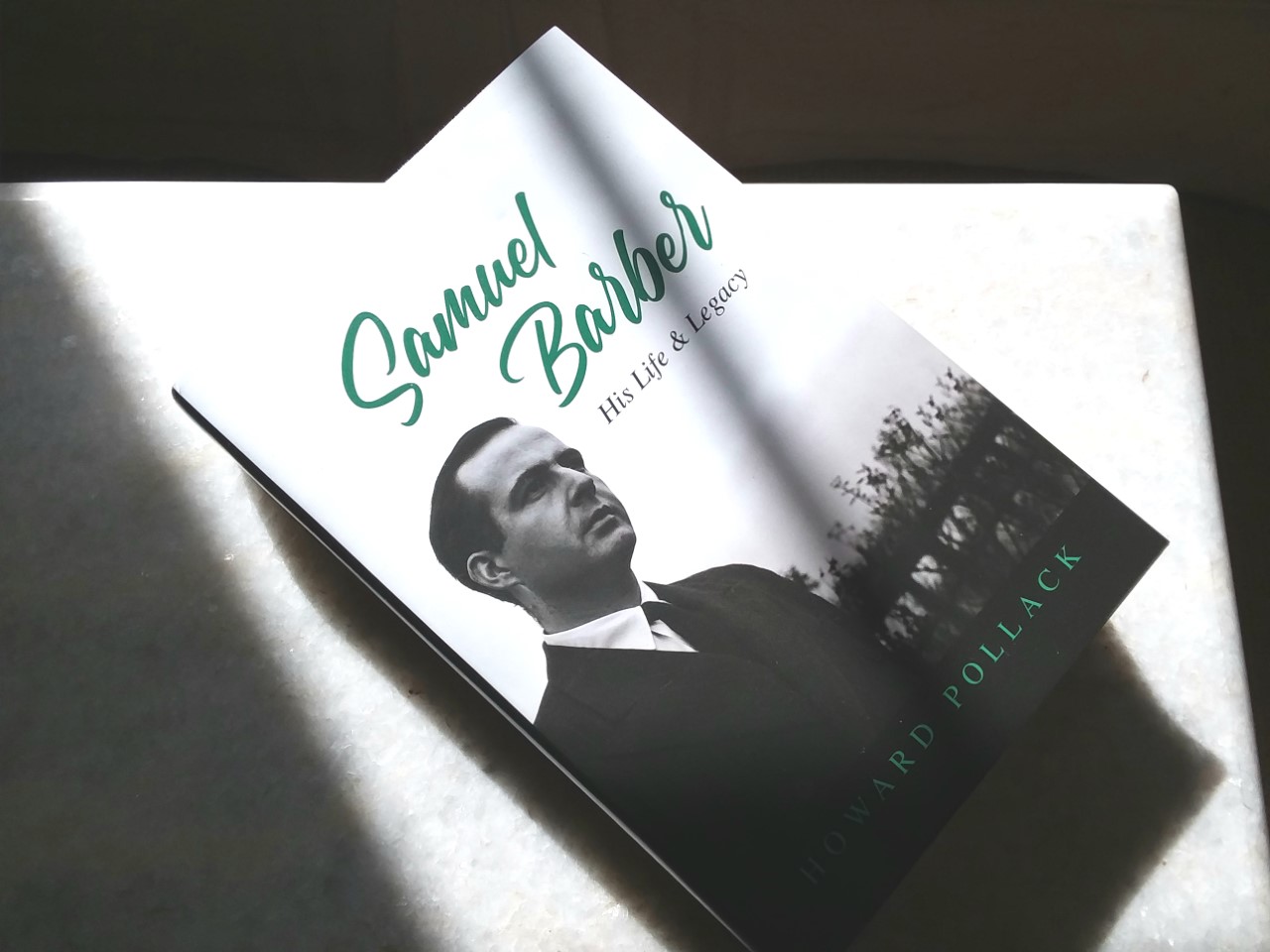
I’ve been reading Howard Pollack’s absorbing biography, “Samuel Barber: His Life and Legacy,” in advance of its release on Tuesday by University of Illinois Press.
Barber is one of our great American composers. You’ll probably recognize his “Adagio for Strings,” at the very least, from its use in so many movies (“Platoon,” “The Elephant Man,” “Lorenzo’s Oil,” “Amélie”) and on occasions of national mourning (such as the deaths of presidents and the terrorist attacks of 9-11).
I must say, Pollack is doing a fabulous job of shedding light on the composer’s multifaceted character. Barber’s manner could be reserved – some would say aloof – and his patrician demeanor and assumed mid-Atlantic accent, rooted in an upper-middle-class upbringing in West Chester, Pennsylvania, and his close identification with his New England forebears, may now seem like affectations from a bygone world.
But he also had a sense of humor, offering the occasional sardonic, or even barbed observation. Once in while, he even teetered over into the downright zany. From the passage below, you’ll see he was a very capable practical joker. I thought it only appropriate to share it with you for this April Fool’s Day.
Barber had moreover what his cousin Katharine Homer Fryer called, in reference to the Beatty side of the family, a “Beatty sense of humor,” meaning, explained Barbara Heyman, “a love of the ridiculous.” As an example, one might cite Barber’s remark to [Nathan] Broder, apropos for his fondness for soups, “I would like to be buried with a sprinkling of croutons over my coffin.” Barber showed a proclivity for childish stunts and mischievous pranks, whether in his student years interrupting a tedious concert by noisily spilling coins on a dare from [Gian Carlo] Menotti, or in later years pretending to topple down a flight of stairs spewing manuscript pages to the amusement of his sister and her children. Planning a visit home while at the American Academy in Rome in the mid-1930s, he hatched a particularly elaborate ruse, telling his parents that he was sending them a portrait of himself and arranging for Menotti, then in New York, to bring a life-size frame to West Chester. “So I brought this empty frame to West Chester,” recalled Menotti, “and I said [to Barber’s parents], ‘Now you all get out of the room because I want to unveil it.’ So then Sam sneaked into the house and he sat inside the frame and then I unveiled the thing and there was Sam who said ‘Hello.’ Poor Mrs. Barber almost fainted!”
“Samuel Barber: His Life & Legacy” is scheduled for release on April 4. I haven’t finished it yet, but if you think it’s the kind of thing that might interest you, it’s a great read. I’ll have a more complete report by the end of the book. In the meantime, you’ll find more about it here:
April fools! No, not the holiday (such that it is); I’m talking about the performers.
This week on “Picture Perfect,” we’ll have musical selections from big screen comedies. For whatever reason, it’s seldom that we get a chance to sample from comedy scores. The emphasis is usually on drama or action. The more I think about it, it seems very few scores for comedies tend to achieve classic status – proportionately speaking, of course.
Henry Mancini never seemed to have a problem with that, thanks in no small part to his long association with director Blake Edwards. We’ll hear music from my three favorite installments in “The Pink Panther” series – the original (1963), “A Shot in the Dark” (1964), and “The Pink Panther Strikes Again” (1976). That’s right, the one in which Chief Inspector Dreyfus goes stark raving mad and determines to destroy the world with a doomsday ray, as the franchise hilariously jumps the shark.
Imagine how difficult it must be to write music for comedy, without it coming across as sounding like cartoon music. Which isn’t always necessarily a bad thing. “Pee-Wee’s Big Adventure” (1985) marked the feature debut of director Tim Burton. It was Burton’s first teaming with composer Danny Elfman, who would become a regular collaborator. Elfman is obviously a big fan of Nino Rota.
If you ever wanted to see Alastair Sim in drag, then I’ve got the film for you. Sim, you’ll recall, played Ebenezer Scrooge in the classic 1951 film version of “A Christmas Carol.” A few years later, he appeared in “The Belles of St. Trinian’s” (1954) in two roles – as the headmistress of a girl’s school and her criminal brother. None other than Malcolm Arnold provided the music hall-style score.
“It’s a Mad Mad Mad Mad World” (1963) is a relic from the “more is more” school of comedy, with Milton Berle, Sid Caesar, Ethel Merman, Mickey Rooney, Phil Silvers, Terry-Thomas, Jonathan Winters, Jimmy Durante, and a tired Spencer Tracy. Ernest Gold’s approach to the music is defined by a manic waltz.
Before John Williams became a household name, with music for blockbusters like “Jaws” and “Star Wars,” he was known as Johnny Williams, when writing for television shows like “Lost and Space” and “Gilligan’s Island,” and for a string of mostly forgettable movie comedies.
“A Guide for the Married Man” (1967) starred Walter Matthau and Robert Morse. Interestingly, the film was directed by Gene Kelly, and a number of cast members from “It’s a Mad Mad Mad Mad World” have cameos. (It seems you couldn’t make a film of this kind without Terry-Thomas.) Looking back on the score is fascinating, in that there are already hints of the Williams we know in the thick of very period-specific music.
Elmer Bernstein, who wrote music for such classics as “The Ten Commandments,” “The Magnificent Seven” and “To Kill a Mockingbird,” received a second wind in the late ‘70s, when he was offered the chance to score “National Lampoon’s Animal House,” produced by Ivan Reitman and directed by John Landis. This led to opportunities to work on “The Blues Brothers” and “Ghostbusters,” among others. We’ll conclude with some of Bernstein’s music for the Reitman service comedy, “Stripes,” which teamed Bill Murray and Harold Ramis. The key to Bernstein’s big success as a comedy composer during the era is that, musically, he mostly played it straight.
We’ll be unscrewing the tops on all the salt shakers and swapping out the hard-boiled eggs, as we spring into April with a smile on our face, on “Picture Perfect,” music for the movies, this Saturday evening at 6:00 EDT, on WWFM – The Classical Network and wwfm.org!
Sergei Rachmaninoff may have been born on April 1, but he was nobody’s fool. Frequently derided by critics, he knew just what the public wanted – good tunes and heart-on-the-sleeve emotion! His Piano Concertos Nos. 2 & 3, the “Rhapsody on a Theme of Paganini,” the Symphony No. 2, the “Vocalise,” and more solo piano works than I care to list, including the Prelude in C-sharp minor – so ubiquitous the composer himself came to hate it – have never been out of the active repertoire.
Rachmaninoff has been my focus on “The Lost Chord” several times over the years – I devoted a show to his friendship with Nikolai Medtner and another to his achievements as a recitalist – but the program most easily referenced is the one that aired this past Sunday on WWFM – The Classical Network.
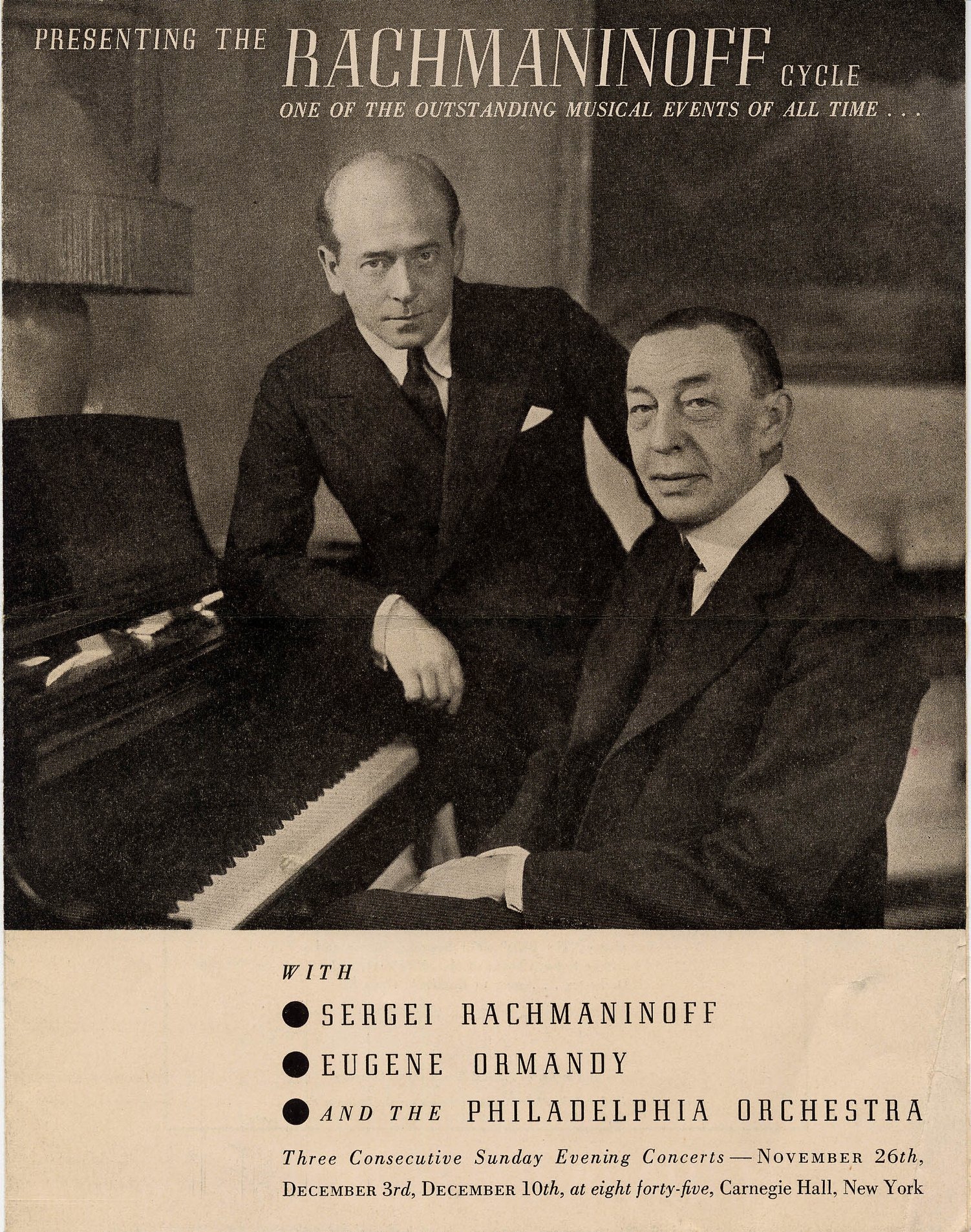
For Rachmaninoff’s 150th birthday, enjoy an hour of vintage recordings of his music, including one of the composer playing his own “Symphonic Dances,” on the piano of Eugene Ormandy, in 1940. Also, Ormandy introduces – and conducts – the Philadelphia Orchestra in a memorial performance of “Isle of the Dead,” given only days after Rachmaninoff’s death in 1943. The hour concludes with a literal party piece, as Rachmaninoff tosses off the folk song “Bublichki,” or “Bagels,” in 1942.
The recordings are taken from a 3-CD boxed set on the Marston Records label. Get a piece of the Rach! Enjoy the webcast by following the link and clicking on “listen.”
Paris of the 1830s was swarming with superstar pianists, who drifted from recital to salon with the grace and mystique of cinematic gunslingers. On this date in 1837, the two most mythologized virtuosi of the day, Franz Liszt and Sigismond Thalberg, were brought together at the home of Princess Cristina Belgiojoso-Trivulzio, an Italian patriot living in exile, to prove once and for all who was the King of the Keys.
The duel would prove to be a clash of styles and temperaments. In contrast to Liszt’s humble beginnings and acquired polish, Thalberg was an aristocrat by association, having been taking under the wing of a wealthy patroness very early on. A large part of his allure was in his unruffled appearance. He was handsome, educated, genteel. At the piano, he remained absolutely placid, sitting as still as possible while performing the most incredible, acrobatic feats.
One of his much remarked upon, crowd-pleasing effects was his ability to simulate the sound of three hands, which he was able to accomplish by picking out a melody with his thumbs and using the rest of his fluttering digitals to ornament with brilliant arpeggios and arabesques. Matters of showmanship aside, his legato was of such beauty that even Liszt commented, “Thalberg is the only artist who can play the violin on the piano.”
Liszt, by contrast, was a fire-eater, who would literally destroy pianos on the stage of the Paris Opera before an audience of 3000. His playing had ladies clawing at one another to retrieve a glove or a cigar calculatedly left behind after a concert.
Partisans and newspaper critics long speculated on who was the greater pianist. The flame of animosity was fanned by rival journalists, as Hector Berlioz (who embraced Liszt) and critic and musicologist Francois-Joseph Fétis (who championed Thalberg) played out their latest grudge match, polarizing music-lovers into two camps.
As the debate grew in intensity, it seemed that whenever one was in town, the other was on tour or vacationing. It all finally came to a head on the morning of March 31, 1837, at Belgiojoso-Trivulzio’s salon, in a war of the gargantuas engineered for charity. March definitely went out like a lion that year, as two titans of the keyboard faced off in the ultimate piano showdown.
The verdict was diplomatic: the princess declared Thalberg the finest pianist in the world; Liszt, she proclaimed, the ONLY pianist.
Popular tradition holds that Liszt mopped the floor with Thalberg, but apparently this wasn’t entirely the case. Nor was there any apparent animosity between the two men, who were cordial and even dined together several times after their legendary face-off. The two would collaborate, along with Chopin and three others, on one of Belgiojoso’s other schemes, the keyboard crazy quilt “Hexameron,” which Liszt titled, orchestrated, and toured with. Proceeds generated from both the duel and the “Hexameron” project went to the benefit of Italian refugees.
An ironic epilogue to this story: in 2017, Thalberg’s final resting place, in Naples, was desecrated, his mummified corpse tossed callously into the corner of a vault. You can wade through a dizzying array of fonts and italics to learn more here:
On a related note, as today is also the birthday of Franz Joseph Haydn, it is perhaps worth noting, as I have on this page several times in the past, that for 150 years Haydn had no head.
Thalberg transcribed a chorus from Haydn’s “The Seasons” as part of his collection “L’art du chant appliqué au piano” (“The Art of Singing Applied on Piano”), Op. 70. You can listen to the complete set of primarily operatic transcriptions if you want to, but I’ve cued the link to jump right to the relevant movement.
For Liszt’s part, the pianist Alfred Brendel drew a parallel with Haydn in his introduction to a certain Liszt biography:
“Arguably, Liszt and Haydn are the most frequently misunderstood among major composers; their biographers afford little food for pity.… In old age, Haydn reigned over the musical world as its undisputed leading light. For this, the nineteenth century punished him – as it punished Liszt for his undisputed supremacy as a performer.… Not until our century did a greater number of composers – from Richard Strauss, Ravel, and Busoni to Schoenberg, Bartók, and Boulez – appreciate Liszt by taking him seriously.”
“Hexameron,” six variations on a theme from Bellini’s “I puritani.” Five well-known composer-pianists – Frédéric Chopin, Carl Czerny, Henri Herz, Johann Peter Pixis and Sigismond Thalberg – each contributed a variation. Liszt composed the introduction, second variation, interludes, and finale, and integrated the piece into an artistic unity.