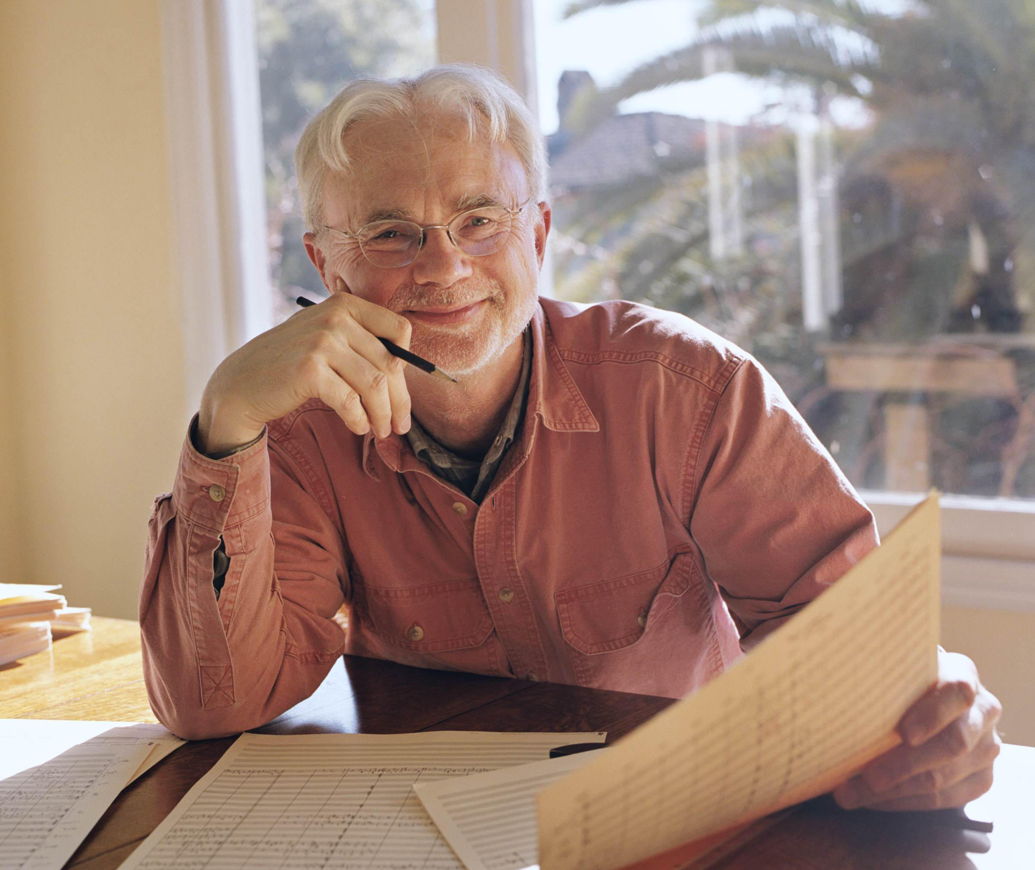
John Adams, the composer, may be no relation to John Adams, our second president, but today he is most definitely feeling the spirit of “76.” Adams was born on this date in 1947. Considered by some to be America’s preeminent living composer, he emerged from the haze of Minimalism to become the most versatile and substantial of early proponents of the style. In 2003, he was awarded the Pulitzer Prize for Music for his 9/11 memorial “On the Transmigration of Souls.”
Personally I’ve always been divided on Adams’ music. Some of it I find to be fun; some of it I find to be quite good; some of it I find to be boring, clumsy, or downright embarrassing. But what do I know? I’m just some dope posting on the internet.
My subjective evaluations do nothing to mar Adams’ influence or his standing. Happy birthday to John Adams on his 76th birthday, and congratulations on his long-term success!
FUN FACTS: Adams’ name may recall our second president, or perhaps his son, sixth president John Quincy Adams, but the composer’s middle name is actually Coolidge. Presidents John Adams and Calvin Coolidge were third cousins five times removed, through John and Priscilla (Mullins) Alden of the Mayflower fame. Admittedly, none of this has to do with the composer, beyond the fact that he was indeed named for Adams the president, who had no middle name.
A few of my Adams favorites:
“Short Ride in a Fast Machine”
“Shaker Loops”
“Nixon in China,” here introduced by Walter Cronkite
The composer Friedrich Cerha has died at the age of 96. But what he left us is a complete “Lulu.”
When Alban Berg died unexpectedly – of blood poisoning from an insect bite on Christmas Eve, 1935 – his second opera remained incomplete. His work on “Lulu,” begun in 1929, was interrupted so that he could develop some of the music into a “Lulu Suite,” an attempt to subvert the Nazis, which had already added Berg to their catalogue of “entartete” – or degenerate – composers in 1933. When Erich Kleiber, who had introduced Berg’s first opera, “Wozzeck,” at the Berlin State Opera in 1925, performed the suite there in 1934, he was forced to resign and basically run out of the country.
Berg broke off work on the opera a second time to compose his Violin Concerto for Louis Krasner. This he dedicated to the memory of 18-year-old Manon Gropius, one of Berg’s muses, whom he and his wife had come to view as their own daughter. Manon’s birth parents were Alma Mahler, Gustav’s widow, and Walter Gropius. The concerto would go on to become Berg’s most beloved work.
At some point, the composer wrote to Anton Webern to let him know that “Lulu” was essentially complete. He anticipated he would need only two or three weeks to overhaul it before he started in on its orchestration.
After his death, it was found he had managed to complete most of it. The parts he did not were left in short score, with detailed indications as to his plans for filling out the orchestration.
Schoenberg, Webern, and Zemlinsky, all friends of Berg, declined to take up its completion. Berg’s widow was left with the impression that the task must have been impractical, if not impossible. It was only after her own death in 1976 that Friedrich Cerha moved ahead with plans to finish it.
“Lulu” received its premiere, incomplete, in Switzerland, in 1937. Cerha’s edition was first staged soon after its publication in 1979. This was rapturously received, and it is now the preferred version.
Lulu” has long since taken its place in the standard repertoire, alongside Berg’s “Wozzeck.”
Cerha himself produced orchestral music and five original operas. He was a teacher at Vienna’s University of Music and Performing Arts (formerly the Viennese Music Academy, where he studied). He received a doctorate in philosophy from the University of Vienna.
A noted interpreter of the music of the Second Viennese School (Schoenberg, Berg, and Webern), he was invited to conduct at orchestra halls, opera houses, and festivals around the world. He cofounded with his wife Gertraud and composer Kurt Schwertsik the contemporary music ensemble die reihe (“the row” or “the series”).
Interestingly, he and Gertraud were also founding members of the Joseph Marx Society. Though Marx is credited with having coined the term atonality, one would be hard-pressed to think of a 20th century composer more Romantic in outlook. The pianist Jorge Bolet described Marx’s “Romantic Piano Concerto” (1919-20) as his favorite among the great virtuoso works.
Of his own music, Cerha’s publisher singles out “Spiegel I-VII” as occupying a special place. His first opera, “Baal,” appeared in 1981.
Percussion Concerto (2007-08)
“Nachtstücke” (“Night Piece”) for piano trio (1992)
Spiegel II for 55 Strings (1964)
Act III of “Lulu”
Cerha talks about his music
Jorge Bolet performs Joseph Marx’s “Romantic Piano Concerto”
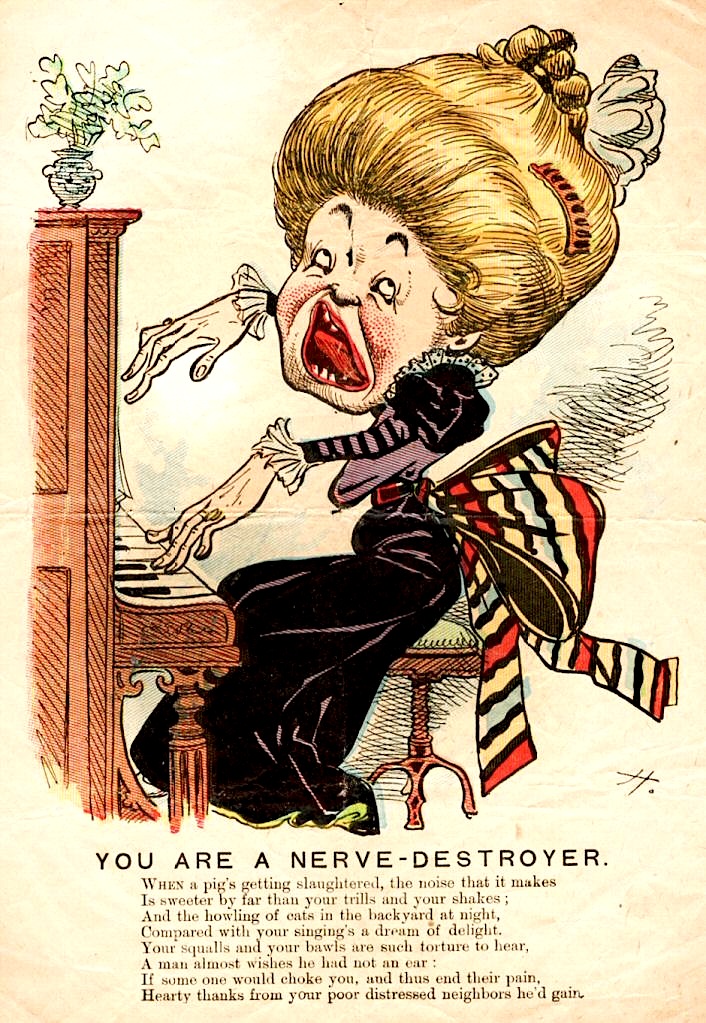
In an era of perpetual outrage and with a general decline in civility, is the time ripe for the revival of the “vinegar valentine?”
Vinegar valentines were insult cards that enjoyed a surge in popularity for a little over a century, beginning in the 1840s. Their creation paralleled a rise in literacy and was abetted by the reasonable asking price of a penny (at their inception) or a nickel (at their twilight in the 1940s and ‘50s).
The tone of a vinegar valentine is invariably sardonic and usually mean-spirited, with garish caricatures and poison pen verse aimed, like so many barbs and brickbats, at targets in a seemingly inexhaustible gallery of types – the spinster, the floozy, the old maid, the dandy, the Romeo, the artiste. Needless to say, they generated a lot of bad feeling and often resulted in shouting matches and fisticuffs.
Compounding the hilarity, in the 1840s, recipients, rather than the senders, were the ones who paid the postage – so that the person on the receiving end actually paid for the privilege of being insulted by an anonymous “admirer.” This is how people entertained themselves before the immediate gratification of the internet.
It’s always refreshing to stumble across theses reminders that human nature never changes.
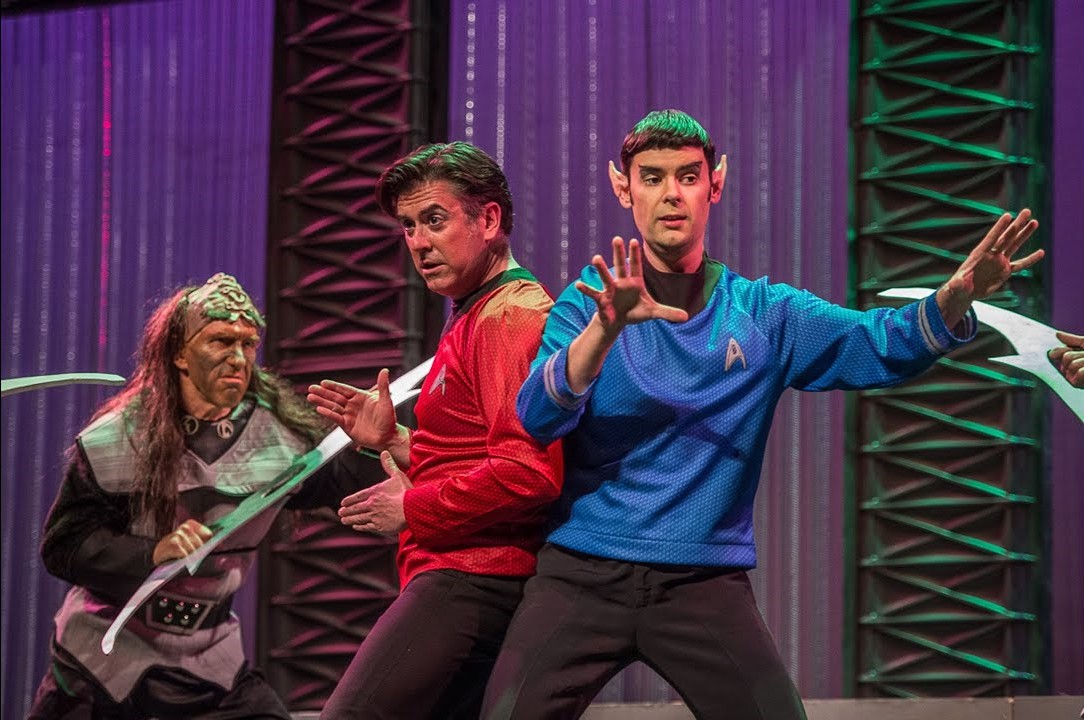
In 2016, Pacific Opera Project boldly went where no opera company went before. But since I’ve been caught in a wormhole, I guess, I am only just now catching up with POP’s bridge-rocking spin on Mozart’s comic singspiel “The Abduction from the Seraglio,” presented “Star Trek” style.
In Mozart’s original, Belmonte, a Spanish nobleman, attempts to rescue his beloved from the seraglio of Pasha Selim, a scenario that would have capitalized on the 18th century European fascination with orientalism, with the added savor of salaciousness in setting the piece in a harem.
Now, Belmonte is reimagined as Captain Kirk (replete with Shatnerisms), his servant Pedrillo is Mr. Spock, Constanze is Lt. Uhura, and Blonde is the iconic Star Trek “green girl.” The Ottomans? They’re all Klingons. There’s even an appearance by the Gorn!
Mozart is given an assist on a couple of occasions by Alexander Courage, whose music was featured prominently in the original television series (along with that of Fred Steiner, Gerald Fried, and George Duning, among others).
Unusually for opera, the singers are all miked, but I assume it’s more for documentary purposes than for amplification, since there’s another performance posted on YouTube with the same cast without the mikes, and it’s very difficult to make out the dialogue.
I imagine this would have been a gas to see live. On video, you have to make the extra leap of imagining yourself in the house.
Mozart and “Star Trek?” Salieri would have been so envious.
It’s Super Bowl/Valentine’s Day/Abraham Lincoln’s Birthday Weekend!
This Sunday night on “The Lost Chord,” we honor our 16th president, on the anniversary of his birth (in 1809), with an hour of monumental selections.
We’ll begin with David Diamond’s setting of the Gettysburg Address as “On Sacred Ground,” a work for mixed chorus, children’s chorus, baritone solo and orchestra. The piece was given its first performance two days before the centenary of Lincoln’s actual delivery of the Address, which he presented on November 19, 1863.
After that, as a bit of a palate-cleanser, we’ll enjoy Paul Turok’s buoyant “Variations on an American Song: Lincoln and Liberty,” also composed in 1963. The song is based on a traditional Irish fiddle tune, “Rosin the Bow,” which was outfitted with new lyrics for use in Lincoln’s 1859 presidential campaign:
“Then up with our banner so glorious,
The star-spangled red-white-and-blue,
We’ll fight till our Cause is victorious,
For Lincoln and Liberty, too!”
Finally, we’ll return to Gettysburg and music by American composer Roy Harris, also born on this date, though 89 years later. Harris was born in a log cabin in Lincoln County, Oklahoma. If that doesn’t fill one with a sense of destiny, I don’t know what will!
In his day, Harris was regarded as one of America’s greatest composers, particularly renowned for his symphonies. His Symphony No. 3 is his most famous work; we’ll be hearing the Symphony No. 6, subtitled “Gettysburg.”
Each movement bears a superscription taken from the Gettysburg Address.
I. Awakening (“Fourscore and seven years ago…”);
II. Conflict (“Now we are engaged in a great civil war…”);
III. Dedication (“We are met on a great battlefield of that war…”);
IV. Affirmation (“…that we here highly resolve that these dead shall not have died in vain…).
I hope you’ll join me for this memorial to Lincoln, on “Lincoln Portraits,” this Sunday night at 10:00 EST, on WWFM – The Classical Network and wwfm.org.
And remember, if the game runs long, the show will be posted as a webcast at the WWFM website for you to enjoy later. It would make a fine soundtrack for any Presidents Day hootenanny.