Category: Daily Dispatch

  • Carl Tausig: Liszt’s Impish Prodigy

    Carl Tausig: Liszt’s Impish Prodigy

    Having had the opportunity to listen to Franz Liszt’s “A Faust Symphony” a couple of times over the past few days, my thoughts lighted on Carl Tausig. Amusingly, now that I think about it, it was during the movement associated with Mephistopheles. And wouldn’t you know it, today is Tausig’s birthday.

    Tausig was Liszt’s supremely talented, though impish protégé. Some say that he was his greatest pupil.

    Tausig joined Liszt in Weimar at the age of 14. Energetic to a fault, he got up to all sorts of mischief, including sawing the ends off piano keys in order to make the instrument more challenging to play. He also hocked the original, unpublished manuscript of “A Faust Symphony,” an entire year’s labor, for a mere pittance. Fortunately, Liszt was able to retrieve it.

    Tausig then joined Richard Wagner in his political exile in Switzerland, where the boy’s boisterous behavior caused the operatic master his own share of distress. There must have been something exceptionally endearing in his personality, since he was always quickly forgiven.

    At a birthday celebration for the young pianist, Liszt predicted, with a twinkle in his eye, that Tausig would become either a great blockhead or a great master.

    Regrettably, his career was cut short. He died of typhoid fever, aged only 29 years.

    Happy birthday, Carl Tausig, scamp to the Romantic masters.


    2 Concert Etudes, Op. 1

    Fantasia on Moniuszko’s “Halka”


    PHOTOS: Carl Tausig (left), with Franz Liszt and Richard Wagner, looking vexed

  • James Litton American Boychoir Director Dies

    James Litton American Boychoir Director Dies

    I only just learned late last night that James Litton died on November 1.

    Litton was well-known in Princeton and abroad for his long association with the American Boychoir, of which he served as music director from 1985 to 2001. Under his leadership, the choir performed more than 2,000 concerts in 12 countries and 49 states. He also broadened the choir’s palette by allowing singers with changing voices to remain.

    Litton prepared the ensemble for performances with a number of the world’s leading orchestras, including the Berlin Philharmonic, the Boston Symphony, the Boston Pops, the Chicago Symphony, the Israel Philharmonic, the National Symphony, the New York Philharmonic, the Philadelphia Orchestra, the San Francisco Symphony, and the Vienna Philharmonic. In addition, he made many recordings with the group, and oversaw its participation in television commercials, television shows, and movies.

    After stepping down in Princeton, he became choirmaster at Washington National Cathedral. He was regarded as one of the country’s finest choral music directors, and his influence was wide, but close to home, he will always be associated in people’s memories with the American Boychoir.

    At the time of his death, Litton was 87 years-old.

    https://obits.nj.com/us/obituaries/trenton/name/james-litton-obituary?id=36990061

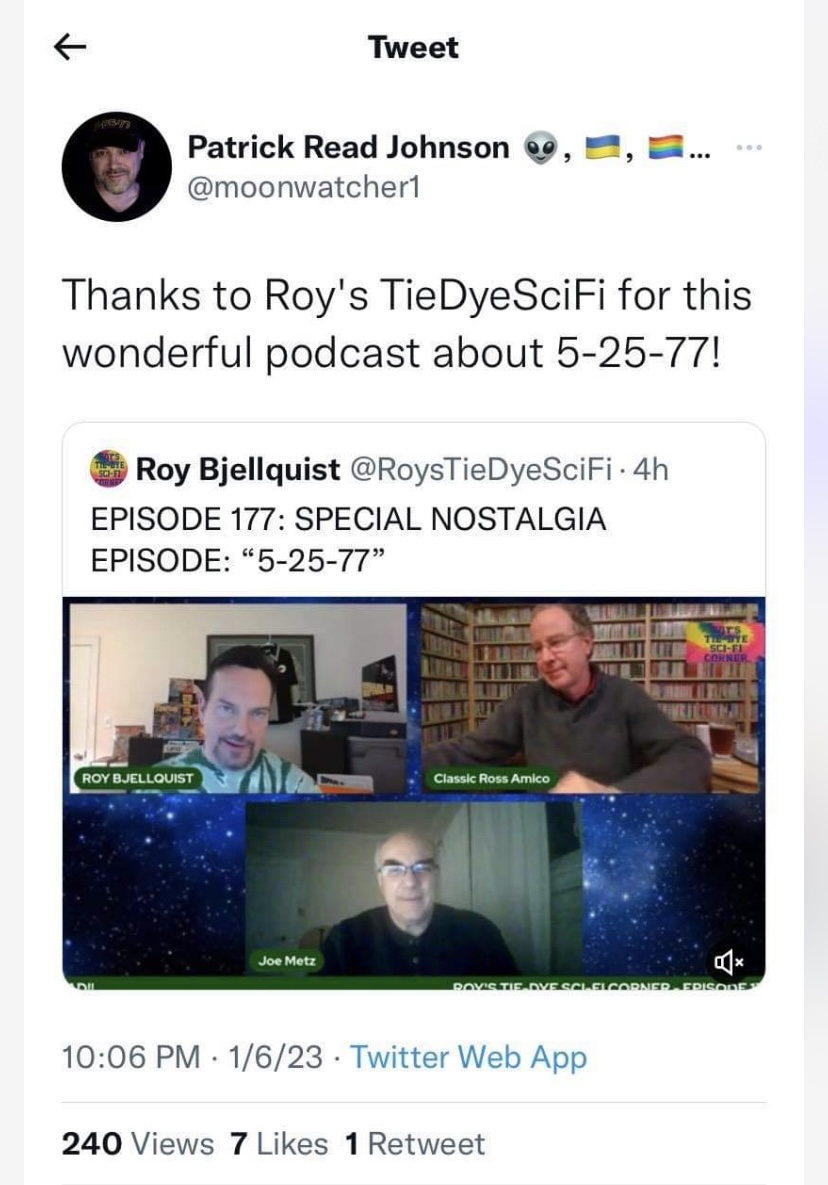
  • Back to the Future on Roy’s Tie-Dye Sci-Fi Corner

    Back to the Future on Roy’s Tie-Dye Sci-Fi Corner

    When we have to turn the clocks back on Roy’s Tie-Dye Sci-Fi Corner, we do so in a big way. Join us this week, when we put pedal to the metal in Doc Brown’s tricked-out DeLorean for a time-traveling discussion of “Back to the Future” (1985).

    Robert Zemeckis and Bob Gale’s tight, Academy Award nominated screenplay is a clever inversion of “It’s a Wonderful Life.” Also, it celebrates a kind of knowing affection and fosters empathy across a generational divide. Incredibly, no studio wanted anything to do with it. It was finally Steven Spielberg who produced, after the success of Zemeckis’ and Gale’s “Romancing the Stone.”

    The film sports career-defining performances by Michael J. Fox, Christopher Lloyd, Lea Thompson, and especially Crispin Glover. All the predictable summer movie set pieces are there, but this is one blockbuster that is genuinely driven by characters and story.

    With just the right balance of innocence and sophistication, “Back to the Future” capped a golden age of Spielberg summer movies that began with “Jaws” in 1975. It’s an era that, without a time-traveling DeLorean, will never come again.

    It’s a reminder to “fall back” this weekend, as we pick up an extra hour. We’ll “make like a tree and get out of here,” on the next “Roy’s Tie-Dye Sci-Fi Corner.” Biff will join you in the comments section with the Turtle Wax (two coats!), when we livestream on Facebook, Twitter, and YouTube, this Friday evening at 7:30 EDT!

    https://www.facebook.com/roystiedyescificorner

  • My Mom’s Unlikely Love of Classical Music

    My Mom’s Unlikely Love of Classical Music

    My mother was not, strictly speaking, “musical.” She played no instrument, and her record collection was full of Carole King, Carly Simon, Barbra Streisand, James Taylor, and Stevie Wonder. But she was encouraging, and she exposed my sister and me to a broad array of stimuli. She did pretty well for someone who got married right out of high school to a man who could have stepped out of an Elia Kazan movie. But she was into painting and crafts and told me she mooned over a poster of Rudolf Nureyev that hung in her room when she was a teen. And when it came to her children, of course, she was very, very supportive.

    When I latched onto classical music in the wake of “Star Wars,” around the age of 11, she encouraged me to build my record collection. Had she only known how successful she was. With no children of my own, I wonder who will be interested in my 10,000+ records and CDs! We attended piano recitals and string quartet concerts at the local college and at the town theater. I scribbled furiously through many of these, as music filled my head with plentiful images and ideas for stories. And she saw to it that I got piano lessons. Yet somehow, for all my enthusiasm, I never heard a live symphony orchestra until after I left for college.

    My parents weren’t really classical music people, especially my stepfather. They got me out of school several times a year, usually on a Friday, so that we could spend the day or get a start on a weekend in New York City, but generally we would wind up catching a Broadway show. We hit the museums too, and caught the occasional foreign film, and we all read a lot, but that was about the extent of our “culture.” Once or twice a week, my parents would hit the disco. There was a Village People 8-track in the car (eventually stolen by an NYC parking lot attendant). My folks were great about letting me put on John Williams or the “Eroica” Symphony on our trips in to the city, my mom at the wheel and my stepdad reading the sports page in The Daily News. They would switch seats before we got to the Lincoln Tunnel.

    One of things that was great about my mother was that she always aspired to better herself. And she wanted the same for us. Hence, I was enrolled in Little League, intramural basketball, tennis, Cub Scouts, and Community Art League, none of which I really cared for.

    When I went to college, she too went back to school. She was enthusiastic about her music appreciation class, among other things, and I helped direct her listening. I was close to home, and would often be there on the weekends and always on holidays. I would be sent to the mall to pick up inexpensive recordings for her latest assignment. For Christmas or birthdays, she would be interested in a Baroque cassette for the car, or some Sousa marches to keep her energy up her while she jogged. Later, an opera highlights disc was a big hit.

    Of course, she repaid these gestures a thousand-fold. My birthdays and Christmases were full of opera and orchestra recordings. One memorable Easter, there were some Vivaldi LPs propped up next to my Easter basket. I hasten to add, I got Easter candy until I was about 40! She was particularly fond of the Vivaldi Guitar Concerto in D. A later Christmas brought me my first Ring Cycle. Now that I think about it, I had taken “Die Walküre” out of the community college library when my mom was taking courses there when I was a teen. I was too young for it to catch me by the throat yet. Gilbert & Sullivan was more my speed. My mom used to accompany me to the excellent Muhlenberg College summer productions of G&S too.

    During my stint as an intern with the Opera Company of Philadelphia, my parents dropped by for a couple of acts at the dress rehearsal of “The Marriage of Figaro.” They got to see me standing in the wings of the Academy of Music with my headset. They claimed never to have been to an opera before. Strictly speaking, I know that wasn’t the case, because we had attended a production of “Carmen” once at the local community college, but it was with piano. Granted, not the full opera experience! The only time we ever attended a full opera together was for a threadbare production of Boito’s “Mefistofele” at New York City Opera, by then a pale reflection of what it had been when Samuel Ramey was the reigning Dark Lord. How I wish she had gotten to attend the Met.

    My mother died 15 years ago today. She was only 59 years-old. Hard to believe she would have been 74 now. Her death was sudden and there was probably no pain. We had a very good relationship, so I have no regrets on that count. It’s only when I think that we could have had maybe another 30 years together that I feel as if I’ve been robbed. And with the erosion of that early support system I enjoyed when I was a kid, between my parents and my grandparents and my aunts and uncles, as my elders die or fade into dementia or become different people, I feel a curious sense of drifting unmoored.

    But I’ll always have those bittersweet memories of a largely happy, if not always ideal childhood. I was very, very lucky to have had my mother’s love to shield me and to guide me through a sometimes confusing, often rocky start.

    Thanks for everything, Mom. You were a woman of remarkable kindness and patience. I miss you very much.

  • Carl Ditters von Dittersdorf A Gift of Cheer

    Carl Ditters von Dittersdorf A Gift of Cheer

    RICK: “You said it for her, you can say it for me. Say it!”

    ILSA: “Say it, Sam. Say… Carl Ditters von Dittersdorf.”

    It’s true, Dittersdorf is good for anything that ails you. Even if you’re a guy standing on a station platform in the rain, with a comical look on your face, because your insides have been kicked out. The very act of pronouncing of his name can’t help but make you smile.

    Dittersdorf (1739-1799) was one of the closest friends of Franz Joseph Haydn. He played first violin in a superstar string quartet, with Haydn (second violin), Mozart (viola) and Dittersdorf pupil Jan Křtitel Vaňhal – a.k.a. Johann Baptist Wanhal – (cello). Imagine being a fly on a wall at those performances, or even rehearsals! Though killjoy Michael Kelly, the Irish tenor who created Don Basilio and Don Curzio in Mozart’s “The Marriage of Figaro,” claimed the ensemble played well enough, but was not really anything exceptional. Oh, Michael. It sounds like you need to make “Dittersdorf” your mantra.

    Among Dittersdorf’s enormous output, which includes some 120 numbered symphonies (it’s possible he may have composed 90 more) are twelve programmatic works inspired by Ovid’s “Metamorphoses.”

    Personally, I find more enjoyment in his chamber music. Here is his String Quartet No. 3 in G major.

    But perhaps you’d prefer his Harp Concerto, once his most-frequently encountered work (which admittedly isn’t saying much).

    Dittersdorf was actually just “Ditters” until 1773. Where’s the fun in that? When he was granted a musical position that required a noble title, he was sent to Vienna, where fortuitously he was dubbed “von Dittersdorf.” And the world has been smiling ever since.

    Here’s looking at you, Carl Ditters von Dittersdorf, on your birthday. Your very name is a gift that bestows a sense of the kind of cheer your music embodies.

Tag Cloud

Aaron Copland (93) Beethoven (95) Composer (114) Film Music (135) Film Score (143) Film Scores (255) Halloween (94) John Williams (194) KWAX (229) Leonard Bernstein (103) Marlboro Music Festival (125) Movie Music (150) Mozart (88) Opera (206) Philadelphia Orchestra (89) Picture Perfect (174) Princeton Symphony Orchestra (108) Radio (88) Ross Amico (244) Roy's Tie-Dye Sci-Fi Corner (290) The Classical Network (101) The Lost Chord (268) Vaughan Williams (103) WPRB (396) WWFM (881)

DON’T MISS A BEAT

Receive a weekly digest every Sunday at noon by signing up here


RECENT POSTS